

Southwest Florida apartment vacancies reach 17-year high
Brian Tietz
Apartment vacancy rates across Southwest Florida have climbed to levels not seen since the Great Recession following an aggressive rush to build multifamily housing.
Entering 2026, vacancy rates were 20.3% in Lee County, 13.8% in Collier County and 19.5% in Charlotte County. Lee and Collier each experienced their highest vacancy rates in 17 years, according to CoStar data pulled by Nelson Taylor, vice president of market research for LSI Companies.
Five years earlier, apartment vacancy rates had hit near-record lows: 6.3% in Lee County, 3.7% in Collier County and 4.2% in Charlotte County. The tight market triggered intense investor interest in building more units across the region.
The storm surge wrought by Hurricane Ian in September 2022 combined with other forces to create a rush to build, creating an oversupply compared with demand.
The storm was only part of the story.
The post-COVID-19 population surge in 2021, an influx of coastal residents seeking inland shelter after Hurricane Ian in 2022, and insurance, federal and investor dollars pouring into the region for hurricane recovery in the years since prompted construction of many more apartment units across Southwest Florida.
The trends unfolded amid rising interest rates that did not begin to soften until late last year. As interest rates rose, they reinforced the perception of intense need for more multifamily units.
The current climate benefits consumers; monthly rents are finally easing for renters. An apartment that cost $2,858.07 per month in 2023 now goes for about $2,209.60 in 2026, a decrease of 22.7%, according to a survey by Mayhugh Commercial Group in Fort Myers. After averaging units of all types, the survey showed that a two-bedroom, two-bath apartment entering the year rented for substantially less, about $1,800 per month.
Many of the new complexes have responded by offering two to three months’ free rent and lowering asking rents. The Cove at 47th in Cape Coral sweetened the deal further with free bridge tolls for a year.
“Everything we have is predicated on population growth,” Taylor says of the statistics. “Think about it. If we have 10 residents on an island, and there’s 10 homes, and we build 10 new homes, we still only have 10 people.
“People will move to the island. Traditionally, this area has always been a growth market. That’s why the traffic gets worse, and we’re building new schools. We weren’t adding homes fast enough to keep up with the people coming down here. Now that we’ve added too many homes, prices are starting to come down. It’s that simple. Supply and demand.”
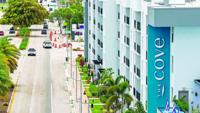
The Cove at 47th apartment community in Cape Coral is among the multifamily developments that have added to Southwest Florida’s housing inventory. The property has offered leasing incentives, including free bridge tolls for a year, as apartment vacancies across the region have climbed.
Brian Tietz
Supply Floods the Area
While the population grew by about 1.9% year over year from 2023 to 2024, per U.S. Census Bureau numbers, apartment units grew by 9.6% that same year, to a combined 53,430 units across a region with a population of about 1.3 million people.
“Rents were rising, vacancy was falling,” Taylor says of 2021. “What do I want to do? I want to fulfill that need. It just so happened that 15 other developers thought the same thing.”
In 2025 in Lee County, developers completed a record 4,330 new apartment units, according to CoStar data. That’s up 17% from the previous record, 3,696 units completed in 2024, which was up 82% from the 2,031 completed in 2023.
In 2025 in Collier County, there were 982 new units, a 12% increase from the 878 in 2024, which was a 77% increase from the 496 finished in 2023. Collier County had a record 1,130 units delivered in 2022, with a 310-unit complex in Ave Maria and 265-unit Hammock Park accounting for a large portion of that record.
In 2025 in Charlotte County, there were 341 new units completed, a 36% decrease from the 533 finished in 2024.
Charlotte County set a record with 1,027 new units built in 2023. The massive jump can be attributed to three new complexes of almost 300 units each: Livano Charlotte Harbor, Babcock Ranch and Jacaranda Apartments.
The market correction signals business as usual, said Phil Fischler, who as president and founder of Fischler Property Company in Fort Myers brokers land for multifamily projects.
“From a long-term market perspective, the apartment sector is doing exactly what it does after a period of rapid growth,” Fischler says. “It pauses and recalibrates. The current increase in vacancies is giving renters more options and better deals today, and based on decades of market cycles, this is a healthy adjustment that sets the stage for a more balanced and stable market as the region continues to grow.”
Three years ago, numerous apartment developers all put their chips into the same place, Taylor says.
“It’s like standing on your tippy toes at a parade,” Taylor says. “It works well until everyone else does it. Someone stood on their tippy toes to have a better view. Everyone else wanted to capture that view. You will now see the tapering off of new supply moving forward. What we saw was too fast of a run-up. Now we’re seeing the correction.”
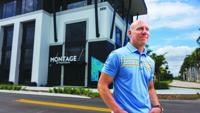
Joe Bonora, founder and president of Catalyst Development, stands outside Montage at Midtown in Fort Myers. Bonora said today’s elevated vacancy rates reflect a temporary surge in new apartment construction rather than a long-term weakness in demand.
Brian Tietz
Upsides of a Renter’s Market
While that correction can create speedbumps to further development, it smooths the pavement for people looking to pay less in rent.
“Do we want to be rent burdened in this area?” Taylor says. “Or do we want to have disposable income? Retail, restaurants, food, experience. What seems like a negative, it’s more of a positive.”
Chase Mayhugh, president and CEO of Mayhugh Commercial, a property brokerage company, said softening interest rates and the single-family home market also are factors in apartment vacancies.
“The multifamily sector is also competing against other forces,” Mayhugh says. “Easing home prices have lured some renters into homeownership, while others, especially young families, are relocating to more affordable markets altogether. These shifts are shrinking the tenant pool just as supply hits new highs.”
Joe Bonora knows the trends. As founder and president of Catalyst Development, he developed CityWalk before selling it. He’s leasing his latest project, Montage at Midtown, and beyond that, he’s planning to redevelop 2442 Dr. Martin Luther King Jr. Blvd., former home of The News-Press newspaper’s offices and now an empty printing press facility.
“Overall, compared with previous projects over the past 12 to 15 years, I expect our leasing velocity will be slower, just given the inventory on the market,” Bonora says of Montage at Midtown. “But absorption is still strong. We had a market study done not too long ago, and it showed absorption aligned with supply. Meaning, there’s still a lot of demand for apartments. There’s just a lot of supply.”
The high vacancy rates aren’t all doom and gloom from the perspective of a developer, Bonora said, just as they’re not all bright and sunny from the perspective of a renter. He cautions against taking the vacancy numbers at face value. The overall rate blends newly opened buildings — which may sit at 30% vacancy simply because they haven’t had time to fill up — with established complexes running at 95% occupancy. The result is an average that looks worse than the stabilized market actually is.
“I think the vacancy rates tend to be misleading when you look at the data,” Bonora says. “When you’re averaging all the apartments and there’s a 20% vacancy rate, that’s not indicative of stabilized apartments. It’s pulling from all of the open leasing apartments.”
Bonora said he has no regrets about building the 321-unit Montage at Midtown amid the current high vacancy rates. He said most of the next wave of apartments being built in Lee County will be workforce and affordable units using federal government funds distributed after Hurricane Ian.
“We started construction two years ago knowing there was a lot of supply,” Bonora says. “But also knowing that, as you get into 2027 and beyond, it’s not like these things get built overnight. What you’re seeing now is a result of the past two or three years.”