
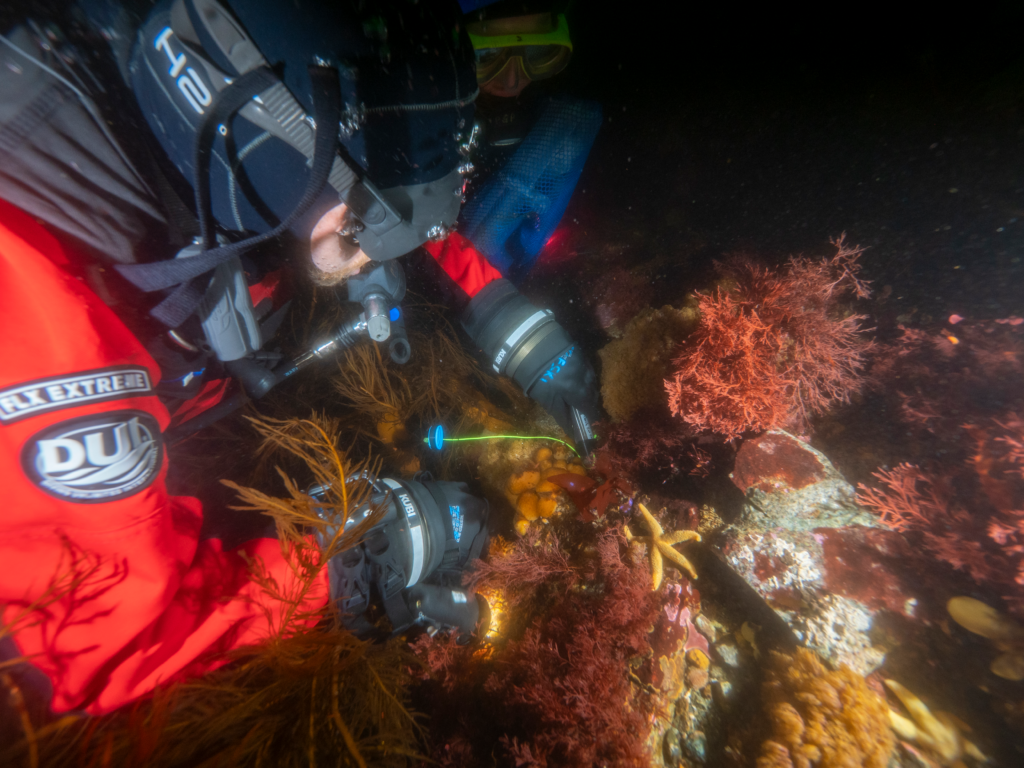

Sam Afoullouss says a key reason why a lot of marine animals produce compounds that are useful for human medicine is survival instinct. Courtesy of the USF Research and diving team.
Listen here:
University of South Florida researchers are studying a sea squirt that produces a molecule that can kill skin cancer cells.
This animal, also known as an ascidian or tunicate, lives only in the depths of Antarctica.
However, the sea squirt is not the one that creates this cancer-fighting molecule.
Dr. Bill Baker, a USF professor in the Department of Chemistry, said they do not know why.
“We don’t know where in the tunicate the metabolite is. We also know that the tunicate doesn’t actually make these metabolites. It’s made by a bacterium that lives within the tunicate.”
Scientists call the anti-cancer molecule palmerolide A.
He adds melanoma has long suffered from toxic drugs and has increasingly become resistant. “Palmerolide’s superpower is that it exerts its activity by a completely different mechanism from existing drugs, so resistance would take years or decades to develop, and if properly managed, may never suffer resistance.”
Alison Murray is a research professor at the Desert Research Institute.
She said this molecule differs from other existing skin cancer treatments.
“It targets a certain enzyme called Vacuolar ATPase. And that is not a current treatment that is being used to treat melanoma.”
Vacuolar ATPase, or V-ATPase, is a protein that helps skin cancers, like melanoma, survive and spread by controlling the acid levels in and around the cancer cells.
The expedition to Antarctica
Earlier this year, the team went on an expedition to Antarctica to retrieve some of the sea squirts.
They worked on a ship called the R/V Sikuliaq.
They visited the region where Palmer Station, a U.S. research base is located, along with sampling over a 200 nautical mile swath of the waters off the Antarctic Peninsula.
Sam Afoullouss is a postdoctoral scholar at the University of South Florida.
He said the Arctic landscape and the abundance of life beneath the water amazed him.
“Once you go into the water and you roll back off the boat, and you go into the water and you come up against the seabed. It’s all these beautiful pinks and purples and oranges and all these kind of rainbow colors. It’s pretty fantastic.”
The team did over 160 dives.
Ben Meister, a USF research diving training officer, said the preparation for the expedition consisted mostly of getting comfortable in the dry suit.
“You know it’d be lovely to be able to reproduce 30 degree temperatures so you can do that training. Not the easiest thing to do in Florida, so at that point you focus on putting time in your dry suit. And there’s some requisite number of dives that you had to do, both for achieving the depth as well as lifetime dives, as well as having the proper amount of dives in a dry suit.”
What’s next?
Murray was also the lead scientist on the ship.
She adds that the team is trying different routes of cultivating the organism that produces the compound.
“We are conducting work in our labs to work together to understand the spatial biology of what is happening in terms of where the microbes are in the animal, where the enzymes are that are inhibited by the palmerolide and where the compound is located in the animal’s tissues.”
The research team says developing this molecule into a cancer drug will take years of additional research.
The National Science Foundation and National Institutes of Health funded this work.