
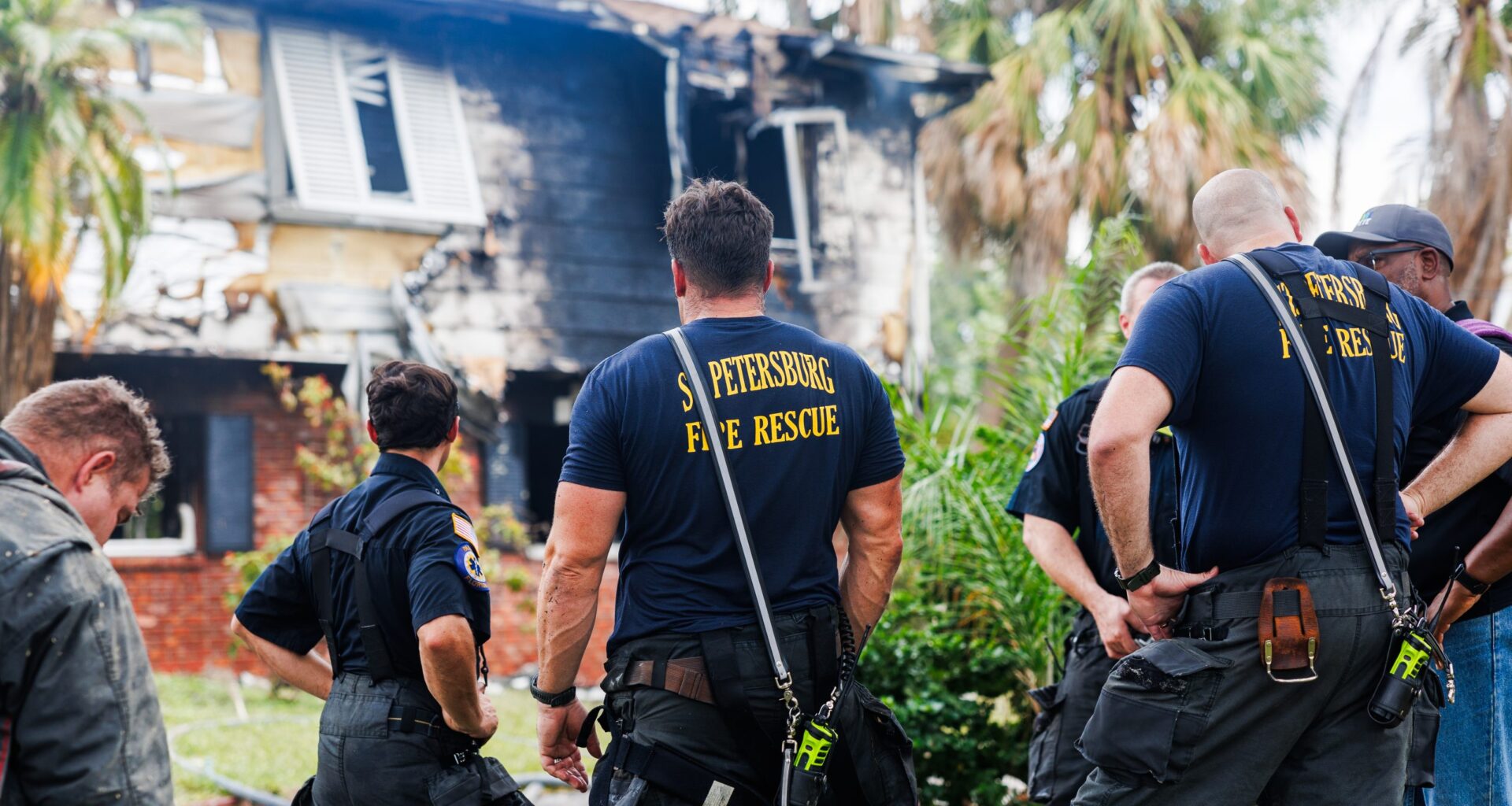
 St. Petersburg Firefighters survey damage during the Hurricane Idalia recovery on on August 31, 2023. Credit: cityofstpete / Flickr
St. Petersburg officials are now working to answer a burning question: Can a new fire assessment fee save public safety from the effects of property tax reform?
The city stands to lose over $54 million if 60% of voters approve Florida’s property tax amendment in November, according to internal projections. Such a significant revenue loss would “make it difficult” to maintain current staffing and service levels, Budget Director Liz Makofske told city council members during an extensive committee meeting last Thursday at City Hall.
Mayor Ken Welch’s administration is already exploring a special assessment for fire services to help guard against a fiscal cliff. Multiple city council members advocated for an aggressive approach.
“I don’t know what’s going to happen in November, but I don’t want us to get flat-footed and not have things in place,” said Council Chair Lisset Hanewicz.
The property tax amendment, hastily approved by the state’s Republican-led Legislature in June, would triple the current $50,000 homestead exemption on primary residences in 2027. An estimated $33 million would evaporate from the city’s budget, according to Makofske.
The exemption increasing to $250,000 in 2028 would cost the city an additional $21 million in projected collections. Subsequent annual losses range between $2 million and $3 million.
St. Petersburg’s first responders rely on property taxes. The city, after accounting for required community redevelopment area contributions, fully funds the police department and then dedicates the remaining revenue to fire rescue.
Richard Pauley, president of the St. Petersburg Association of Firefighters, has warned that the loss of municipal funding would directly impact emergency response capabilities and preparedness.
“Our firefighters see firsthand what it takes to keep this city safe during emergencies, storms and daily calls for service,” Pauley said in a statement. “Stable local funding is critical to ensuring departments have the personnel, equipment and resources needed to protect residents.”
Property taxes cover less than half of the fire department’s budget, and Makofske said the amendment does not require local governments to maintain current public safety spending levels. “For those who are listening, the Florida Legislature has decided to defund the police and fire,” Hanewicz added.
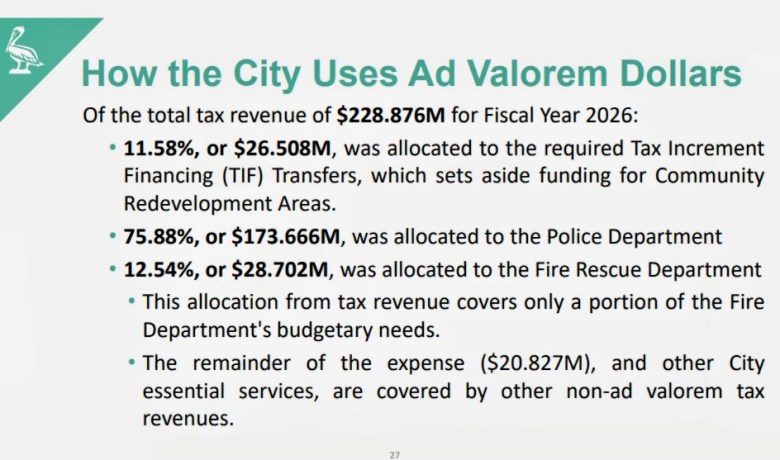 A graphic highlighting how St. Petersburg allocates property taxes Credit: Screengrab / City of St. Petersburg
Officials have dedicated additional revenue from increasing property values to public safety, Makofske said. Councilmember Copley Gerdes called it “outlandish to say that we have been irresponsible with our dollars when they have been going specifically to the protection of our community.”
“All we have done is invest in our safety and our people,” Gerdes continued. “To say anything else is negligent, in my opinion.”
Florida Chief Financial Officer Blaise Ingoglia has claimed that St. Petersburg overtaxed residents by $49 million from 2019 through 2025 to support a bloated bureaucracy. Mayoral candidate and former Gov. Charlie Crist has similarly admonished the administration over allegedly exorbitant salary costs and pledged to lower local property taxes.
Last Friday, during a conversation with WMNF public affairs radio program The Skinny, Welch called Ingoglia’s audit “simplistic” and “juvenile.” He pointed to raises for police and a push to hire more officers, in addition to purchases of high water rescue vehicles and investments in St. Pete’s CALL mental health response system.
“He doesn’t know what we’re spending the money on,” Welch said of Ingoglia, arguing that new growth in the city is helping pay for increased demands on public safety.
“It was a circus,” Welch said of the state DOGE shakedown. “There’s a lot of waste and fraud and abuse if they just looked within five miles instead of coming down here.”
The city’s public safety expenditures increase by about 7.5% annually due to union contracts, rising pension costs and technological investments, Makofske explained. St. Petersburg is already operating on thin margins, and lacks an alternative source to “fully replace this loss of revenue.”
Hiring freezes, early retirement incentives, and the reduction or elimination of city programs are on the table. Stakeholders must consider the “best of the worst options,” said Administrator Rob Gerdes (uncle of Councilmember Gerdes).
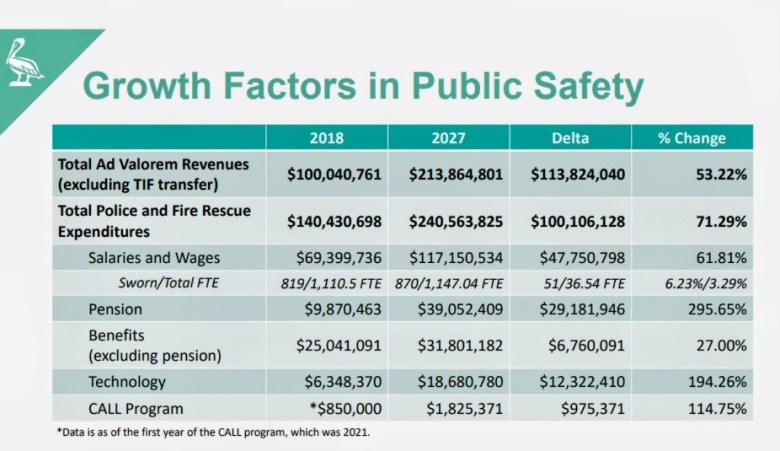 A graphic showing that unencumbered property tax revenues have increased by 53.2% since 2018, while public safety expenditures have soared by 71.3%. Credit: Screengrab / City of St. Petersburg
A graphic showing that unencumbered property tax revenues have increased by 53.2% since 2018, while public safety expenditures have soared by 71.3%. Image: City documents.
While the city is limited in its ability to create new taxes, a fire special assessment provides a legal pathway to increase revenue. Chris Roe, an attorney with Bryant Miller and Olive, said the option does not extend to police or emergency medical services, which benefit individuals rather than properties.
By implementing a fire fee, however, officials could potentially redirect funding to other agencies. Roe said the most common and advantageous payment collection method is to include it as a new charge on property tax bills.
The implementation timeline is tight. If the city decides to collect a fire assessment fee on tax bills in November 2027, council members must adopt a resolution expressing that intent by the end of this calendar year.
Roe explained that the resolution would serve as a formal notice, not an obligation, but is a mandatory precursor to implementation. State statutes guide a complex process.
The city must first hire a methodology consultant to analyze specific budgetary needs and recommend an apportionment framework, Roe said. Officials will likely choose between the “demand method,” based on historical calls for fire rescue service, or the “availability method,” based on constant readiness.
Required public hearings and mail notifications would follow. With local elections also looming in November, the decision could fall to a new mayor and city council.
“We’re probably looking at next year, if we were going to move forward,” Gerdes said of the current administration.
Hanewicz noted that the “clock is ticking, and we’re having these conversations with the community.” Councilmember Brandi Gabbard said a special assessment could circumvent “Tallahassee’s way to control us as local governments.”
“We have come too far to have any backsliding on our investments, specifically around fire,” Gabbard—who is also running for mayor—added. “If there is a way that we can start to get the pieces in motion … I think that is prudent.”
Gerdes said the assessment could impact nonprofits and churches, and “there’s just a lot of discussion to be had about this.” However, the city will formally launch its search for a methodology consultant this week.
Pitch in to help make the Tampa Bay Journalism Project a success.
Subscribe to Creative Loafing newsletters.
Follow us: Google News | NewsBreak | Reddit | Instagram | Facebook | BlueSky
This article appears in Jul 30 – Aug 05, 2026.
Related