

ATLANTA, Ga. (CBS12) — The full 11th U.S. Circuit Court of Appeals has cleared the way for Florida to enforce a 2023 law restricting children from attending sexually explicit live performances, reversing earlier court decisions that found the measure was likely unconstitutional.
In a ruling issued Tuesday, the Atlanta-based appeals court vacated a preliminary injunction that had blocked enforcement of Florida’s Protection of Children Act. The law makes it a misdemeanor to knowingly admit a child to an “adult live performance.”
Florida Attorney General James Uthmeier celebrated the decision in a statement posted on X, describing the ruling as a victory for the state’s effort to protect children from sexually explicit performances.
The case was filed by HM Florida-ORL LLC, the operator of Hamburger Mary’s, a restaurant known for hosting drag performances. The Orlando-area business argued the law was vague, overly broad and violated the First Amendment by discouraging constitutionally protected performances.
The law does not specifically mention drag shows. It applies to performances depicting or simulating nudity, sexual conduct, sexual excitement, specific sexual activities or lewd conduct, including the lewd exposure of imitation or prosthetic breasts or genitals.
For a performance to fall under the law, it must also appeal predominantly to a prurient interest, be patently offensive under statewide community standards for the age of the child present and lack serious literary, artistic, political or scientific value for that child’s age.
A federal district judge initially agreed with Hamburger Mary’s and issued a statewide preliminary injunction in 2023. A divided three-judge panel of the 11th Circuit later upheld that decision, finding the restaurant was likely to succeed in showing the law was unconstitutionally vague and broad.
The full appeals court agreed to reconsider the case, however, and on Tuesday rejected both the scope of the injunction and the restaurant’s constitutional arguments.
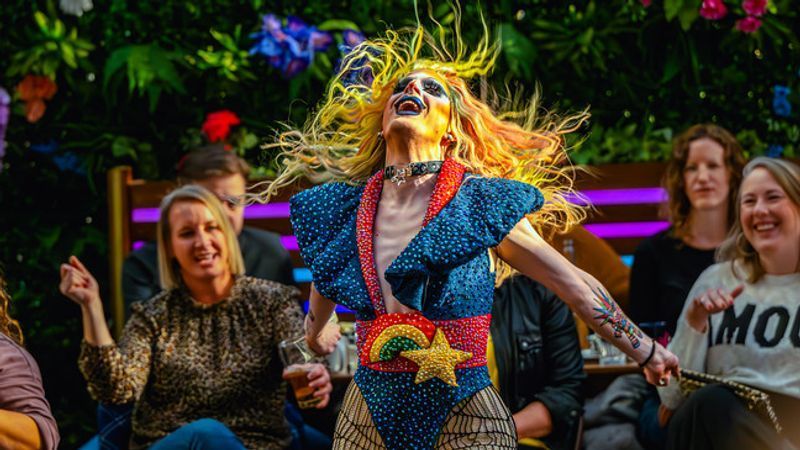
Drag performers are shown in a file photo. A federal appeals court has cleared the way for Florida to enforce a law restricting children from attending sexually explicit live performances, including certain drag shows. (Image: Andrew Meade / Seattle Refined)
The majority said the district court lacked the authority to issue what amounted to a universal injunction protecting everyone in Florida, rather than limiting relief to the restaurant that filed the lawsuit.
The court pointed to a U.S. Supreme Court ruling that restricted federal judges’ ability to issue injunctions benefiting people or organizations that are not parties to a lawsuit. The majority said that limitation applies to statewide injunctions as well as nationwide orders.
See also: Search warrant served at Fort Pierce home tied to $7 million Southern Truss fraud
The appeals court also found Hamburger Mary’s was not entitled to a narrower injunction protecting only the restaurant and its performers.
The majority concluded the law’s definition of “lewd” was sufficiently limited by existing Florida court precedent and that its references to the age of the child did not make the measure unconstitutionally vague.
The court said states have broader authority to regulate minors’ access to sexual material and may restrict material considered obscene for children even when the same material would be protected for adults.
Hamburger Mary’s had said it canceled family-oriented drag performances and prohibited children from attending its other shows after the law passed. The restaurant also reported losing about 20% of its bookings.
The appeals court did not find that every possible enforcement of the law would be constitutional. Instead, it rejected Hamburger Mary’s attempt to block the law on its face before Florida officials had taken enforcement action against the restaurant.
HM Florida-ORL, LLC v. Secretary of the Florida Department of Business, No. 23-12160 (11th Cir. 2026)PDF previewPreview PDF
Four judges joined a dissent arguing the law remained vague and threatened constitutionally protected expression. The dissenters said the ruling could allow Florida officials to enforce the measure selectively and leave performers and venues uncertain about what conduct is prohibited.
The majority sent the case back to the federal district court for additional proceedings, but the preliminary injunction was vacated in its entirety. That means state officials may enforce the law while the underlying legal case continues.