
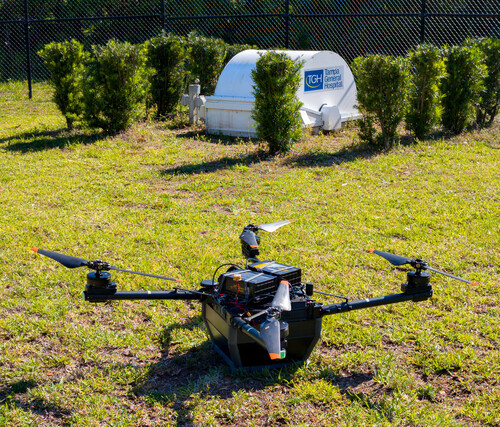
For decades, the race to save patients with catastrophic blood loss has focused on getting them to a trauma center as quickly as possible. Tampa General Hospital and its partners are preparing to test a different approach by sending blood to the patient instead.
The hospital announced Monday that it will launch what it says is the nation’s first emergency medical services-operated drone delivery program for pre-hospital whole blood. The system is designed to place blood in the hands of first responders in an average of less than three minutes, allowing transfusions to begin at the scene rather than after arrival at the hospital.
The pilot program brings together Tampa General Hospital, Hillsborough County Fire Rescue, the USF Health Morsani College of Medicine, the Florida Center for Emergency Medical Services, OneBlood and Archer First Response Systems.
The technology is expected to begin operating in October, pending approval from the Hillsborough County Commission. Commissioners are scheduled to consider the program Sept. 2.
The initiative addresses one of the most difficult problems in trauma medicine. Patients suffering severe hemorrhage can lose a fatal amount of blood within minutes. Trauma physicians often describe the first hour after a major injury as the “golden hour,” when rapid treatment has the greatest influence on survival. Whole blood transfusions are increasingly recognized as one of the most effective treatments for patients experiencing life-threatening blood loss, but getting blood to an emergency scene has traditionally been difficult.
Under the new system, a 911 dispatcher handling a call involving severe bleeding can trigger both a traditional emergency response and the launch of a drone carrying refrigerated whole blood. Once the aircraft lands, firefighters and paramedics can begin a transfusion immediately if the patient’s condition requires it.
John Couris, president and CEO of Tampa General Hospital, said the investment reflects the health system’s focus on combining new technology with emergency care to improve patient outcomes.
Michele Moran, senior vice president for emergency services at Tampa General, said the program effectively moves the beginning of trauma care from the hospital to the emergency scene by giving first responders access to blood before transport begins.
The initial deployment will operate from Hillsborough County Fire Rescue Stations 9 and 37, serving the Faulkenburg, Sabal Park and Riverview areas. Those stations were selected because they respond to the county’s highest concentration of penetrating trauma and hemorrhagic injuries.
Together, the two drone systems are expected to cover about 70 square miles.
Chief Todd Carnell of Hillsborough County Fire Rescue said placing whole blood directly into the hands of field crews gives responders another critical tool during the earliest moments of an emergency, when treatment decisions can have the greatest effect on survival.
Dr. Jason Wilson, Tampa General’s chief of emergency medicine and founding chair of the Department of Emergency Medicine at the USF Health Morsani College of Medicine, said faster access to whole blood has consistently been linked to improved survival for patients experiencing severe hemorrhage.
If the pilot proves successful, its significance could extend well beyond Hillsborough County. Drone delivery has been tested for medical supplies, medications and laboratory samples in other settings, but using it to routinely deliver blood for emergency transfusions would represent a new model for pre-hospital trauma care.
The pilot will also generate operational data on flight reliability, response times and patient outcomes. Those findings could guide future expansion throughout Hillsborough County and provide a framework for other trauma systems considering similar programs.
For the Tampa Bay region, the project adds another example of local health care organizations using aviation and autonomous technologies to solve time-sensitive medical problems. In trauma medicine, where survival is often measured in minutes, reducing delivery time from a traditional vehicle response to less than three minutes could determine whether a patient reaches the hospital alive.