
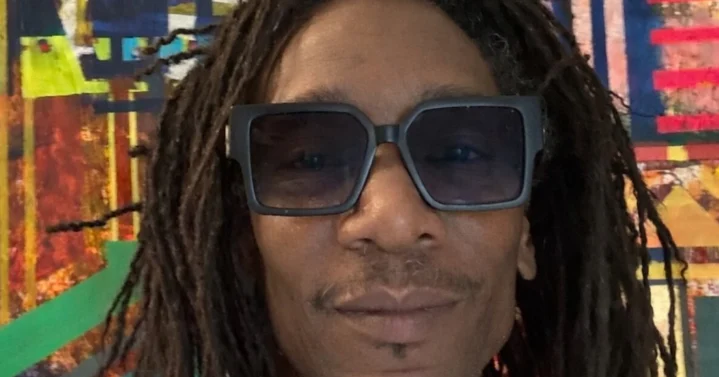
For Jamaican-born, Miami-based multimedia artist and creator Marcus Blake, there was really no beginning to his creative journey — no distinct point in which creation became art.
“I’ve always been into being creative, not necessarily making art but just enjoying the process of being creative,” said Blake. “Maybe from an outside point of view, it’s art. But I like to create. I’m always inspired to create something.”
Blake’s work blends visuals — often in the form of street art — as well as poetry and live performance to express and interpret our shared humanity. He describes life as “an experiment… almost alchemy.”

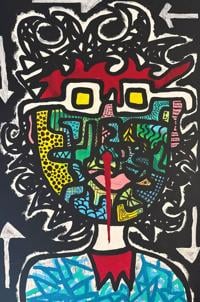
“Buy Blake,” Marcus Blake, 2026.
(Thompson Talent)
Prominently featured in historically Black neighborhoods like Overtown, Little Haiti and Liberty City, his large-scale public works are distinguishable by his use of vibrant geometric patterns, a visual language he calls “Tapenology.”
“They’re just lines, you know?” said Blake. “But these lines somehow give off a particular energy that is attractive. It could just be lines, but the lines are genuine in their expression, their translation. I really want to make anyone understand it.”
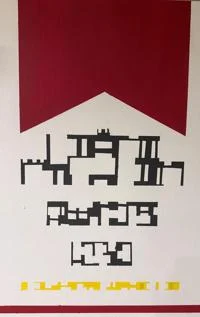
“Fill Lips,” Marcus Blake 2026.
(Thompson Talent)
Blake is the founder of Base Art Space, housed in “Little Bohemia,” which functions as both his studio and his home in Little Haiti. Although he’s lived in many neighborhoods across Miami-Dade County, Blake has always made his home a community art space. Other artists live and create in Little Bohemia, and Blake has helped turn the space into a work of art in and of itself.
“In every house that I lived in, I would paint the door,” said Blake. “Then that work moved on to the inside of the house. From there, it slowly started branching out onto other canvases.”
Blake does this everywhere he lives across the city, to mark the space as his own. For him, Miami is a unique place to create and reside.
He praises the street art movement but worries that the city is trying to “change over” the artists instead of changing with them. Blake believes the city is trying to find the balance between polish and creativity, but in doing so, it is limiting the places to display art.
“Miami is not [catering] to the artists, even though they might respect what the artists have done for the city,” he said. “We’re in that changeover where it was a city filled with art in different little pockets. Now it’s a very polished place. If the streets are so polished, where do you put the street art?”
He identifies Little Haiti as the most recent hub for street artists who want to exist outside of the “machine” Miami has created.
“The essence of the artist is part rebellion,” said Blake. “You’re still going to find a place to put [your art], either allowed or not allowed.”
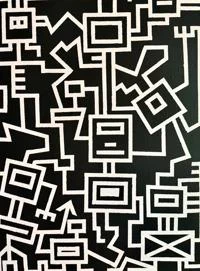
“Road Bots,” Marcus Blake, 2026.
(Thompson Talent)
Rebellion for Blake takes others forms as well. As an artist whose work deeply reflects his own individual emotions, he refuses to label his creations as “Black art.”
“None of the other artists are considered ‘white art’ — they’re just great artists,” said Blake. “What is ‘Black art’? Me being Black makes it Black art, so there’s no need to put a title on what kind of art I’m making.”
By labeling art according to race, Blake said, Black artists are often pigeonholed into being a representative for the entire Black diaspora. He believes no one should be able to decide what Black means for the individual artist.
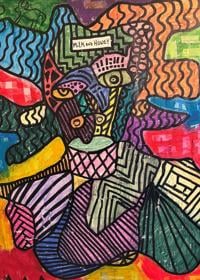
“Milk and Honey,” Marcus Blake, 2026.
(Thompson Talent)
“Free self-expression comes first,” said Blake. “Your world will dictate what [your art] looks like. Say the work is about struggle; not all Black people are struggling. Most of the time, it’s a negative connotation, and that’s not true.”
There is a beautiful side to art, according to Blake, an alternative in which people are only representative of themselves and their creations. He believes identity “bleeds into” creation and hopes to inspire others to explore and share their creative sides.
“I’ve lived my life as a free person, an artist now, and to say that you could be like me, you could just be free and be creative and chase your dreams and your visions — it’s very important to be able to share that with the world,” said Blake. “There’s more to experience than the surface stuff.”
Creating is Blake’s life, but he “never set out to be an artist.” He wants to invite viewers into his world, provoking contemplation through visual narrative. In September, he will be a resident artist at Nicklaus Children’s Hospital, leading children through artistic exercises and fostering their creativity by sharing his own hand-painted canvases for them to color in.
“I’m going into these children’s programs in the next few weeks, and it’s just got me thinking,” said Blake. “I’ve been doing this since I was a kid, literally drawing on the walls. To be able to turn that into something and share that gift not with just anyone but with these particular children, I just feel like that’s so powerful.”
To learn more about Marcus Blake and for examples of his work, visit his website, mdotblake.com.