
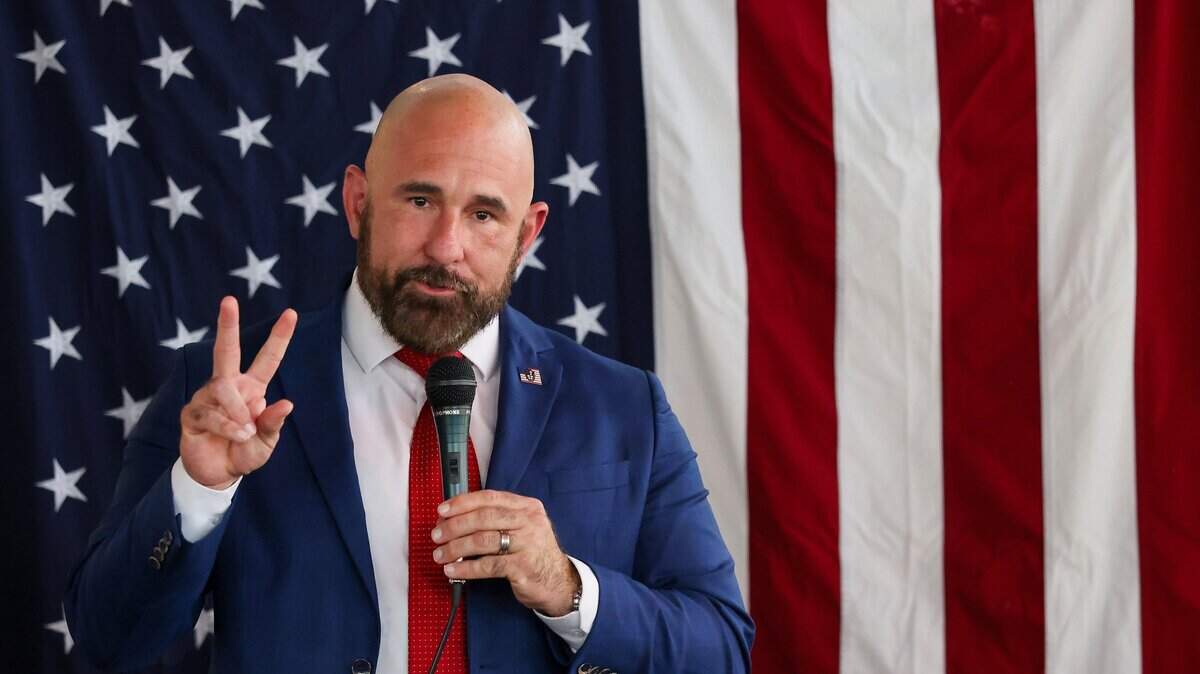
Florida Lt. Gov. Jay Collins on Sept. 28, 2025, at Las Vegas Cuban Cuisine in Doral.
Carl Juste
cjuste@miamiherald.com
When Florida gubernatorial candidate Jay Collins addressed a group of people at Miami’s Versailles restaurant in Little Havana Tuesday, he wore a fishing shirt, jeans and sneakers.
Most politicians have to work to project a blue-collar image — work boots and rolled-up sleeves. That’s nothing new. But in Collins’ case, he doesn’t have to play the part. He has a blue-collar background. And even though he may not be Florida’s next governor, Republicans should pay attention to his candidacy anyway.
If Republicans want to remain the party of the working class, they should recruit more candidates who come from it. Collins is one of those candidates. Born to a teenage mother, he was adopted by his grandparents. He worked on the family farm and joined the Army, where he became a Green Beret.
Those experiences don’t necessarily make him the best choice for governor, but his background is unusual in a party where many candidates traditionally come from professional backgrounds such as law, business or finance.
In Florida, affordability has been a buzzword surrounding almost every political campaign. Candidates promise to lower costs and ease the burden on working families. Yet, few can speak from personal experience about manual labor or being on welfare. That’s the gap. Many of the people promising to solve affordability have rarely experienced it firsthand.
Collins — and others like him — are the exception, but they shouldn’t be.
Over the past decade, the Republican Party built a bigger big tent — mostly for the better. President Donald Trump, despite being born into privilege, reshaped the Grand Old Party and won over working class voters who felt increasingly disenfranchised by the Democratic Party. Trump spoke to their concerns about the economy, inflation and immigration. His message resonated with millions of working Americans and proved a billionaire could turn out the blue collar voter.
Trump has been the exception, of course, and he isn’t from the working class. The GOP should look at the larger picture: We need more blue-collar candidates.
Republicans have come a long way. In 2024, the International Brotherhood of Teamsters, one of the largest unions in America, didn’t endorse a Democrat for president — for the first time in nearly 30 years. In fact, Teamsters didn’t endorse either candidate, though president Sean O’Brien released internal polling showing overwhelming support for Trump, among union members, including freight drivers and warehouse workers.
It’s clear that Republicans have earned credibility with voters who once formed a reliable Democratic base. Now they need candidates who reflect those voters instead of merely campaigning to them.
Blue-collar credentials aren’t a substitute for competence or principled leadership. But lived experience offers something that focus groups or polling can’t: understanding. People who’ve worked in physically demanding jobs often bring a different perspective to issues like taxes, regulations, workforce development and the dignity of work.
When Collins was campaigning in Miami, he talked about losing the family farm, leaving college to join the Army and said he would like to expand trade education in Florida’s high schools. Republicans frequently champion vocational education and apprenticeships, but those ideas are more convincing coming from someone who has actually worked with their hands.
Hard work and upward mobility are principles the GOP has long celebrated. If Republicans want to remain the party of working Americans, they should broaden the kind of candidates they recruit and promote.
Representation is more than race, ethnicity and gender. It’s also about having leaders who have been part of the working-class and experienced the challenges of having to decide between paying the light bill or buying groceries.
Mary Anna Mancuso is a member of the Miami Herald Editorial Board. Her email: mmancuso@miamiherald.com