
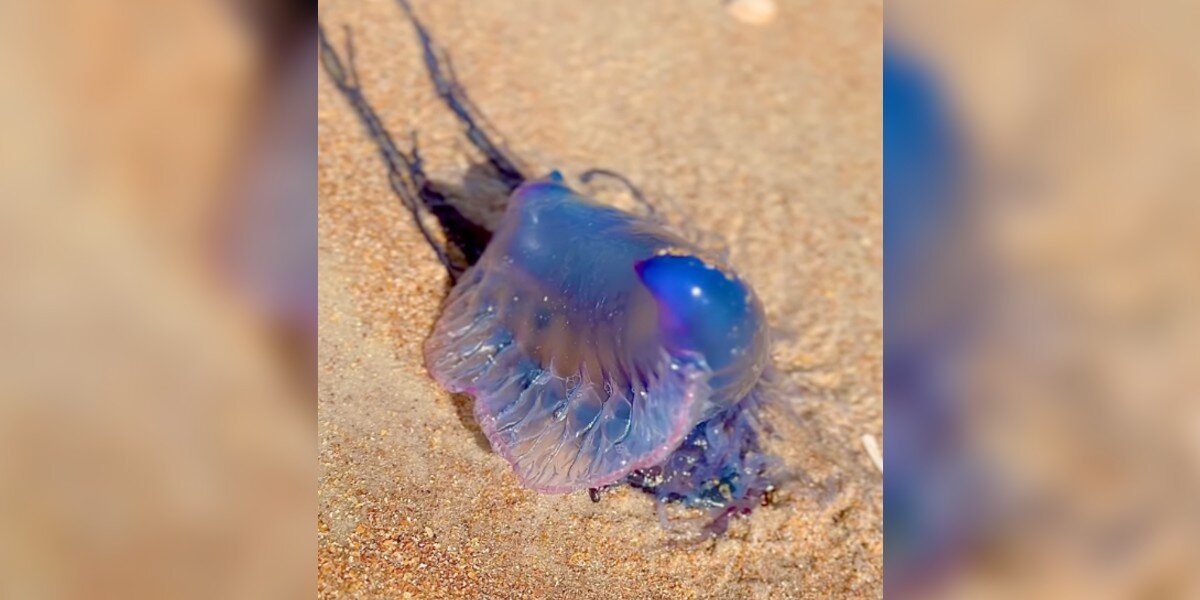
This past spring, Elise Grandizio was exploring the beach in Key West, Florida, when she saw a strange blue blob lying in the surf. At first, she didn’t know what it was and assumed she’d just found a piece of litter someone had left lying around.
“From a distance, it looked like a balloon with strings tangled beneath it — something left behind that didn’t belong on the beach,” Grandizio wrote on Instagram. “I figured I’d pack it out and trash it.”
Just as Grandizio was about to pick up the “balloon,” something shocking happened — it moved. As she looked closer, she realized it was actually alive.
“Up close, it was striking — translucent blue, almost glass-like, with a soft lavender fin catching the light,” Grandizio wrote. “Then it clicked. Not garbage. Not harmless.”
After some quick research, Grandizio learned that she’d come across a Portuguese man o’ war, an animal who looks similar to a jellyfish but is actually their own unique species. They live in tropical and subtropical seas around the world and consume fish, larvae and crustaceans.
“Men o’ war are propelled by winds and ocean currents alone, and sometimes float in legions of 1,000 or more,” NOAA wrote on their website.
The part of the Portuguese man o’ war that was moving around on the beach is called the float. Portuguese men o’ war use their floats to sit on the water’s surface and be carried by the wind, just like the sailboats they’re named after.
“The species is named for its resemblance to a class of warships that was developed in Portugal beginning in the 15th century with the caravel, a light agile sailing ship, called a man-o-war, that efficiently harnessed the wind,” Britannica wrote on their website.
Of course, if there’s one thing most people know about Portuguese men o’ war, it’s their notorious stinging tentacles. The tentacles can extend to over 100 feet in length and are nearly invisible in the water, allowing them to easily catch their prey.
“The tentacles contain stinging nematocysts, microscopic capsules loaded with coiled, barbed tubes that deliver venom capable of paralyzing and killing small fish and crustaceans,” NOAA wrote.
When people get stung by Portuguese men o’ war, they typically suffer from extremely painful welts. The stings can even sometimes be deadly if the person has an allergic reaction. Luckily, Grandizio figured out what was going on quickly enough to avoid a painful or even deadly animal encounter.
“I almost picked it up,” Grandizio wrote.
Grandizio is perfectly happy to have gotten to observe the Portuguese man o’ war from a distance. She got to admire the gelatinous animal’s stunning blue coloring and delicate tentacles — sting-free.
“Nature is a place that doesn’t always announce its danger,” Grandizio wrote. “Sometimes it disguises it as something beautiful.”
