
Welcome to the Catalyst’s Community Voices platform. We’ve curated community leaders and thinkers from all parts of our great city to speak on issues that affect us all. Visit our Community Voices page for more details.
A version of this article was previously published in the Northeast Journal.
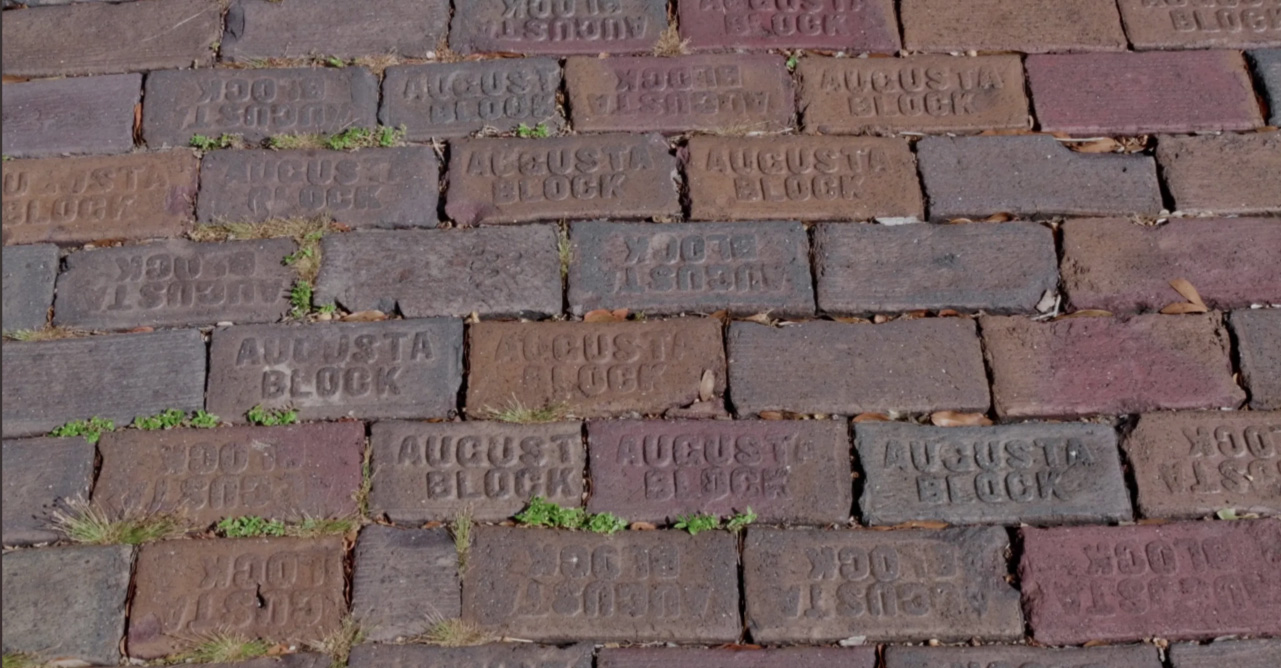
Following the red brick roads, most paved with Augusta Block, will not get you to the land of Oz. But it will lead to an enchanting walk in time back to early St. Petersburg
Polita Glynn is a documentary filmmaker, screenwriter and creative storyteller, with a background in American studies and history. Glynn says she has “always been drawn to the past,” and is “enthusiastic about storytelling as a way to get people to see our community and city with different perspective.” She studied film and television as a way to tell those stories.
Along with director and cinematographer Devin Rice, she has produced and directed several documentaries about Florida history, most recently, The Brick Roads of St. Petersburg. This short film focuses on the history of our brick roads, a signature historic and cultural feature of the city. The film mixes rich visual imagery with archival images, period newspaper articles, historic maps and animation.
In the film Glynn recounts the story of the 92 miles of remaining brick roads found in our historic neighborhoods, downtown and other places. The film was partially supported by a grant from the City of St. Petersburg. The historical narration from the film follows (italics):
St. Petersburg, Florida has more surviving brick streets and alleys than almost any city in America. Over 100 years old, they are rippled by more than a century of travel, expanding tree roots and shifting foundations. On their uneven surface, you watch your step, slow your car and maybe think about earlier times.
In 1903, St. Petersburg incorporated as a city with a population of 1,500 people. Seeking to modernize, civic leaders wanted to upgrade the rutted dirt roads into orderly grids of smooth wide streets. mounds and middens.
But when the mud persisted, they turned to brick. With only enough funds to pave a few blocks, the first brick roads were laid in 1904 along Central Avenue. Each year, more money was allocated to expand the brick roads. Block by block and mile by mile, the paving continued. In 1910, the St. Petersburg City Council passed a resolution to pave 75 miles of streets with brick. Subsequent resolutions added 48 city blocks and then another 16 miles.
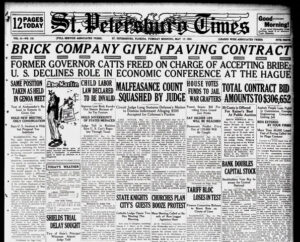 By 1910, the Georgia Engineering Company emerged as the main recipient of city contracts to manufacture the bricks, transport them to St. Petersburg by railroad and install them in designated areas. A subsidiary of Georgia Vitrified Brick and Clay Company, the company manufactured the “Augusta Block” paving bricks in Campania, Georgia, near the city of Augusta. They consistently offered the lowest cost in their bids for the city contracts to manufacture, transport and install brick streets. The company was soon producing over a million bricks a month.
While building bricks are made from surface clay, road bricks need to be stronger and are made with shale. Shale is a type of clay found beneath the surface which compacts to a rock-like texture from the weight of the ground above it. Georgia Vitrified mined weathered phyllite or shale from the Belair pits next to its factory.
They combined the shale with local clay to create a mixture which was cut into bricks. The bricks were partially vitrified, fired at such high heat that the clay began to fuse like glass, and then over days at a lower temperature. The result was a tough and durable brick that was hard but not brittle. They more than met the “rattler test,” which evaluated the quality of the brick by the clear ringing sound produced when two bricks are struck against each other.
Augusta bricks were transported by train along the Atlantic Coast Railway from Georgia to St. Petersburg. Before installing the brick, roads were graded, and the sand or shell base was compacted and leveled with a roller. Work crews installed the bricks by hand, and the brick durability was tested with a five-ton roller. Any broken brick was removed and replaced.
We may never know the names and stories of the people who mined the shale, shaped and fired the bricks, loaded them onto trains and installed them in the city of St. Petersburg. Records are scarce about the labor for the Georgia Vitrified Brick Company and the road crews in St. Petersburg. We can only speculate that the conditions were harsh. In the early 1900s, convict labor was used in Georgia brick manufacturing and in Florida road construction. Arrested for petty charges such as loitering or vagrancy, convicts were leased to private companies or forced to work.
Bid by bid, contract by contract, streets changed from dirt to brick. By 1928, there were 213 miles of vitrified brick street in St. Petersburg. By the end of the early 1930s that number was reported at over 300 miles of paved roads in the city. By that time, the era of big brick street building projects had come to an end.
The expansion continued every year until the 1940s. That was the peak of brick production. Brick installation began to decline as asphalt and cement offered a more cost effective and efficient solution. New roads started were built with this material. And miles of old brick streets which needed repair were paved over. By 1960, only 113 miles of brick roads remained.
Recognizing their value as an historic asset, in 1992 the City of St. Petersburg passed preservation policies to protect the historic bricks and prevent any further paving of brick streets and alleys or removal of granite curbs. The remaining 92 miles of brick roads and alleys are now protected by this policy.
Explosion of autos
Given Glynn’s summary history of the Georgia Vitrified Brick and Clay Company and its extensive paving of St. Petersburg’s streets with Augusta Blocks, what specifically brought about this huge demand for brick-paved roads, and what were the implications of this massive construction effort?
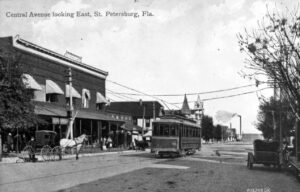
Replacing sand roads with a more durable and tractable surface such as brick was essential infrastructure to accommodate the growing number of tourists as well as local residents purchasing their first auto. Prior to 1920, about 80% of tourists would arrive by train, and 20% by boat and auto. They would then use local transportation, still including horse-drawn carriages mixed with early automobiles, and trolleys to get about the city and nearby areas of interest.
St. Petersburgh’s trolley system began in 1904. By 1915 it had an amazing 25 miles of track. However, with development of the Ford assembly-line production of cheap Model T Ford cars, production and availability of automobiles skyrocketed in the early 1920s. By 1927 the Ford Company alone had produced over 15 million cars. As both local and visiting automobile owners increased, “good roads meets” of automobiles were organized to demonstrate for better, more durable roads, and bricks were the preferred material.
In 1920 an influx of tourists with autos saturated available accommodations. The new city publicity genius John Lodwick, who had been sending hundreds of stories and photos about St. Pete’s paradise to hundreds of newspapers across the nation likely was a significant player in this.
In order to accommodate those who could not find lodging, the mayor established “Tent City.” A small parcel of land was set aside with utilities provided by the city. Some tourists stretched a tarpaulin alongside their cars, and other pitched tents. St. Petersburg soon became awash with cars.
The Gandy Bridge was opened between St. Petersburg and Tampa in 1924 to facilitate and shorten auto travel between the two cities and other nearby areas. In December 1924, its first month of operation, 60,573 cars crossed the bridge. By December 1925 traffic nearly doubled, increasing to 113,666. After only a year’s operation plans were underway to double the width of the bridge so as to eventually accommodate 24,000 cars a day, though the bridge was not actually widened until 1956. Later a second span was added. (For perspective, in 2019 the bridge accommodated 37,500 vehicles a day.)
At the other end of the city, the Bee Line Ferry was opened between St. Petersburg and Bradenton in 1926, transporting 1,500 cars a day across the bay. However, the growing tourist trade by automobile and growing city population purchasing automobiles were not the only reason for new brick roads.
Development boom, bust and bankruptcy
A second significant contributor was the development. In the 1920s our city was undergoing a real estate boom – one historian called it “money madness” because of the thousands of lots sold and repeatedly flipped at ever higher prices. It is estimated that at the peak of the 1920s boom there were nearly 6,000 real estate salesmen in St. Petersburg, a city of a mere 14,000 residents.
Many brick-paved streets were in developments with unsold lots. Typically, at that time developers platted the neighborhood, arranged for roads and other infrastructure, then sold lots. The lot buyer then built the home. As recounted by historian Walter P. Fuller, the brick roads in a great many of the developments were provided by the city, at no or sometimes partial cost to the developer. During the early and mid 1920s St. Petersburg spent more than $12M (approximately $470M now) backed by bonds for road paving. As historian Raymond Arsenault noted, this was “a staggering sum for a community that had been satisfied with roads of rutted dirt or crushed shell fifteen years earlier.”
The Great Depression hit St. Petersburg in 1927 before the 1929 stock market crash. Aside from the tourist influx, much of the city’s economy depended on the sale of lots and construction. In 1925 the value of building permits peaked at $25M. The following year this fell to $15M and in 1927, $3M. By 1931 less than $1M.
The property tax generated by lot sales and construction fell proportionately. Businesses failed, mortgages defaulted and property values plummeted along with city revenue. As Arsenault wrote, “unreimbursed spending on streets and other public improvements, left the city in a precarious financial position.” In 1930 the city defaulted on its bond payments and declared bankruptcy. Bond payments were not resumed until 1937. Eventually the city’s investment in brick streets was partially recovered as the largely vacant subdivisions became populated. But it took many years.
Telling our history
While Augusta Blocks predominate city brick streets, other block types may also be found. These include Rockmart, Monarch Brick Company/Rockmart Shale Brick & Slate Co., Rockmart, Georgia (found especially in the Snell Isle neighborhood); Graves, Birmingham, Alabama; Copeland and Ingles, Birmingham; Southern Clay Manufacturing Co. (imprinted with a diamond shape); and wire cut bricks carrying no signature imprint. In addition to brick streets there were also sidewalk hex blocks. These, too are protected by city ordinance.
St. Petersburg’s brick streets greatly add to our city’s rich sense of place and charm, and have their story to tell. One film viewer commented, “I never looked at brick streets the same after I saw the film.” No greater compliment could be paid to filmmaker Polita Glynn.
Glynn is now working on another documentary, Maximo Hernandez and the Fishing Ranchos of Tampa Bay” featuring Maximo Hernandez, after whom Maximo Point and Park are named. Maximo was perhaps the first non-Native American settler at Pinellas Point and established a fish rancho in the vicinity of Maximo Park.
Polita expects the film to debut in February at Eckerd College (just adjacent to Maximo Park). Previously she produced Underground History, a documentary film and poetry visualization project which explored connections between the Tampa Bay region’s diverse cultural history and community efforts to better acknowledge and understand lessons of that past in charting the future. Polita’s website may be found at https://merfolkmedia.org .
Will Michaels is former director and trustee of the St. Petersburg Museum of History, and author of The Making of St. Petersburg and The Hidden History of St. Petersburg.