
“When added as an adjunctive procedure, subdural hematoma recurrence rates have been reported to drop below 10%,” said Kunz, noting that patients may also experience a faster and easier recovery.
His work looks closely at which patients benefit most from the procedure, either as a standalone treatment or in combination with surgery. The study focuses on groups that haven’t been studied in depth, including older adults, patients with dementia and those with larger hematomas.
The project earned Kunz the 2026 Carolyn L. Kuckein Student Research Fellowship, awarded by the Alpha Omega Alpha (AΩA) Honor Medical Society. It is one of the nation’s most competitive honors for medical student researchers.
“It means the world to me,” he said. “Positive feedback in medical research and training often takes time, so it was rewarding to receive that kind of encouragement.”
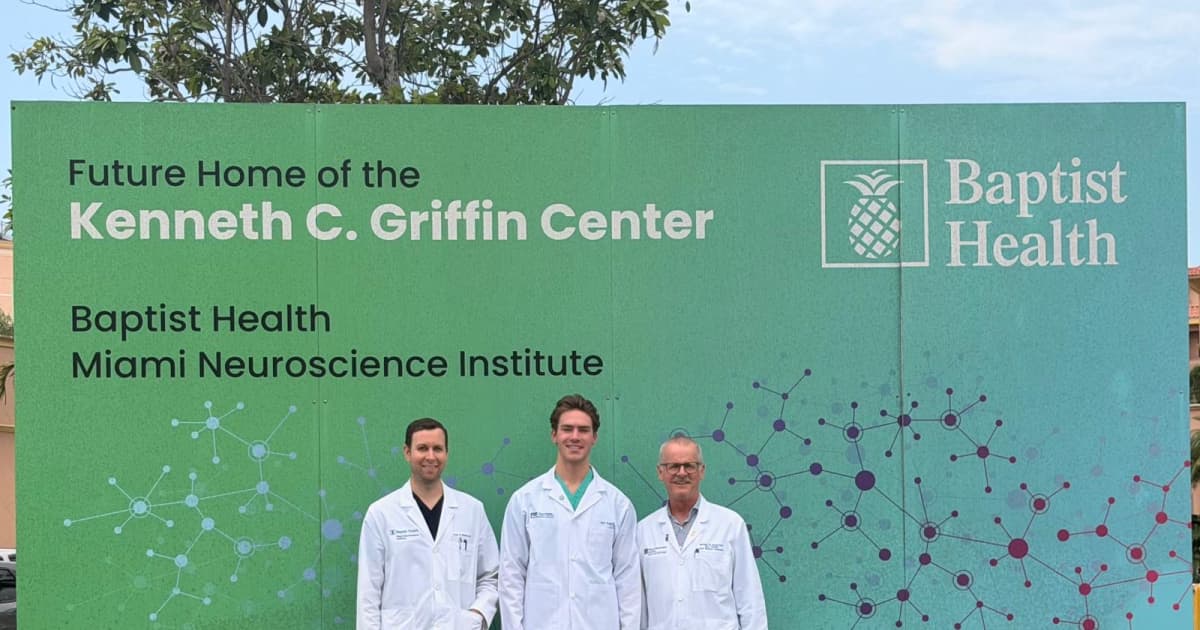
Supported by the fellowship, Kunz is working on the project with Dr. Robert Wicks, principal investigator, associate professor at FIU Medicine, co-director of cerebrovascular surgery and director of the Neuroendovascular Surgery Fellowship at Baptist Health Miami Neuroscience Institute, to generate better data and help physicians make more informed decisions at the bedside. He is also mentored by Dr. Michael McDermott, chair of the Department of Neurosciences at FIU Medicine, system chief executive of Baptist Health Brain & Spine Care, and chief medical executive at Baptist Health Miami Neuroscience Institute.
“This project allows us to communicate our own results, not someone else’s, to patients during the informed consent process while also helping identify opportunities for improvement,” said McDermott.
Kunz has already presented preliminary findings at the American Association of Neurological Surgeons Annual Meeting, with additional presentations planned this year.
Mapping how tumors reshape the brain
Kunz has also been recognized for his research in connectomics, the study of how different regions of the brain communicate.
The research focuses on anterior skull base tumors, which form near the front of the brain and can subtly change how brain networks function. Kunz is using advanced brain-mapping technology to examine how these tumors disrupt connectivity across different regions of the brain and what that might mean for both surgery and recovery.
His work earned him the Emerging Innovator Award from Omniscient Neurotechnology, a global medical technology company that develops FDA-cleared, AI-powered brain-mapping tools to help neurosurgeons better understand complex neurological conditions.