
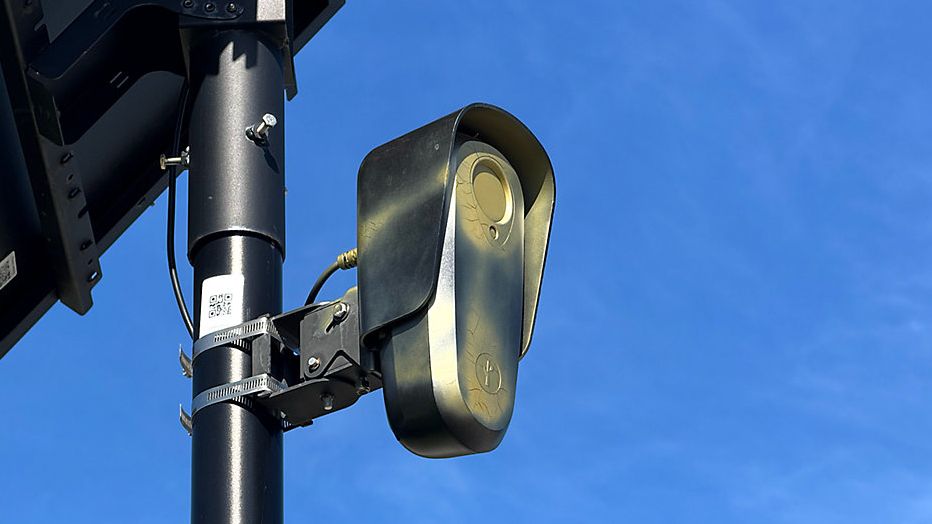
ST. PETERSBURG, Fla. — A Flock camera overlooking the Snell Isle Bridge in St. Petersburg was vandalized with gold spray paint over the weekend as the debate over police use of the license plate reader devices continues to grow in the city.
Previous Flock camera headlines in Florida
“These cameras were put up here without our permission,” said resident Carl Gunn, 77. “Without us voting on them.”
Gunn began his one-man protest against the surveillance cameras four weeks ago, by using a sign attached to a long pole to block the lens and has since been nicknamed the “Flock Blocker.” Gunn said his protest has garnered a lot of local, national and even some international attention.
“I never knew that this was going to blow up the way it has,” he said. “I am really thankful it has, because it’s brought a lot of attention to the problems that we have with these cameras.”
Gunn said his problem with the Flock camera system is police can use the network to track his movements and called the program mass warrantless government surveillance.
“The problem with them surveilling us all the time is that I know it violates my rights,” he said. “I don’t want people to know where I go. I don’t want people to know where I’ve been. It’s none of their business and it’s none of their business to know where you have been.”
St. Petersburg Police Chief Anthony Holloway recently had his department put out its first public press release explaining how the agency uses the Flock camera system, which began operating in the city under a free pilot program in 2022.
“This tool will be used the right way,” he said. “We’re being very transparent about it and that it is here for one reason, to help us get a starting point when a crime happens in our city. To make sure we continue to make our city safer.”
Chief Holloway said the city has the basic Flock camera model which only takes photos of vehicles and their license plates. No faces or people are captured in those photographs.
“Our cameras only capture the license plate and the make and model of the car because that’s what we want,” he said. “It’s just a series of photographs.”
The cameras do not record video, audio, log nearby Wi-Fi or Bluetooth signals or capture photos of people on the street, and all of the data gets deleted after 30 days, according to police. Holloway said the agency did not know a camera was recently vandalized until Spectrum News brought it to their attention on Monday, which shows officers are not monitoring the camera system in real time.
“Until you told us today that that Flock camera’s out, we didn’t know,” he said. “The only time we would have known that Flock camera’s out is when a detective would have gone back and said, ‘Hey, something happened. Let me go look at that Flock camera.’ Then we would have realized it was vandalized.”
Police said it’s the third case of a Flock camera being vandalized in St. Petersburg over the past five months. Holloway said the vandals could be arrested or prevent a serious crime from being solved.
“Something happens to someone in that neighborhood, it could be your loved one,” he said. “And we go look for a lead. We don’t have a lead because you were stupid and you took our possible only lead that we have.”
Since March, the Flock camera system has helped police catch murder suspects in three high profile violent crime cases, according to Holloway. Those cases include the Coquina Key arson which killed an 18-year-old girl, the 11th Street South homicide where an 86-year-old man and his dog were found dead inside a house and most recently, the homicide case where a city employee was killed while sitting inside a front-end loader.
“We’re just using them for felonies,” he said. “That’s what we want to use them for is a violent crime or a felony that happened in our city.”
Holloway said he has strict protocols in place to prevent Flock data misuse by his officers, who could also be held civilly liable in court. The police chief said anyone who thinks their tag was run illegally by an officer should file a complaint, and the agency will investigate it.
“Our policy states that if you use this data for non-related police activity, that you can be terminated,” he said. “We have an audit system put in place… random audits to see who ran what on what person.”
The city had 25 cameras installed in 2022 under the free Flock pilot program, according to police. The number of cameras doubled to 50 when the city signed a five-year, $700,000 contract with Flock in 2024, which expires in January 2028.
The Flock debate has spread to Pinellas County, where commissioners asked for a presentation from Sheriff Bob Gualtieri at their July 21 meeting. Commissioner Brian Scott said he has gotten a lot of communication from concerned residents over the past six months.
“I don’t know that we’ve ever had a really discussion about how they’re used, why they’re used, what their purpose is. Who has access to the data? What the data retention policies are?” he said. “I have no idea what is the cost of them? What do they cost to implement? What’s the ongoing cost to maintain them? I think those are things we should know about.”
Administrator Barry Burton said he did not know the answers to those questions and would ask Gualtieri to prepare a presentation for a future workshop for Pinellas County commissioners.
“I’ve kind of watched this topic kind of boil up and we’ve watched other jurisdictions try to address it,” he said. “It’s a little bit more complicated with us having an independent elected sheriff.”
Gunn said he plans to continue his protest at a different Flock camera location every Saturday until there is federal legislation passed which prohibits their use.