
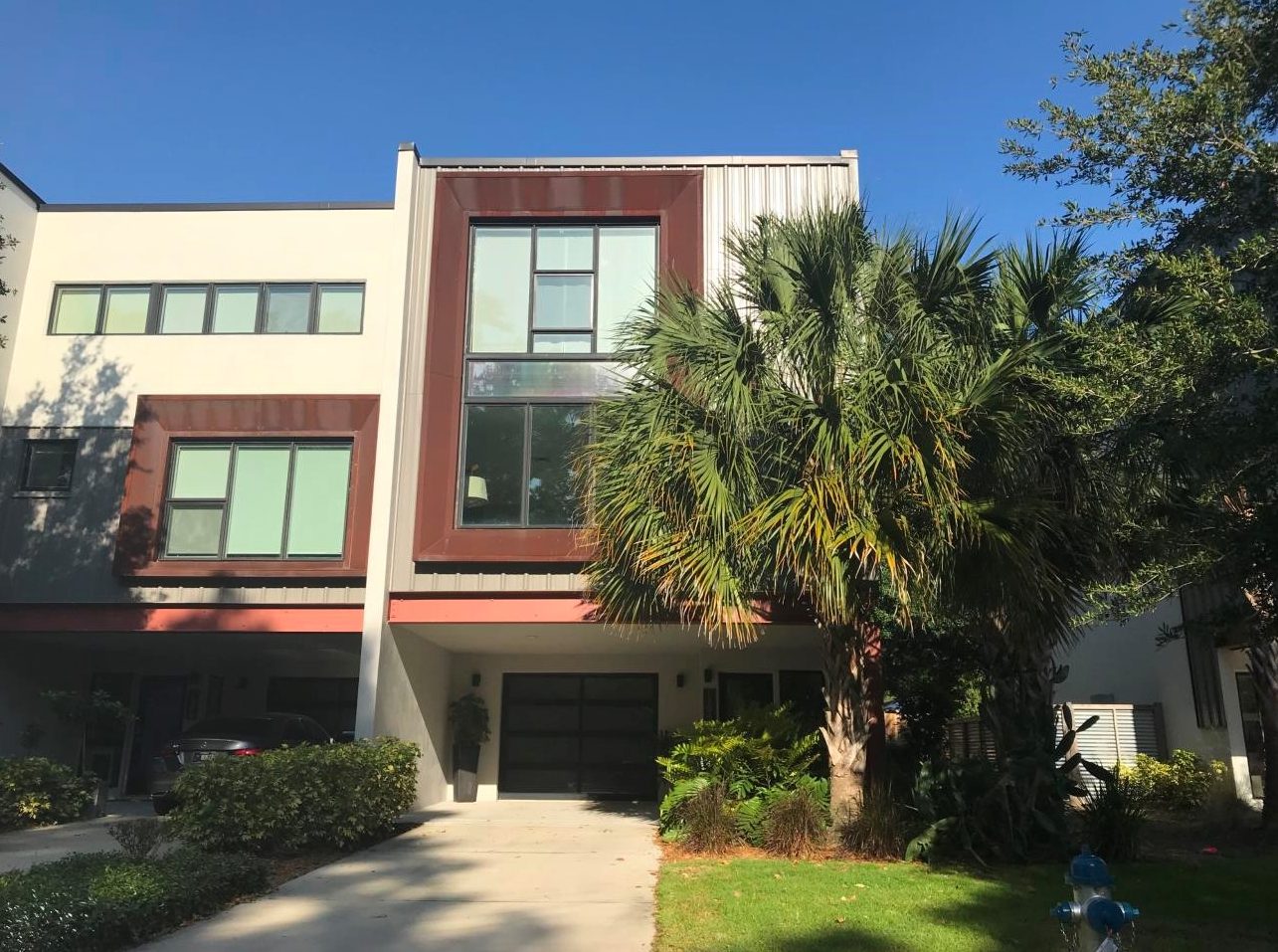
An unusual proposal from Orlando-based firm Interstruct Design + Build to unify 10 properties in Orlando’s Hourglass District was brought before the Orange County Technical Review Group on Aug. 5. Dubbed the Francis Park Land Use Plan, the project would bring pieces of a residential portfolio assembled over nearly two decades under one development framework. Ultimately, the complex would have 27 rental units.
Some of the units are already built, while others would be built over time. If the rezoning goes through, Interstruct would maintain the development’s shared infrastructure and ungated recreational areas, which would be available to all tenants.
The proposal arrives as Orange County prepares another attempt to enact Vision 2050, its long-range plan for managing growth while encouraging affordable housing, protecting established neighborhoods and directing development toward appropriate areas.
County commissioners adopted Vision 2050 and its accompanying development regulations, Orange Code, in June 2025. But the Florida Department of Commerce declared the plan null and void the following month, citing conflicts with a new state law. Orange County has continued reviewing development under its existing comprehensive plan and zoning code while preparing to readopt Vision 2050. Public hearings on the vision plan are scheduled before the Local Planning Agency on Aug. 20 and the County Commission on Sept. 29.
Though Vision 2050 is not in effect, its approach to housing became a central point of discussion during the county’s review of Francis Park.
Interstruct wants to rezone 1.49 acres from a residential district that allows houses and duplexes to planned development. The project would place a mix of detached houses and duplexes on properties along Francis Avenue and Vine Street.
Orange County would classify the homes collectively as one multifamily rental development under common ownership and management, even though each would meet single-family construction standards.
The planned density is approximately 18 units per acre, with 40% of the homes, or about 11 units, reserved as attainable housing. Orange County defines attainable housing as homes serving households earning between 120% and 140% of the area median income. The county has not yet established the income limits, rents or length of the restrictions that would apply to the Francis Park homes.
Interstruct also wants waivers from county requirements governing building height, setbacks, landscape buffers, parking design, open space, impervious surfaces and landscaping.
Some of the 10 parcels are separated by conventionally zoned properties outside Interstruct’s control.
“It’s unprecedented,” said Bryan Salamanca, an Orange County Zoning Division planner who participates in development reviews. “I don’t think we’ve had a PD in the past where it jumps lots.”
County staff would therefore evaluate some setbacks and other standards according to the conditions surrounding each lot.
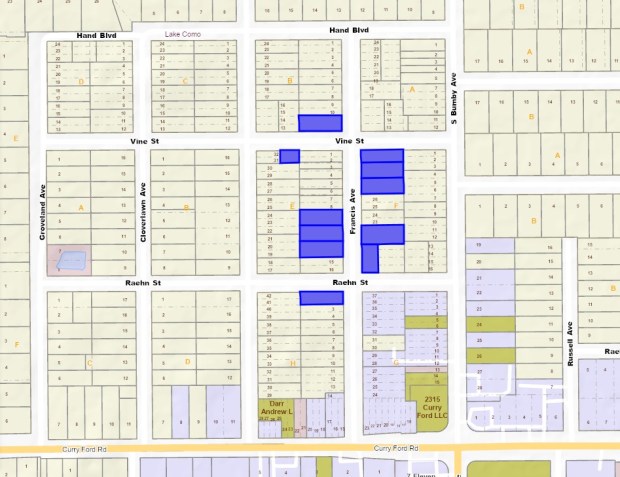 The 10 parcels included in the Francis Park Land Use Plan, shown in blue, are scattered along Francis Avenue and Vine Street in Orlando’s Hourglass District. Interstruct proposes treating them as one 27-unit rental development despite intervening properties outside its control. (Orange County Property Appraiser)
Attainable housing process unresolved
Interstruct began pursuing greater density in exchange for attainable housing before submitting the current proposal.
Katy Magruder of Longwood-based Dix.Hite + Partners, Interstruct’s planning consultant, said she and the property owner met with Orange County housing officials in March about obtaining the required certification. They were told no certification procedure was available for the proposed density increase, even though Vision 2050 contemplates additional density for developments that include affordable or attainable housing.
County planning staff said approximately 12 units per acre would generally be appropriate for the surrounding residential neighborhood. Vision 2050 could allow as many as 20 units per acre for qualifying projects, but staff cannot base its review on a plan that is not in effect.
“We’ve tried, and they don’t have a process,” Magruder said. “So, I don’t know. It’s sort of a stalemate.”
Interstruct assembled properties over two decades
Interstruct’s history in the Hourglass District began in 2006, when co-founder and CEO Ryan Young built a loft-style home at 1316 Francis Ave. Young has said the neighborhood appealed to him because of its small houses, comparatively large lots and proximity to downtown Orlando.
A little-used Masonic Lodge stood on an adjoining property surrounded by an open lawn. Interstruct acquired the site in 2015 and built the first three Francis Park townhomes there. A second three-unit phase, completed in late 2020, brought the development to six three-story townhomes of approximately 2,200 square feet each.
Meanwhile, the company continued acquiring properties nearby. By 2018, its holdings included five rental houses on Francis Avenue as it considered further development in the neighborhood. The portfolio eventually included a house at 2218 Vine St. Interstruct said it waited three years for a county variance before completing the conversion.
The proposed development would expand Francis Park by bringing 10 parcels under a single plan. This would include Young’s home at 1316 Francis Ave., which he still owns. Interstruct LLC owns the other nine.
The 10 properties have a combined just value of $2.43 million, including $1.77 million attributed to the land, according to 2025 property appraiser data. Interstruct’s most recently documented purchase was 1321 Francis Ave., acquired for $155,000 in December 2024.
The proposal will face its first neighborhood audience Aug. 31, on the request of District 3 Commissioner Mayra Uribe.
“As you can tell, these are surrounded by single-family detached homes. While I’m all about infill, I’m not about changing the character of neighborhoods unless that neighborhood agrees. There’s still a thing called consistency when you talk about the value of homes,” she told GrowthSpotter. “The one thing that always gives me reservation is once we approve a land use, it doesn’t mean that developer’s going to build it. You know how many times properties get sold from developer to developer, and then they completely change the scope of what they said?”
No decision will be made at the meeting. The rezoning will later proceed to public hearings before the Planning and Zoning Commission and County Commission.
Have a tip about Central Florida development? Contact me at SKinbar@GrowthSpotter.com or (407) 420-5246. Follow GrowthSpotter on Facebook and LinkedIn.