
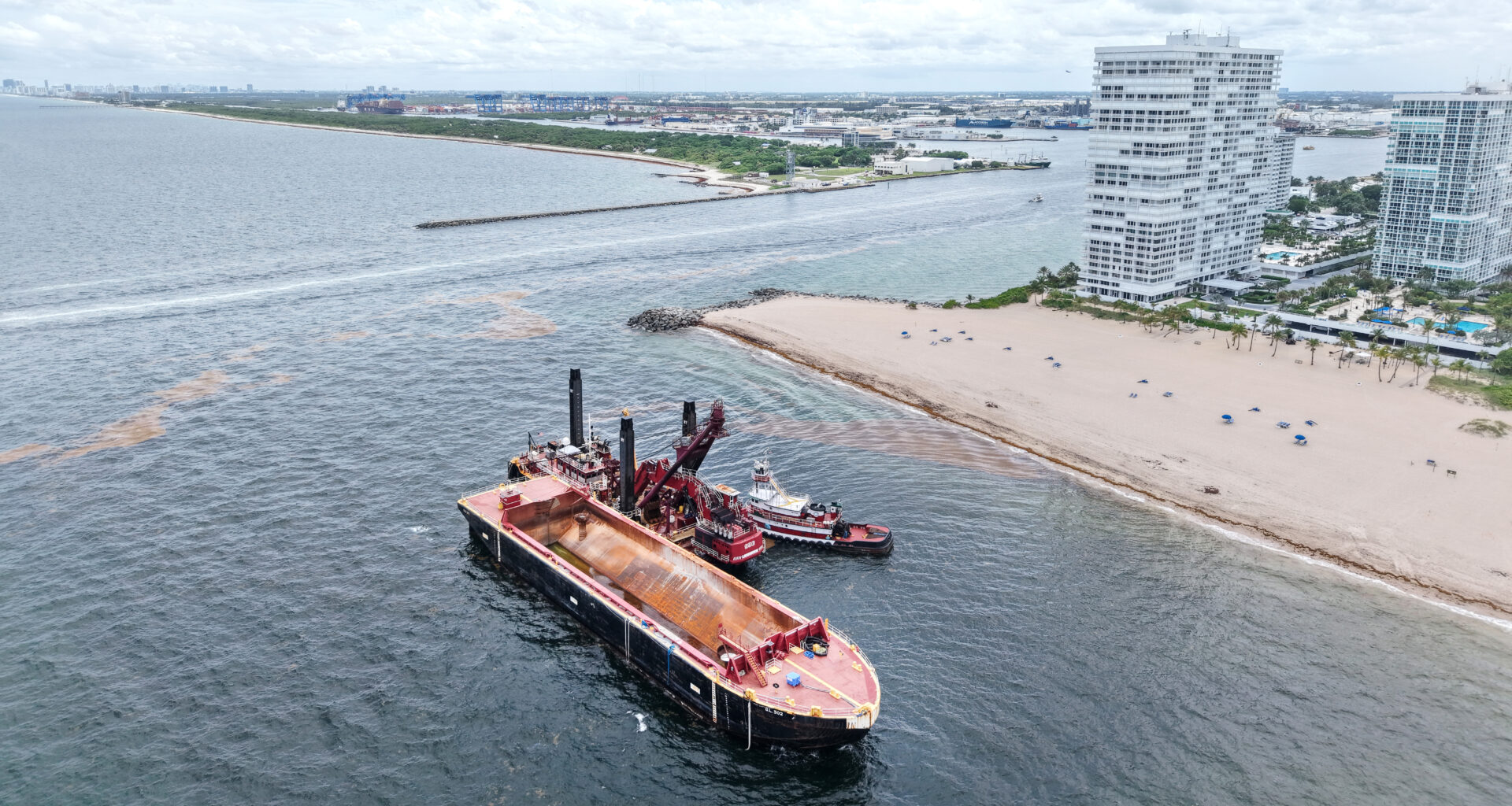
Concerned about the possible damage that might be done to fragile coral colonies off Port Everglades, officials have extended a halt on dredging activity for a sand-relocation project.
The move comes a week after environmentalists and conservationists filed a federal lawsuit seeking to stop the work on a giant sand trap being constructed in a beach renourishment effort.
The dredging effort, known as Broward’s Sand Bypass Project, had already been halted for the summer and was not expected to resume until October.
The reason, according to Army Corps Project manager Jeffrey Meyer, is that the work might be having a more negative impact than originally anticipated on the underwater coral.
On Friday, “the Corps reinitiated consultation with (the National Marine Fisheries Service) after it analyzed the survey results and concluded that the project may be approaching or have exceeded the incidental take limit for staghorn coral colonies,” Meyer wrote.
The “incidental take limit” is how the Endangered Species Act refers to how much unintentional damage a species can endure under an approved project before it’s considered too much.
The Army Corps of Engineers and National Marine Fisheries Service are tasked with ensuring that the work complies with the federal Endangered Species Act.
Broward County government spokesman Greg Meyer said about 94% of the dredging project was already complete and that officials hope the work can resume in the fall with minimal interruption, assuming the damage assessment allows for it.
“We are aware of the notification from the Army Corps of Engineers and are continuing our dialogue with them,” Meyer said. “It should be noted that our project was already paused for the coral spawning season in July 2026 through October 2026 consistent with our previous agreement with the Corps and state and federal permit conditions.”
The groups that filed the federal suit celebrated the Army Corps of Engineers’ announcement as the first major indication they were right to challenge the project.
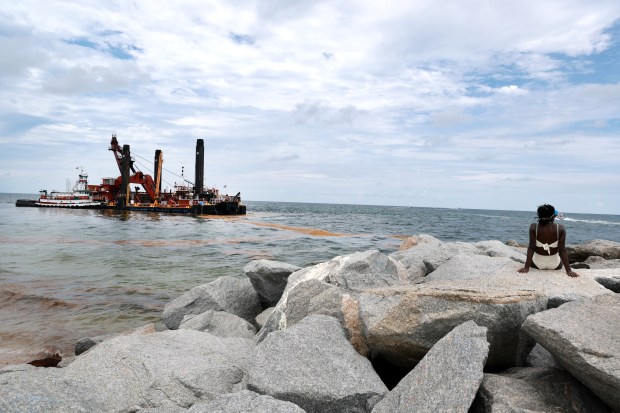 A beachgoer sits north of the inlet at Port Everglades in Fort Lauderdale in June, near where Broward’s Sand Bypass Project is located. (Carline Jean/South Florida Sun Sentinel)
“I hope the Army Corps’ decision to stop dredging for now is a good sign that the federal government is ready to take the conservation of Florida’s coral and queen conch seriously,” said Alex Muir, an associate attorney at the Center for Biological Diversity. “We won’t stop our work until these threatened marine species and their habitat are given the protection they’re entitled to.”
“The speed with which the Army Corps capitulated after we filed our legal action, agreeing to halt the dredging and revisit environmental assumptions almost immediately, shows just how blatant the project’s threats really are,” said Rachel Silverstein, CEO and Waterkeeper at Miami Waterkeeper.
Jess Melkun, vice president of conservation policy at the Florida Wildlife Federation, said the protection of marine life was a main reason for the lawsuit.
“Everyone benefits from healthy reefs and coastlines,” she said. “So we are cautiously optimistic that the Army Corps is finally taking a hard look at the science.”
Rafael Olmeda can be reached at rolmeda@sunsentinel.com or 954-356-4457.