
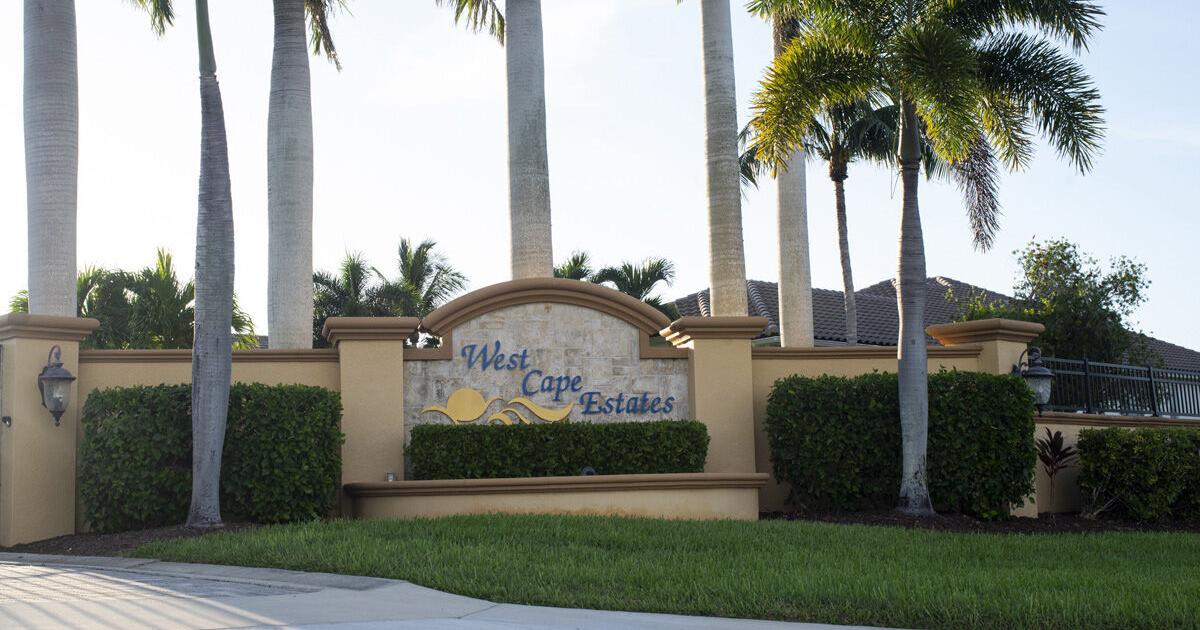


West Cape Estates in Cape Coral is facing the prospect of legal action over the city’s demand that the private community connect to municipal water and sewer service.
Evan Williams
Cape Coral is threatening to sue members of West Cape Estates, forcing homeowners there to hook up to the city’s water and sewer lines instead of using their own septic systems.
Because the community is privately managed, homeowners could be responsible for up-front costs of $150,000 to $200,000 each for a system residents contend they don’t need, according to residents and an attorney representing West Cape Estates Community Association Inc.
“For many of us, the amount is simply not financially realistic,” West Cape Estates resident Linda Grasshorn said at a Cape Coral City Council workshop Aug. 12. “As the wife of a disabled veteran, we live on a fixed income, and the possibility of having to take on a financial burden of this magnitude is extremely concerning. It would threaten the financial security of homeowners who have worked and planned for years to remain in their homes.”
Cape Coral’s demand that the community comply is part of the city’s massive Utilities Extension Project, or UEP. The city is hooking up residents north of Pine Island Road — a once-rural area where residents relied on wells and septic systems — to the city’s water, sewer and irrigation systems.
According to the city’s website, “failed septic tank effluent can flow into groundwater and canals which has the potential to cause environmental problems.”
But West Cape Estates residents and their attorney, Rob Robinson, contend that the community uses aerobic treatment units, or ATUs, which are inspected twice a year, rather than conventional septic systems that should be targeted for replacement.
“Homeowners are required to maintain service contracts, and the systems are inspected twice a year with the information reported to the Florida Department of Health,” Grasshorn said.
She added, “The water quality is perfect and the ATU works every time. You’re trying to fix something that is not broken.”
The community also utilizes wells for potable water and irrigation. Cape Coral has told West Cape Estates that the sewer and potable water connections are mandatory, but an irrigation connection is voluntary.
Cape Coral City Attorney Aleksandr Boksner at the Aug. 12 meeting asked Council members for their blessing “to pursue all legal action to force the (West Cape Estates Community Association) to connect to the city’s wastewater and potable water system.”
Council didn’t take an official vote on Boksner’s request. But most members offered a verbal “yes,” arguing that other communities throughout Cape Coral have already complied with the UEP.

Homes along the water in West Cape Estates in Cape Coral. Residents say mandatory connections to the city’s water and sewer systems could cost homeowners $150,000 to $200,000 each.
Evan Williams
Boksner said he had private discussions with council members about potential litigation against West Cape Estates. He advised them not to publicly discuss or debate the matter because it could be used against them in court.
The city’s communications office said no legal action has been necessary to get compliance from other areas of the city.
Cape Coral City Manager Michael Ilczyszyn said other private communities, such as Heatherwood Lakes, Trafalgar Woods and Bella Vida, have already agreed to the mandatory hookups.
In all UEP areas, homeowners are shouldering the cost burden. But most have the option of spreading the cost over decades of annual tax bills because the city issued long-term bond debt to pay for the project.
Private communities, such as West Cape Estates, are charged with managing the project and figuring out how to pay for it on their own. So, residents could end up with a bill due immediately.
Boksner argued that the potential cost to homeowners is not legally relevant.
“I don’t want that to be the basis for which you make your decision,” he told council members.
Council member Keith Long, whose District 6 includes West Cape Estates, argued that the cost to homeowners — which he called “the human element” — should be considered.
“He’s asking you to take the human element out of it,” Long said of the city attorney’s statement.
He added, “If each homeowner is looking at $200,000, they’re not going to mind litigating this thing all the way to the end, which is going to (cost) our taxpayers, as well.”
Ilczyszyn said it might be possible to reach a settlement agreement with the West Cape Estates Community Association to put the cost of the utility hookup on residents’ annual tax bills. Boksner agreed to speak with the association’s attorney to try to reach a solution before pursuing court action.