
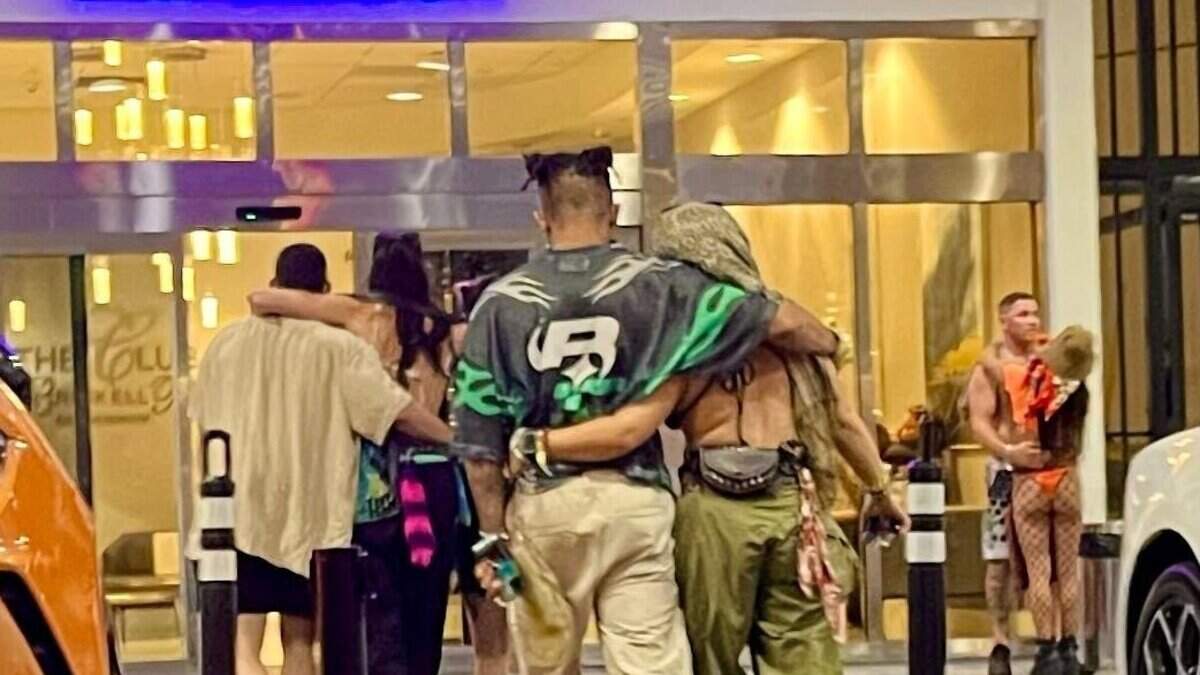
Partygoers stumble back at 4 a.m. March 30, 2026, to the The Club at Brickell Bay, 1200 Brickell Bay Dr., Miami.
Linda Robertson
lrobertson@miamiherald.com
Enforce condo codes
My education in the value of short-term rentals and housing policy began when I was a child, in a building not far from the Brickell Bay condo the Herald profiled in its Animal House series and Luis Andre Gazitua mentioned in his Aug. 3 op-ed, “Brickell’s party towers aren’t just chaos — they’re a housing supply heist.”
In August 1992, Hurricane Andrew devastated our family home in South Kendall. In the most difficult period of my parents’ lives, a short-term rental restored something we had lost: the feeling of home, while our own was being rebuilt. It served us so well that, years later, once my brother and I had left to build our own lives, my parents returned to that same building and stayed for more than two decades.
This is not incidental to Miami’s story; it is part of its fabric. From the laborers Henry Flagler housed as his railroad pushed south in the early 1900s, to the executives of today who rent a condo during Formula 1’s Miami Grand Prix weekend, few industries have withstood the test of time and afforded ordinary people a modest, dignified way to earn income from an asset they already hold.
That capacity for micro-entrepreneurship merits protection in its own right, especially now amid a broader societal reckoning over jobs displaced by artificial intelligence. This moment calls for widening the avenues by which people can earn from what they already own, not narrowing them.
Gazitua’s underlying premise — that short-term rentals are the engine of Miami’s affordability crisis — mistakes a symptom for a cause. Rents here have risen for reasons far larger than any building’s leasing calendar: a sustained migration of technology, finance and professional capital to South Florida; a climate that remains among the most desirable in the country; and a construction cycle constrained by rising insurance costs, scarce land and financing conditions that have made new supply slower and costlier to deliver. A handful of towers converting to nightly rentals did not make Miami the least affordable rental market in the nation. A half-decade of demand outpacing supply did.
A good place to look for affordability is in the housing stock we already have. Then-County Commissioner (now City of Miami Mayor) Eileen Higgins advanced the county’s Naturally Occurring Affordable Housing (NOAH) program, which preserves below-market units by giving owners of older apartment buildings a reason to rehabilitate rather than sell into redevelopment. That is a strategy built on supply and has nothing to do with how a homeowner across town chooses to use her own unit.
None of this excuses the conduct the Herald documented. As a lifelong Miamian who has seen this use at its best and at times, at its worst, I don’t dismiss what residents at The Club at Brickell Bay have had to endure. But the competing interests at stake — the tranquility they’re entitled to expect and an owner’s ability to earn a living from her own property — aren’t actually in conflict. They just require someone to distinguish between the two.
The good news is that Miami already has the regulatory apparatus to do it. Quality-of-life ordinances, licensing regimes and code enforcement can target the conduct residents find objectionable — noise, refuse, an unmanaged rotation of guests — without disturbing the underlying use, extending the privilege of hosting to responsible operators while withdrawing it from those who abuse it. The remedy exists; it requires only the will to apply it.
I welcome the chance to work alongside Gazitua and the City of Miami toward a solution. The erosion of property rights, however incremental and well-intentioned, does not resolve the described problem. Enforcement does.
Tom Martinelli,
Miami
Repurpose schools
The closing of Miami-Dade County’s underpopulated schools reflects a nationwide trend. When Evanston, Illinois, grade schools began closing, the city turned the Noyes Elementary School, a historic building, into the Noyes Cultural Arts Center in 1980.
Community artists applied for spaces and soon the former classrooms held artists like the Light Opera Company, Piven School of Drama, sculptors, writers, dance troupes, jewelry makers, painters, the Next Theater, etc. In exchange for greatly reduced rents, each artist was required to donate time and expertise to the community. (As a writer, I spent a month exciting children to write at grade schools throughout the city.)
The old Noyes school took on a new life, our rents covered most of the Cultural Center’s operating expenses and the entire community benefited.
Sue Sussman,
Aventura
Israel then, now
The Aug. 6 editorial, “Democratic socialist: ‘Anti-Zionist’ isn’t antisemitic. Jewish voters know better,” does a disservice to the growing number of people, Jews among them, who oppose the policies and actions of Israel. Being anti-Zionist when the state of Israel was being formed may have had antisemitic overtones, but that was then.
Being anti-Zionist today means opposing the expansion of Israel beyond its internationally proscribed and recognized borders; opposing the construction of Jewish settlements on occupied land; opposing an anti-Arab apartheid system; opposing the targeting of civilians and civilian infrastructure; opposing the collective punishment, forced dislocation, intentional starvation and genocide of the Palestinian people — all of which are international crimes.
Anti-Zionist is not antisemitic. The Miami Herald should know better.
Tom Carney,
Coral Gables
Sunny proposition
Regardless of November’s election results, our next governor must embrace the motto imprinted on our license plates and join a growing number of states that have codified the use of plug-in solar. Encouraging the adoption of solar technologies in the Sunshine State is a no-brainer.
Plug-in solar is one of the easiest, most affordable ways for households to start generating clean energy. Unlike traditional rooftop systems, these units can be set up in minutes, plugged into a standard outlet and immediately begin reducing your electric bill.
This technology is a game changer for renters, condo owners and anyone whose roof isn’t suitable for panels. More people are empowered to participate in clean energy transition without costly construction, upgrades, or permits. Renters also benefit, as the system can be transported with minimal setup.
By supporting policies that make plug-in solar accessible and affordable, we can cut carbon emissions, lower utility costs and keep more energy dollars in our community. Let’s embrace this simple, smart solution.
John S. Szalasny,
Miami
Free Vorbe now
Re: the Aug. 9 story, “Haitian businessman Dimitri Vorbe has been locked up for over 300 days. He’s not alone.” I do not understand this.
In 2005, the U.S. Supreme Court rebuked the government for claiming the authority to indefinitely imprison immigrants. The Court held, in Benitez vs. Mata, and Clark vs Martinez, 543 US 371, that when an immigration detainee’s deportation cannot be carried out within six months, the government cannot continue to hold that person.
Clearly, the habeas corpus petition should be granted with no further delay.
Emilio de la Cal,
Coral Gables
Flip that query
The nonsense has got to stop. The next time a Democrat in Congress queries a Trump sycophant, the question should be, “Who lost the 2020 election?”
I’d love to see how they answer it.
Tony Chifari,
Miami
Caring for tomorrow
Drema Hymon’s Aug. 13 op-ed, “We will all grow old someday” was a clear, concise, compassionate assessment of old age. Asking politicians how their policies will affect retirees is key to providing affordable care and ongoing maintenance.
It is easy to look the other way until an issue affects you personally.
Let’s all take this personally. Stand up and speak out for the vulnerable who can no longer speak for themselves.
Peg Evans,
Biscayne Park