
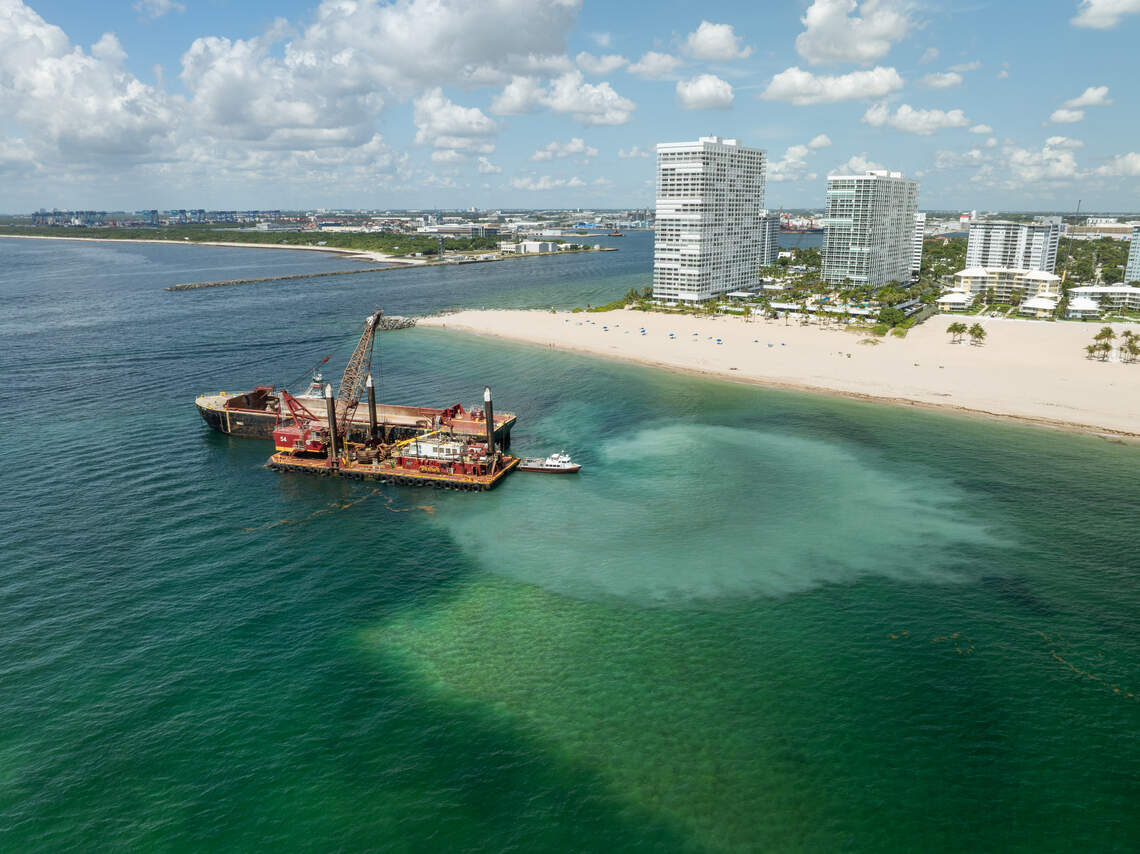
No more dredging is happening near Fort Lauderdale anytime soon.
The Army Corps of Engineers paused its Port Everglades Inlet Sand Bypass Project — designed to harvest sand to refill bare beaches in Broward — this week after the Corps realized it had likely damaged too many endangered corals.
The announcement comes less than a week after multiple environmental groups filed a lawsuit alleging that the project used outdated environmental information and did not take proper steps to protect nearby endangered corals and Queen Conchs. The suit was filed by Miami Waterkeeper, the Center for Biological Diversity, Earthjustice, Florida Wildlife Federation and the Diving Equipment and Marketing Association.
The Corps did not respond to a request for comment. In a statement to the Herald, Broward County Spokesman Greg Meyer said it’s aware of the pause and remains in conversation with the Corps.
The Army Corps acknowledged it had potentially harmed more staghorn corals than it was legally allowed to in an Aug. 7 letter to the National Marine Fisheries Service. In the letter, the Corps said it wanted to re-do the 2020 environmental assessment of the project. That could delay dredging activities until November at the earliest.
“There were lots of things missing from that biological opinion,” said Rachel Silverstein, CEO of Miami Waterkeeper. The nonprofit’s lawsuit pointed out that the original biological opinion, a National Oceanic and Atmospheric Administration-crafted document, did not include the fact that staghorn corals were declared “functionally extinct” late last year.
“Starting a mass dredging project right after a species is declared functionally extinct and not taking that into account is a pretty major oversight,” Silverstein said.

The dredging equipment in operation being used in the sand bypass project off the beach north of Port Everglades
She said that Port Everglades is one of the last places in Florida where staghorn corals naturally occur, instead of the artificial groves of planted corals preservationists are busy plopping all over the Keys. And, Port Everglades is one of the few documented places where the endangered Queen Conchs still breed.
The dredging project was a relatively small affair, compared to the project that cleared a way for larger ships in PortMiami — and killed 80 times more corals than the Corps was originally allowed to — or the even larger planned Port Everglades dredging project that was recently halted after similar pressure from the same environmental groups.
The sand bypass project was already well underway and had already temporarily paused since July to allow the remaining corals to spawn. This decision extends that pause.
“The project dredging sits at 94% complete. The county looks forward to the opportunity to complete permitted work as originally approved,” Meyer, the Broward spokesman, said.

An aerial view of sediment plumes from the Port Everglades Inlet Sand Bypass Project.
Dredging stirs up thick clouds of sand and mud, obscuring the water and potentially blanketing wildlife in a harmful layer of muck. Silverstein said NOAA flagged the amount of sediment spun up by the project as concerning back in April, but it wasn’t until the results of a July underwater survey that project managers realized that more corals were getting smothered than originally planned.
The project was initially approved to destroy 125 staghorn coral colonies in the 2020 biological opinion, an amount scientists at the time calculated would impact but not extinguish the nearby population.
Upon reviewing recent dive surveys, the Corps “concluded that the project may be approaching or have exceeded the incidental take limit for staghorn coral colonies.”
The environmental groups who filed the lawsuit Aug. 4 and asked for a stop to the project on Aug. 5 has claimed victory and said they’ll be watching to make sure any new environmental assessment includes the information they flagged.
“I hope the Army Corps’ decision to stop dredging for now is a good sign that the federal government is ready to take the conservation of Florida’s coral and queen conch seriously,” wrote Alex Muir, an associate attorney at the Center for Biological Diversity, in a statement. “We won’t stop our work until these threatened marine species and their habitat are given the protection they’re entitled to.”