
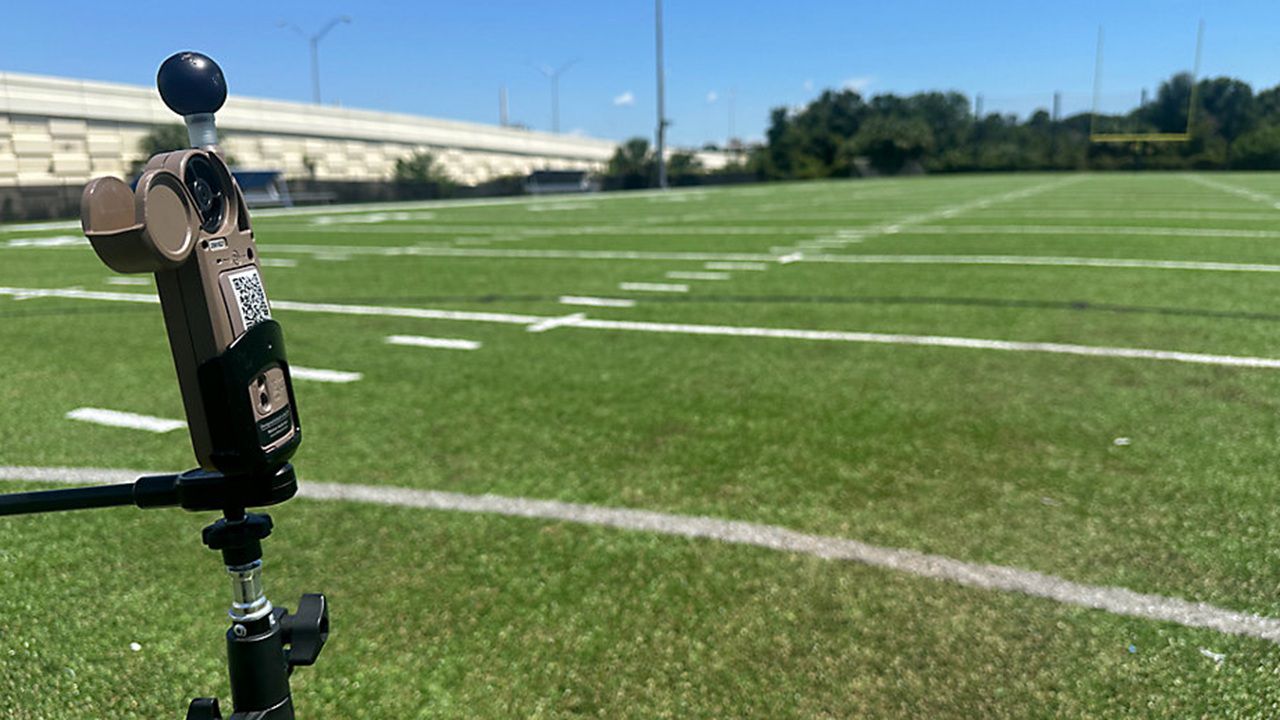
TAMPA, Fla. — Hillsborough County Parks and Recreation is using wet-bulb globe temperature meters at sports complexes to monitor heat conditions and help protect young athletes during practices and games.
The devices have been in use on county fields for about a year and a half, according to Mikah Collins, community relations coordinator for Hillsborough County Parks and Recreation. Staff members bring them out hourly when temperatures reach 85 degrees or warmer.
Collins said the meters measure conditions including wind speed, UV rays and humidity. He said they also calculate how much players are likely sweating to produce a reading that helps staff determine whether conditions are becoming unsafe.
“We hit 92.1, there is data-backed science that tells us that is a completely unsafe environment for heat stress,” Collins said. “What we do is we come out here, we engage with the coaches, we let them know, ‘Hey, we’ve reached that threshold. Unfortunately, we cannot be on the field right now.’”
A county spokesperson said other safety steps come before a field shutdown. When the devices reach certain readings, staff can require more and longer rest breaks and limit how much equipment players can wear.
“In the last two years, we’ve gotten very, very serious about it,” Collins said. “We saw an uptick in heat-related illness events at our sports complexes countywide, and really, when we saw that, we were like, ‘OK, we got to do something about this.’”
At Skyway Sports Complex, the home field for Cambridge Christian’s middle school football team, head coach Geoff Parsley said heat safety is a central part of practice. He said water breaks and time in the shade become as important as drills when temperatures climb.
“Extreme heat, extreme front of mind, right? It kind of goes hand in hand,” Parsley said. “Their safety is far and above winning games.”
Parsley said Cambridge Christian also uses the meters.
“You know, we’re kind of guessing if we didn’t have something like that,” Parsley said. “We’re looking at the weather, looking at how hot it is, checking field temp as much as we can. But this gives us a straight measurement with a guideline on what we can do, how often we can do it, and any precautions we need to take on the side.”
According to the U.S. Environmental Protection Agency, about 9,000 high school athletes are treated for heat-related illnesses every year.
Dr. Patrick Mularoni, a pediatric sports medicine physician at Johns Hopkins All Children’s Hospital, said athletes in Tampa Bay do come into the emergency center with heat-related illness.
“It might not necessarily be a heat stroke just from the heat, but they can present with other symptoms because of dehydration,” Mularoni said.
Mularoni said Florida’s humidity adds to the risk.
“So, kids are going to be sweating a lot more, and sweating, quite frankly, doesn’t work very well when the humidity is as high as it’s been,” Mularoni said. “So, we need to take frequent breaks, we need to provide shade.”
Mularoni said signs of heat-related illness include lethargy, fast breathing, lack of sweating and altered mental status. He said anyone showing those symptoms should get out of the heat as soon as possible.
A county spokesperson said a pilot program using the meters was successful, and Hillsborough County plans to expand the system to more fields.