
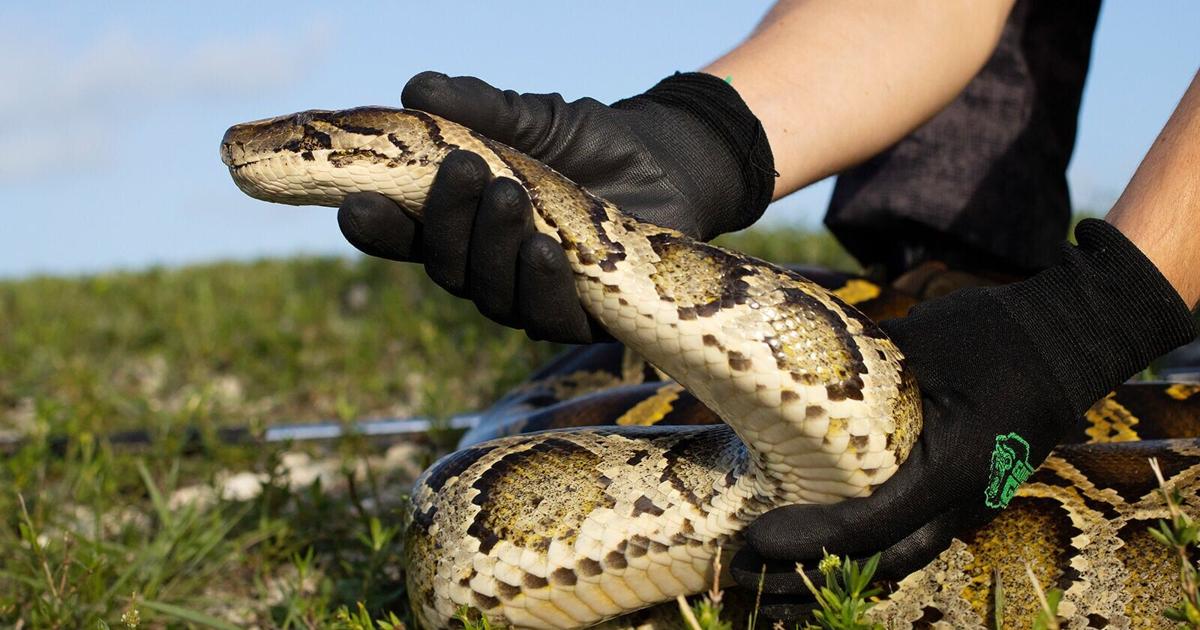
ROTONDA WEST — Experts say Burmese pythons are in Charlotte County.
But is it unclear if they’ve slithered north through the years from apparent displacement into the Everglades decades ago or if area pet owners released them into the Charlotte County woods when they became too big for a home.
They are not certain, but that is what wildlife officials believe — that the local population is not from migration.
Officials with the Florida Fish and Wildlife Commission told The Daily Sun the invasive reptiles have become “established” in western Charlotte County.
According to FWC officials, when a nonnative animal population becomes established, that means it is reproducing in the wild and is self-sustainable.
Burmese pythons, according to Lisa Thompson with the FWC, are established just south of Lake Okeechobee to Key Largo and from western Broward County west to Collier County.
“Pythons found outside of those areas are likely escaped or released captive animals,” Thompson stated.
She noted their establishment in western Charlotte County.
“FWC staff and volunteers, along with staff from partnering agencies, have been working to remove pythons in the Charlotte County area for several years and routinely monitor and survey for pythons in Charlotte and Lee Counties,” Thompson stated.
From the decade of 2015-2025, the agency received 63 “verified or credible reports” of the pythons, she stated.
Those have been mainly in the areas of Rotonda West, Placida, Englewood East and South Gulf Cove.
There was a spike in the latter half of that decade. In 2020, she said, FWC received an increase in python reports.
That forced FWC to increase surveys, locally.
Thompson said FWC encourages people to report pythons to 888-Ive-Got1, or 888-483-4681.
People can also get involved in volunteer surveys online at:
myfwc.com/get-involved/volunteer/contact/
Pythons, Thompson noted, are nonnative and are not protected in Florida apart from animal-cruelty laws.
They can be captured and humanely killed year-round without a permit or hunting license on 32 commission-managed lands in South Florida, with no bag limits, Thompson said.
In Rotonda West last year, resident Wade Gardner caught one of the large reptiles and reported it to FWC.
Gardner was able to catch a python that was 11 feet and 9 inches long with a 15-inch girth just four houses down from his Rotonda West residence.
After capturing the snake, he contacted FWC.
Gardner and two friends had a photo taken of them holding the captured python.
“I had to call the other two to come over because we bulls— each other so often, neither one of them would have ever believed me,” he stated. “(We’re just) three old guys that live off of making stupid pics with ChatGPT.”
FWC urges people wanting to get involved in the removal of Burmese pythons to have the knowledge and training to do so safely and humanely.
“I did what needed to be done, but I’m far from a snake hunter by any means,” Gardner said in a message. “It was a one-and-done experience for me.”
Every year, the state holds a contest against the pythons.
Participants in the 2026 Florida Python Challenge removed 280 invasive Burmese pythons from South Florida during the 10-day event in July, the Florida Fish and Wildlife Conservation Commission said.
Tom Rahill won a $10,000 ultimate grand prize after removing 96 pythons, all from Everglades National Park.
The competition drew 907 participants from 30 states and from Canada and Vietnam. Everglades National Park returned this year as one of eight official competition locations. The longest python taken in the event measured 16 feet, 5 inches and was removed by Rahm Levinson in the park.
Burmese pythons prey on native species while reproducing quickly. A female can lay 50 to 100 eggs at a time.
Since 2000, nearly 28,000 wild Burmese pythons have been removed from Florida and reported to the FWC.
To learn more about invasive Burmese pythons visit: myfwc.com/wildlifehabitats/nonnatives/python/