
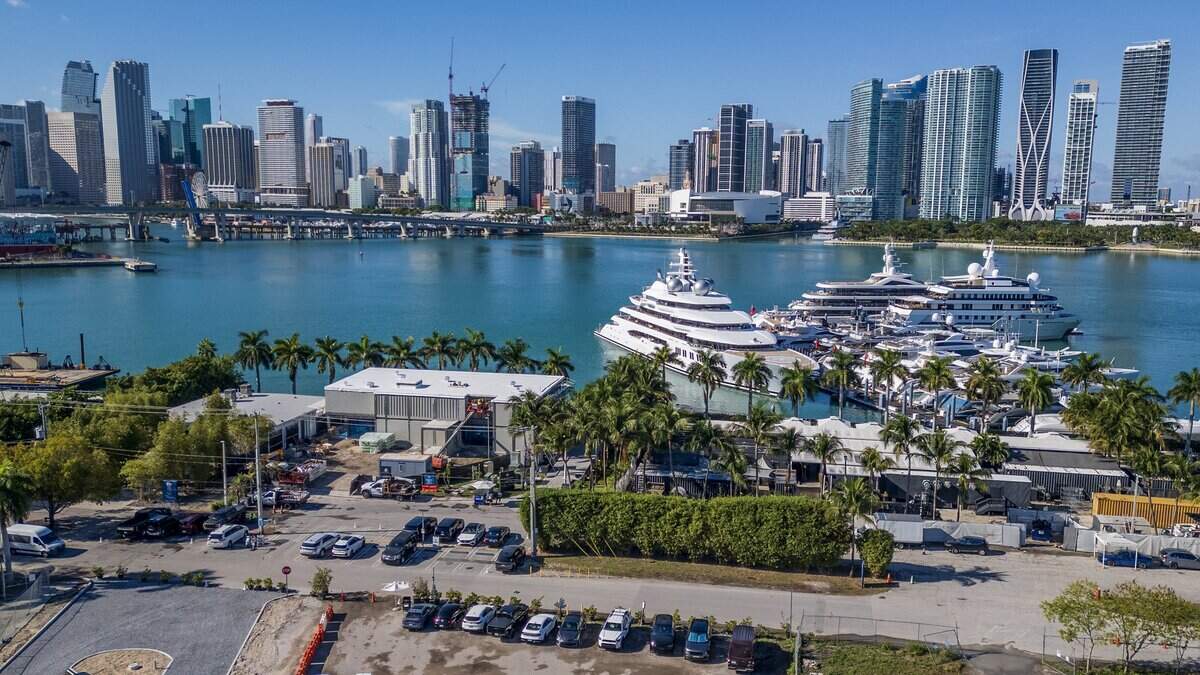
Yachts dock on Biscayne Bay at a marina on Watson Island.
Pedro Portal
pportal@miamiherald.com
In the 1980s, Boston Harbor was a national disgrace. Sewage from 43 communities poured into the water, fouling beaches, fueling algae blooms and fish kills that festered in the summer heat.
Today, Boston Harbor is home to the cleanest urban beaches in the nation. Flounder and striped bass have returned. Herring runs are thriving. Clam beds have reopened. Public beaches once written off as polluted are now civic assets. The recovery drove billions of dollars in investment to Boston’s waterfront neighborhoods and coastal communities.
That transformation happened because citizens organized, nonprofits advocated, lawyers litigated, courts compelled action and government ultimately invested more than $4 billion in modern wastewater infrastructure.
Philanthropy did not pay for the Boston Harbor cleanup. It supported the advocacy, research, coalition-building and public engagement that connected community outrage to legal strategy and political action.
Today, Biscayne Bay is flashing the same warning signs as Boston Harbor in the 1980s.
According to Miami-Dade County’s 2026 Biscayne Bay Report Card, fish kills, algae blooms, sewage discharges, septic failures, stormwater runoff and warming waters continue to take their toll on Biscayne Bay. Scientists and civic leaders warn that meaningful restoration requires large-scale infrastructure investment — not symbolic gestures, ribbon cuttings or one-off projects.
Miami knows what’s at stake. Biscayne Bay is the “blue heart” of Miami-Dade, central to the region’s identity, economy, ecology and quality of life. It supports tourism, recreation, property values, marine life and the sense of place that makes South Florida distinct.
But the Boston Harbor playbook is not enough to save Biscayne Bay.
Today, Biscayne Bay faces a harder landscape: federal and state governments hesitate, courts are less likely to compel action and local governments lack the billions of dollars required to do the job.
At the same time, private wealth has flocked to our shores, attracted by Florida’s business-friendly tax policies and our stunningly beautiful natural surroundings.
Miami-Dade is now home to extraordinary fortunes: technology company founders, hedge fund managers, finance leaders, real estate investors and entrepreneurs who have chosen to live along Biscayne Bay. The question is not whether the money exists. The question is whether Miami has the will and the civic machinery to connect private wealth to public solutions at the necessary scale.
Without coordination, even generous philanthropy fragments into legacy projects, pilot programs and well-intentioned grants — laudable efforts, but not enough to repair regional systems.
Boston highlights an important lesson. Philanthropy was most powerful when it helped create the conditions that compelled government to act. Foundations sustained advocates, supported research, convened partners and kept attention focused when political will drifted.
That’s what Miami needs now. Restoring Biscayne Bay requires strong intermediaries capable of convening major donors, vetting scientific plans, aligning nonprofits, working with local governments and deploying capital strategically.
Miami has institutions with the credibility and relationships to do this, including the Knight Foundation and The Miami Foundation. Now is the time for them to step up.
Imagine a pooled regional resilience and restoration initiative — funded by nine-figure commitments from the billionaires who live along the bay, accountable to the public, coordinated with county and local governments and designed by top scientists and engineers.
Imagine if Jeff Bezos, Ken Griffin, David Martin, Jared Kushner, Ivanka Trump and other wealthy residents treated Biscayne Bay not as a backdrop, but as the defining civic project of this time and place.
This is not about billionaires acting alone. No single donor can design and execute a regional environmental recovery. We need disciplined, collective philanthropic leadership that strengthens public action instead of replacing it.
Government action still matters. But in today’s political climate, philanthropy must mobilize capital in strategic, coordinated ways capable of driving systemic civic transformation.
The money is here. The technical expertise is here. The need is undeniable. The question is whether South Florida’s wealthiest residents can be organized to restore and protect Biscayne Bay — or will they watch from their waterfront vistas as the fish die and the life drains from the water.
Paul S. Grogan is president and CEO emeritus of The Boston Foundation and a former trustee of the John S. and James L. Knight Foundation. E. Bruce Berman, Jr. is director of strategy and communications emeritus for Save the Harbor/Save the Bay. He divides his time between Boston and Miami and leads the Miami Beach Cupid Splash, an annual fundraiser to help jump‑start restoration efforts for Biscayne Bay.