
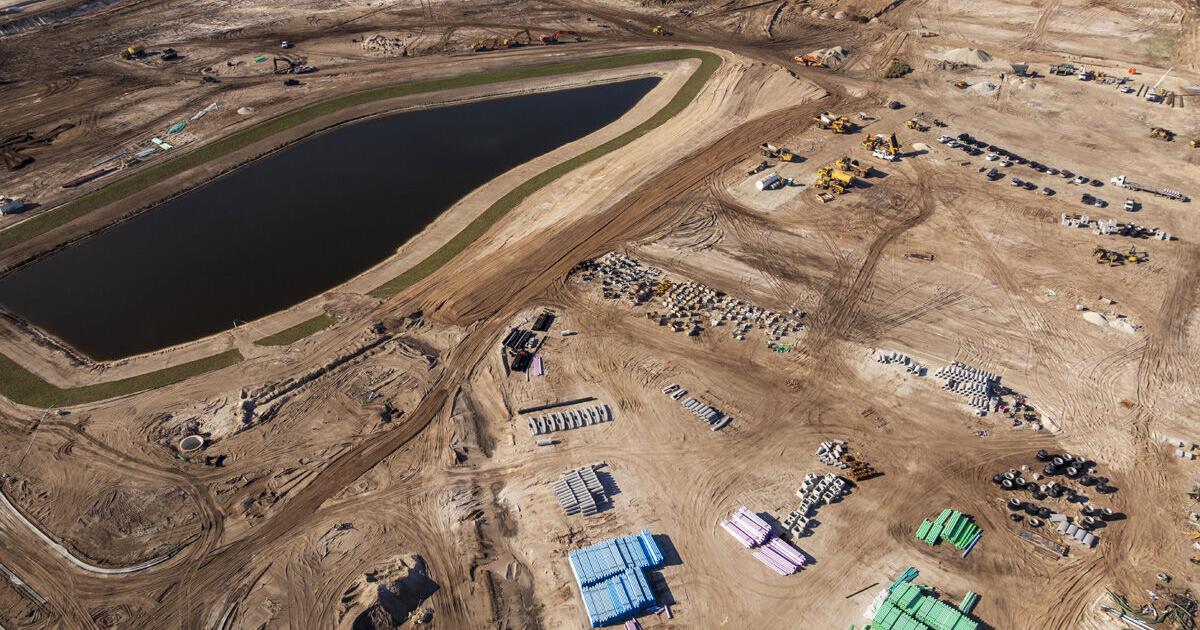


Crews install infrastructure and prepare building sites at the Kingston development, a planned community near Corkscrew Swamp Sanctuary.
Brian Tietz
National Audubon Society and Cameratta Companies reached an agreement settling a federal lawsuit two months before the first model homes open at Kingston, a master-planned, 10,000-home community in eastern Lee County that lies just north of Corkscrew Swamp Sanctuary in Collier County.
Cameratta Companies, developer of Kingston through its subsidiary Cam7-Sub LLC, agreed to purchase about 98 acres off Carter Road, just southwest of the southern edge of Kingston.
That land, owned by Corkscrew Tree LLC, is used to grow sabal palms, according to the Bonita Springs-based landscape design company’s website. The property is under contract and expected to close within the next two months, said Chené Thompson, an attorney with Pavese Law Firm representing Cameratta Companies. The purchase price has not been disclosed. Landowner Steven Bishop declined to comment until the transaction closes.
No taxpayer dollars will be used to purchase the land. Instead, those costs will be absorbed by Kingston homeowners when they purchase homes.
Cameratta Companies also pledged in the settlement agreement to relinquish its 100-foot easement, inherited from the previous landowners, that would have allowed it to build a road through Corkscrew Swamp Sanctuary, creating an eastern connection between Lee and Collier counties.
Unrelated to the settlement, Cameratta Companies plans to buy about 39.5 acres owned by Okeecrops LLC. Thompson said she could not divulge whether that land would be developed or preserved. It lies between Corkscrew Tree LLC’s land and Kingston.
The Army Corps of Engineers issued a permit to Cameratta in April 2025. Audubon sued the Army Corps in August 2025. A federal judge denied Audubon’s emergency injunction in January 2026. By then, the model homes already were under construction.
Lennar, Neal Communities, Pulte and Taylor Morrison are the homebuilders developing in the early phases of Kingston.

Officials and developers participate in a groundbreaking ceremony Nov. 13, 2025, for the Kingston project, which is planned to include thousands of homes in Lee County.
Cameratta Companies
In filing the lawsuit, Audubon noted the U.S. Fish and Wildlife Service’s analysis that Kingston’s eventual estimated 24,400 residents would bring 95,200 additional traffic trips to Corkscrew Road — and result in the deaths of three to 22 panthers per year.
There are an estimated 120 to 230 adult and subadult panthers, according to the U.S. Fish and Wildlife Service.
Joe Cameratta, founder of Cameratta Companies, and Julie Wraithmell, vice president of Audubon Florida, jointly signed an Aug. 13 news release announcing the resolution of the litigation. They each declined to comment. Cameratta deferred to his attorney.
“We are just very appreciative of being able to work with Audubon,” Thompson said. “We’re very appreciative of being able to reach a resolution that will be super helpful for both sides. We built Verdana Village and have historically had a good relationship with Audubon. We were fortunate to be able to sit across the table from them.”
Ray Blacksmith, president of Cameratta Companies, said the settlement was 54 weeks in the making.
“Both parties achieved what they were looking for,” Blacksmith said. “Corkscrew Swamp Sanctuary has always been a plus for Collier County and for Lee County. This worked out well for Audubon. It worked out well for us.”
But the settlement — and Kingston as a whole — will not work out well for the future of the Florida panther, said Matthew Schwartz, executive director of South Florida Wildlands Association. He founded the organization in 2010 with a mission of “protecting the beauty, biodiversity and ecological integrity of the Greater Everglades — one of the most unique and imperiled ecosystems on Earth.”
Even though Kingston will preserve between 3,500 and 3,800 acres of the 6,700-acre community, the wide-open spaces favored by the Florida panther will be gone, Schwartz said.

Joe Cameratta, founder of Cameratta Cos., speaks at the Kingston groundbreaking in southeast Lee County, where work has begun on an 10,000-home master-planned community.
Cameratta Cos.
A male panther typically roams across about 200 square miles, Schwartz said. The amount of land to be preserved in Audubon and Cameratta’s settlement agreement measures about 0.15 square miles. Kingston in its entirety comprises about 10.5 square miles.
“My gut reaction to the settlement is disappointment,” Schwartz said. His organization, along with the Center for Biological Diversity and Sierra Club, filed a lawsuit in April against the U.S. Fish and Wildlife Service, Department of the Interior and Army Corps of Engineers over the Town of Big Cypress in eastern Collier County, a master-planned community of 9,682 homes spread across 12,000 acres that’s also considered prime panther habitat.
“All of these projects are going into the primary and secondary habitat of the panther,” Schwartz said. “And there’s no amount of science that says a panther can survive this kind of loss. Roadkill is already the No. 1 cause of death of the Florida panther. It’s all primary and secondary habitat in and of itself. It’s a huge loss for this project to go through. The settlement I would have loved to have seen is a judge saying, ‘No. That’s a step too far.’ That’s the settlement I’m hoping to see with the Town of Big Cypress. You can’t just keep developing until the panther is extinct. The problem with the settlements is we never get to hear a judge’s rationale. We’re not going to settle. This is going to court.”