
A national debate over the risks of Flock Safety license plate cameras played out locally this week.
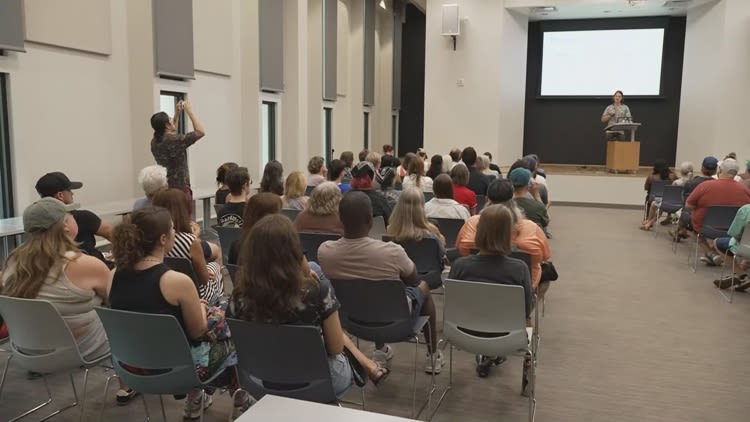
Frustrated residents packed a “DeFlock St. Pete” event as police departments and the technology company continue to defend the cameras as essential crime-fighting tools.
St. Petersburg has installed 50 Flock cameras throughout the city. Police say the system identifies suspected vehicles, not drivers, recording details such as license plate numbers, makes and models. That includes the arrest of Jeremy Mason last month, who was accused of kidnapping his girlfriend and heading through five different counties before a Flock camera spotted his license plate in Polk County.
Yet, some residents worry the technology could be misused.
Daisy Quinn, a Kenneth City resident who has lived in the St. Petersburg area for more than 20 years, attended Saturday’s meeting and said keeping the city “peaceful” matters deeply to her.
“You want to keep your kids, their future kids and any of their friends safe. It’s not turning out that way,” Quinn said.
She raised concerns about surveillance overreach.
“We’ve seen it in other countries. We’ve seen what’s going on. We hear what’s going on. We shouldn’t have spies, people just sitting at desks watching people all day long,” Quinn said.
Those concerns come as the Sarasota Police Department announced Thursday that one of its officers had been placed on paid administrative leave for allegedly misusing “law enforcement-only search databases.” The department has since launched an agency-wide audit into its Flock camera use.
The same day of the Sarasota announcement, Flock Safety CEO and founder Garrett Langley said the company is reducing its default data retention period from 30 days to seven, according to CBS News. Data tied to an active investigation can be preserved longer through a setting called “evidence mode,” CBS News reported.
“No one should use Flock without criminal intent. That is explicit in our contracts, with our customers and in many states, there is an attestation as soon as you log in to a state like California this technology can not be used for immigration enforcement and it can not be used for non-criminal offenses,” Langley said.
CBS News also reported that by the end of the year, all of Flock’s law enforcement customers will be required to activate a tool that flags abnormal search behavior and locks out users until the searches are reviewed by an administrator. Flock said about a third of its contracted agencies have already enabled the tool since its rollout earlier this year.
St. Petersburg Police Chief Anthony Holloway said in a recent statement that the department does not use the cameras to monitor people’s daily activities or track their movements “without a legitimate law enforcement purpose.”
Some residents said the controversy was compounded by logistical frustrations at Saturday’s event, where not everyone who RSVP’d was able to get inside.
“It’s a community. This is St. Pete. We’re supposed to be one,” Quinn said. “We don’t want any spies. We don’t want any wrong doing. Everybody protects each other. That’s the whole point of this city. We shouldn’t have these cameras here. If you were performing a meeting like this and you have people that RSVP’d to this and can’t even get in because they let those other people in first, it’s a little ridiculous.”
10 Tampa Bay News reached out to St. Petersburg police asking for comment about Saturday’s “DeFlock” event turnout or attending future events, but as of this report, the department has not provided a response.
Some of the attendees said they will continue to come to events like Saturday’s as long as it takes to make their voices heard or they see change.