
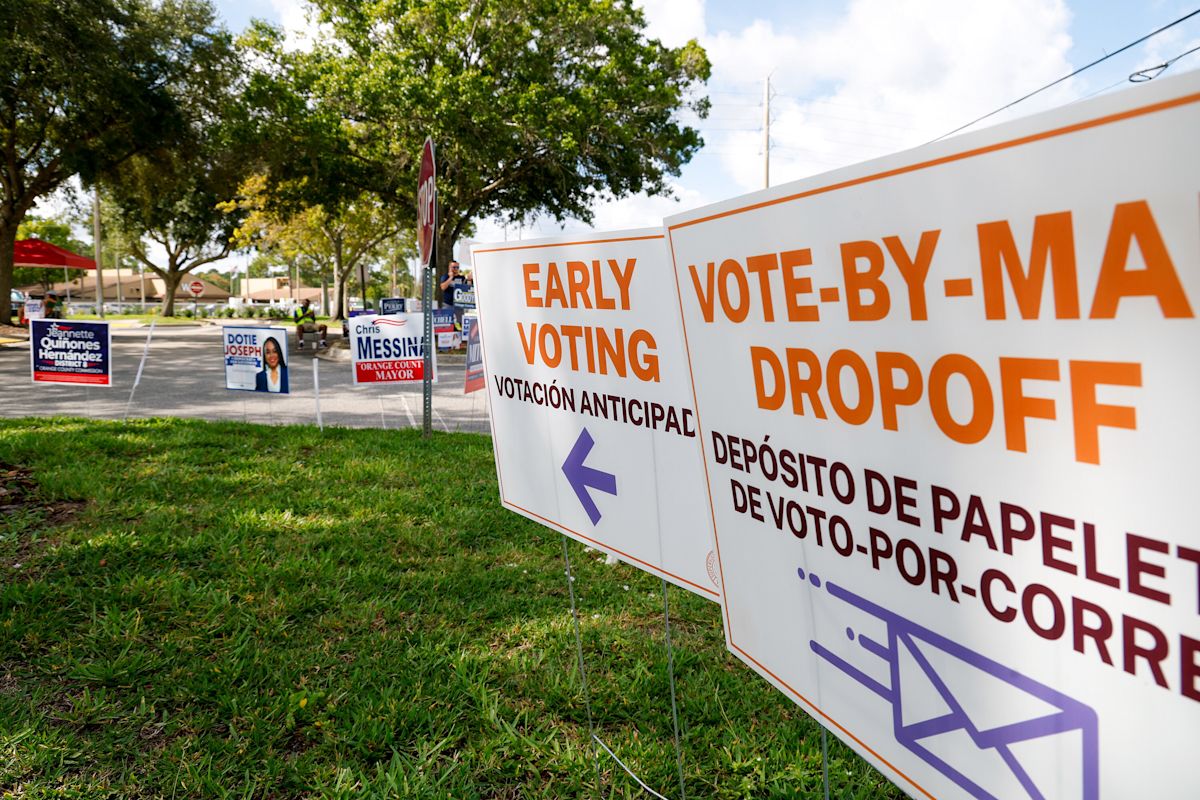
More than 60% of Orange County’s 806,000 voters will be shut out of Tuesday’s primary for the clerk of courts race due to a technicality in Florida’s election law.
Because no Republican candidate qualified for that Orange race, but a write-in candidate did, only registered Democrats — about 312,000 people — will get to vote in the primary for one of the two Democrats who qualified. If there had been no write-in, the Democratic primary would have been opened to all.
In other words, nearly half a million voters, Republicans and independents, won’t get to participate in the race that should determine the county’s next clerk of courts, as Tuesday’s winner will face an unknown write-in candidate in November, one with little money and no party affiliation to back his candidacy.
“It’s outrageous,” said John Opdycke, president of Open Primaries, one of several groups that have spent years trying to make primaries more open around the country.
Florida’s write-in loophole is just one example of the ways election laws can block — or conversely, encourage — wider participation in party primaries. Some states allow no-party-affiliation voters to pick which party primary they want to vote in. Others, like California, have ditched the notion of each party picking its own general election contender altogether, letting every primary participant vote for whomever they want.
“If you want to find a systematic way to restrict voter participation, there is nothing better than a closed primary,” said Opdycke, whose group hopes not simply to eliminate the write-in loophole in Florida but also broaden opportunities for those who register NPA.
For example, he said, New York’s closed primary in June had a 9% turnout compared to California’s open, top-two primary last month that had a 41% turnout.
“It’s transformational,” he said of California’s system approved by voters in 2010. “It went from being the least competitive state to the most competitive.”
Florida’s closed primary system is shutting out 3.3 million independent voters, said Vilia Johnson of the League of Women Voters of Sarasota County.
“We support systems that encourage participation and fair representation. Florida’s closed system fails on this foundation,” Johnson said. “Every eligible voter should have freedom to vote for any candidate, regardless of party, in any taxpayer-funded election.”
Both the Democratic and Republican parties in Florida, however, have historically opposed open primaries, saying that only voters registered with their party should be allowed to pick their party’s candidates. The American Civil Liberties Union and League of Women voters also raised concerns that an open system would dilute Black representation.
Sid Bastian, 35, an Orlando Democrat, said his advice to no-party voters would be to reconsider registering. “At the end of the day, pick a party that you feel comfortable with and see if you can get the right candidates,” he said.
Steve Hough, who belongs to Veterans for all Voters and is a member of Florida Open Primaries, said he’s done that, just “to have a say in who represents me.”
But people shouldn’t have to join one party or the other just to exercise their fundamental right to vote, Hough said, especially when the two major parties are using state resources to conduct private primaries for their own candidates.
In 1998, Florida voters approved a constitutional amendment creating a so-called universal primary — one that would allow all voters of all stripes to participate in a primary, but only if the sole candidates who qualified were of the same party and faced no opposition in the general election.
In Florida House District 47, for example, where incumbent Rep. Paula Stark of St. Cloud failed to qualify because of a paperwork problem, only two Democrats filed to run. Tuesday, all voters regardless of party affiliation will get to vote.
But Florida’s 1998 law contained one loophole. The primary is closed if there’s a write-in candidate to force a “competitive” general election.
Both parties have exploited that loophole, advocates believe, by putting up write-in candidates to restrict primaries to only their own voters. Ondycke’s organization found 114 instances between 1998 and 2022 where write-in candidates closed an open primary in Florida.The write-in loophole shut Republicans out of 47 of those races and Democrats out of 67 during that same period.
A total of 8 million voters — 1.3 million Republicans, 3.2 million Democrats and 3.7 million independents — were disenfranchised by the write-in loophole, the report said.
The report noted that all but a handful of the write-in candidates studied raised no money for their campaigns, and had no staff, listing themselves as their own campaign treasurer, for example. And more than a dozen filed from outside the district they were running in.
This year, the primary for state Rep. Angie Nixon’s District 13 seat, which she resigned from to run for the U.S. Senate, would be open if not for a write-in candidate who has raised no money. The two Democrats, former state senator Audrey Gibson and Leslie Jean-Bart, are vying to face write-in candidate Brice Gaillard in November.
Groups have been trying for more than a decade to either eliminate the write-in loophole or create a nonpartisan system. Efforts failed in 2016 and 2018 to get an amendment on the ballot but succeeded in 2020. That year, the measure received 57% of the vote – just shy of the 60% required to pass.
It cost $8.5 million to put that on the ballot, something they cannot do without a wealthy benefactor like they had in 2020, Opdycke said.
Civil rights groups opposed the open primaries referendum, saying it would dilute the voting power of minority residents.
But current data shows that minority candidates are winning office more often under systems that embrace electoral reforms like ranked-choice voting and opening the primaries, said Ramon Perez, Executive Director of the Digital Democracy Project.
The data also shows an increasing number of minorities are abandoning the Republican and Democratic parties. Hispanics are two to three times more likely to be registered as independents, he said. Blacks under 40, especially men, are about half as likely to register as Democrats as they were 20 years ago. And Asians are about eight times as likely to register as independents as their caucasian neighbors, he said.
“And so we have actually made the case that despite what people in the party will argue, indies are not overwhelmingly white conservative men who don’t want to register as Republican, which is often what is bandied about,” Perez said.
John Marvin, state coordinator for Florida Open Primaries, said an online survey of 600 Democrats and independents showed greater than 90% think Florida should adopt a more open primary system.
A shifting political landscape might make Democrats more amenable to change, Perez said. Prior to the pandemic, they held a 500,000 voter registration advantage over Republicans. But in 2026, Republicans have a 1.5 million advantage over Democrats.
“We’ve engaged with the Republican leadership but of course but that’s been a nonstarter because when you’re the party in power you don’t want to change,” Perez said.
Advocates are also pushing lawmakers to sponsor legislation to make changes, but they acknowledge it won’t be easy.
“The parties and their consultants, they don’t like independent voters,” Opdycke said. “They’re messy, they’re hard to market to, they don’t listen to your dog whistles, and consultants and candidates would much rather campaign to people that are in lockstep and so we have to push back against that culture.”
_____
(Sara-James Ranta of the Sentinel staff contributed to this story.)
_____