
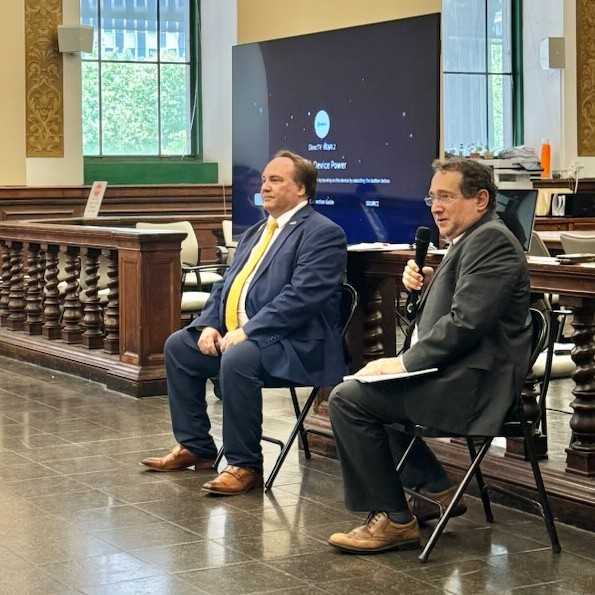
In collaboration with Administrative Judge Suzanne Adams and Justice James d’Auguste, the internship program has expanded in recent years. More than 400 high school, undergrad and law school students participated this summer and observed court proceedings, visited appellate courts, and assisted with legal research and drafting.
Interns are overseen by the judges for whom they work during the summer. As part of the program, the judges may choose their own interns, while others may prefer to have them assigned from a pool of resumes Justice Adams receives regularly.
The interns also participated in periodic “Lunch and Learn” sessions, featuring judges, lawyers and other professionals. The programs, curated by Kawtar Merfouk and Larisa Blinderman, provide opportunities to learn, network, and hear firsthand accounts about public service.
A wide variety of guest speakers participate in the Lunch and Learn series, including former Presiding Justice of the Appellate Division, First Department, Rolando Acosta, to Deputy Chief Administrative Judge for the Office of Justice Initiatives Edwina Richardson, a vast number of judges from New York and other counties, as well as lawyers from around the country coming to speak on a myriad of topics, including commercial litigation or transaction law, as well as aviation, insurance, criminal, family and entertainment law, as some of the topics interns have expressed their interests lay.
The following piece was authored by Giovanny Esguerra, Annabel Greenberg and Dimitri Morales.
Don Orlando’s journey into law
By Giovanny Esguerra, Annabel Greenberg, and Dimitri Morales
Don Orlando’s path into the world of insurance law and RICO investigations was unorthodox. Before starting his career in the insurance field, and eventually becoming the Director of Litigation at the Tradesmen insurance agency, he drove trucks cross-country. Mr. Orlando explains how these experiences, coupled with his Italian-American upbringing, created the work ethic and opportunistic mentality he has now.
Mr. Orlando is an incredibly accomplished and fulfilled individual. That much was clear when he strode into the Ceremonial Courtroom at 60 Centre Street to impart his wisdom to a group of judicial interns. Many of these students’ days have been riddled with wry warnings from attorneys telling us not to go to law school – it’s a place of hopelessness that sucks you into a life of monotony.
Mr. Orlando doesn’t think that way. He approaches each day with renewed enthusiasm and vigor. Age and experience have not tempered his love for his job. He is able to go to work each day knowing that he is able to make a difference in people’s lives, exposing corruption and exploitation. Mr. Orlando loves this sense of purpose, and he loves what he does – an outlook that has shaped his successful career. Mr. Orlando told the interns to always believe in themselves. Being successful starts with being grateful for what you have and working from there.
However, rather than focusing solely on fraudulent claims, Mr. Orlando spoke to his listeners with great concern about the human consequences of his work and the lives at stake in every case. He explained how organized fraud schemes frequently target undocumented immigrants, coercing them into unnecessary medical procedures and exploiting them in elaborate insurance scams. Doctors, at an equally “shady” attorney’s suggestion, will perform unnecessary surgeries on unwitting patients, damaging their spines for life with painful implants. Through Mr. Orlando’s work with agencies like the FBI and DHS, Tradesman has closed more than $2.5 billion in fraudulent cases, stopping dozens of medical professionals from fraudulently treating patients through the removal of their medical licenses. Mr. Orlando actively shows that insurance litigation can serve a broader purpose, reminding us that the legal profession offers opportunities to advocate for those who cannot always advocate for themselves.
Finally, Mr. Orlando warned that success should be approached with caution. Working to prosecute corrupt professionals has shown him another side to achieving supposed success – that of corruption and exploitation. Mr. Orlando cannot tolerate this and has made it his mission over the last several years to eliminate this corruption from our judicial system. He emphasized the importance of ethics, reminding us that no matter the temptations that cross our path, we need to remember why we are (aspiring) lawyers: to serve others.