
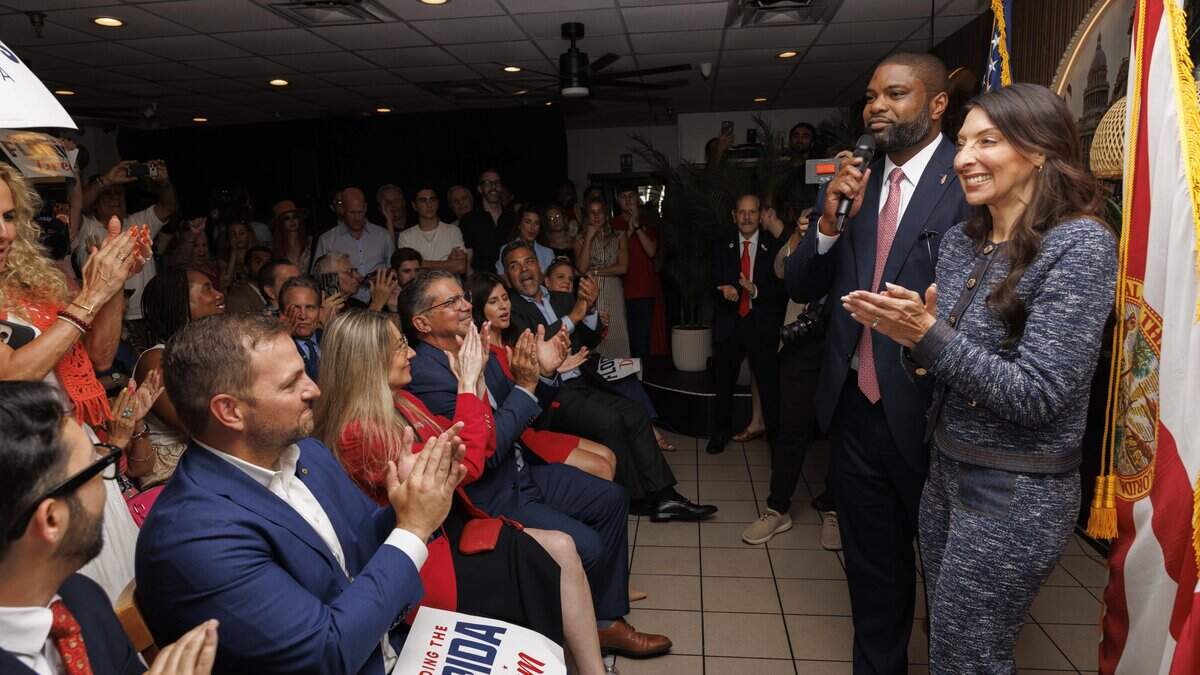
U.S. Rep. Byron Donalds, running for the Republican nomination for Florida governor, center, speaks while people clap including his wife, Erika, right, during a campaign event on Monday, Aug. 17, 2026, at El Tropico restaurant in Sunny Isles Beach, Fla.
Alie Skowronski
askowronski@miamiherald.com
With Florida Republicans set to head to the polls Tuesday to determine who will carry the GOP gubernatorial ticket into November, the front-runner, U.S. Rep. Byron Donalds, stopped at a Sunny Isles Beach restaurant for one last appeal to voters, promising South Floridians that, with him, they will have a “friend in the governor’s mansion.”
Donalds, who is backed by President Donald Trump, held a get-out-the-vote rally Monday evening at El Tropico Cuban Cuisine, where he reminded the crowd of his journey from growing up in Brooklyn to finding his footing in Florida. He spoke on a range of issues, from reducing insurance costs to housing affordability and traffic.
“When you go to the polls tomorrow, understand that the person you’re voting for, somebody who loves this state,” he said to the thundering sounds of applause. “I love this state like I love my wife and I love my kids.”
The restaurant vibrated with excitement as more than 60 supporters cheered and hugged while Donalds appealed to the Cuban immigrant community, saying that a “free Cuba will have a friend here in Florida” when he’s elected.
But he did not have to convince that many. In a show of hands, some in attendance had already voted for him and just wanted the opportunity to meet the man they saw on television and social media.
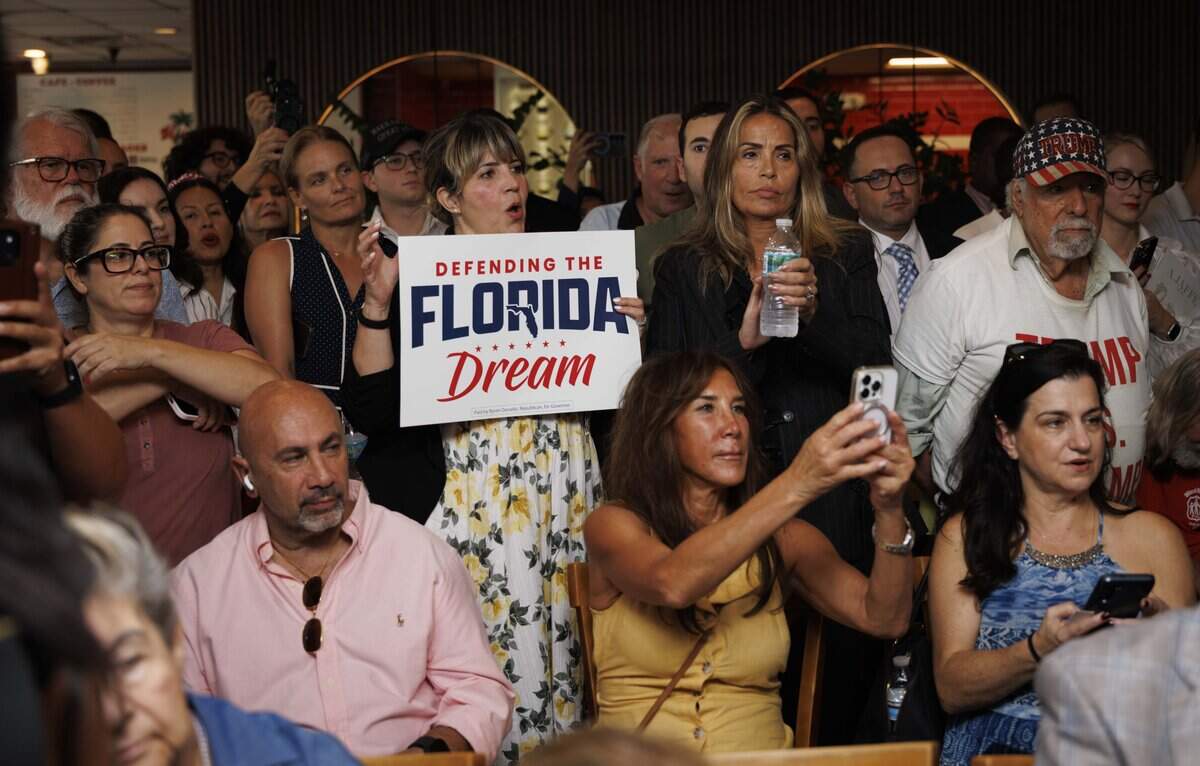 Antedates listen during a campaign event for U.S. Rep. Byron Donalds, running for the Republican nomination for Florida governor, on Monday, Aug. 17, 2026, at El Tropico restaurant in Sunny Isles Beach, Fla. Alie Skowronski askowronski@miamiherald.com
Among them was 66-year-old North Miami Beach resident Roberto Elovic, who said he had already voted for Donalds and knew his policies but wanted to see the candidate in person.
Elovic, who immigrated to the United States from Venezuela in 2003, said this was part of his civic process: listening, evaluating each of the GOP candidates, and finding that Donalds “was the better option” for the state.
‘What I see is that he’s a family man. He’s a trustworthy man,” he said.
Miriam Alam, a 68-year-old Aventura resident, agreed. She said she had first seen Donalds on television almost three years ago and immediately thought, “I like this guy. He’s gonna go far.”
Alam said she likes voting in person and plans to vote for Donalds tomorrow because “he’s ready to fight” against Democrats.
Though the rally centered on tomorrow’s primary elections, Donalds was already campaigning for the November election. He described himself as best suited to defeat the gubernatorial Democratic frontrunner, David Jolly,
“Let’s win tomorrow night. Go vote, and in 79 days, let’s beat Florida red,” he said.
A Miami-Dade voter push
Donalds is not the only Republican candidate appealing to Miami-Dade voters. Over the past month, Miami-Dade has been a hot spot for GOP gubernatorial candidates hoping to secure the votes of predominantly Hispanic immigrant communities.
Far-right candidate James Fishback spent Sunday hopping throughout Miami-Dade County on his sprint across the state, making hourly campaign stops in the final days of his campaign.
Earlier this month, Jay Collins and Paul Renner also campaigned in Miami, pitching themselves to voters as the better option over Donalds for a general election matchup against Jolly.
Collins and Renner specifically targeted Cuban-majority areas. Collins held a Tuesday morning breakfast in early August at Versailles Cuban restaurant in Little Havana, where he told his life story and took questions from audience members for nearly an hour.
He addressed a wide range of issues, including denouncing socialism, emphasizing how education should better meet the needs of autistic students and sharing worry “about people who want to make Venezuela a state.”
“He is a pure anti-communist and is a pure man,” said Andrés R. Rodriguez, a supporter and Cuban biologist touting books he’d written about Marxism at the event.
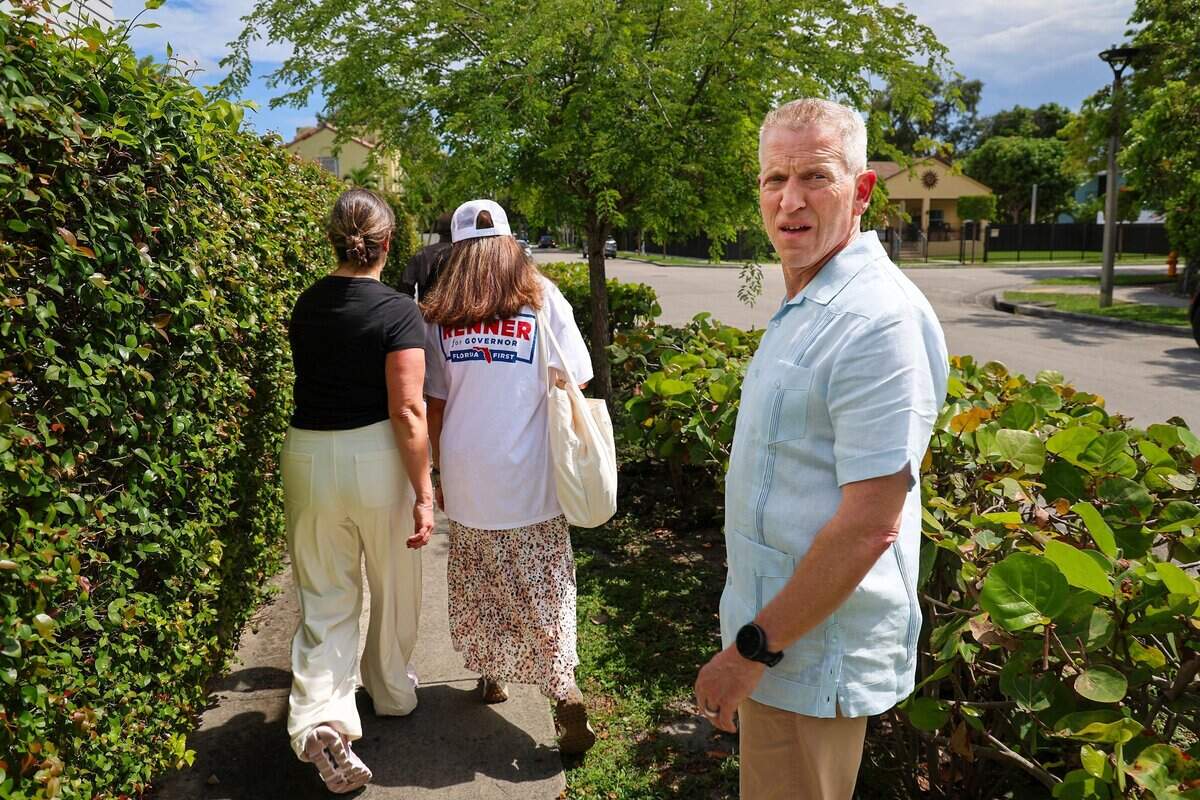 Republican gubernatorial candidate Paul Renner, right, glances back to get his bearings while campaigning in Miami’s Little Havana on Tuesday, August 4, 2026. Carl Juste cjuste@miamiherald.com
A few blocks away that afternoon, Renner made an ill-fated attempt at door knocking in Little Havana. He had a volunteer cameraman and a couple of reporters snap his photo near people huddled around the tables in Domino Park, but didn’t introduce himself or pitch his campaign to those playing.
He knocked on two doors but no one answered. Then a small team of campaign employees, Renner’s wife and two loyal Renner supporters tagging along, called it a day and headed to Versailles to eat.
Rommel Lopez, a paid field organizer for Paul Renner, said he’s backing Renner personally as well because he sees him as the best candidate to reach the wide scope of Hispanic and Latino communities in Florida. Renner lived in Venezuela in the 90s and speaks Spanish.
“He understands the Latino community, he understands the Hispanic community. I’m not saying you have to be Latino to understand the community, but you have to share time,” Lopez said.
But he sees an uphill battle for Republicans this election cycle: “Hispanic Republicans, we are at odds. I personally think it’s going to be a tough cycle for us. I hope that we win, I’m praying that we win, I think we’re going to win. But it’s gonna be a little bit rough for us,” he said.
“Immigration is a big issue,” he added. “The way that immigration is being handled, I think that it could be different ways that we can handle more humanely.”
Miami Herald
Churchill Ndonwie is an Esserman Investigative Fellow at The Miami Herald. Before this role, he was an Ida B. Wells investigative intern with the New York Times, where he examined the hidden pipeline of undocumented workers into U.S. factories and the victimization those individuals experienced. He was also a Global Migrations Fellow at Columbia Journalism Investigations, where he worked with Reuters to investigate and reveal the smuggling routes through commercial and charter airlines used to facilitate illegal immigration to the U.S. Southern border from India and West Africa.