
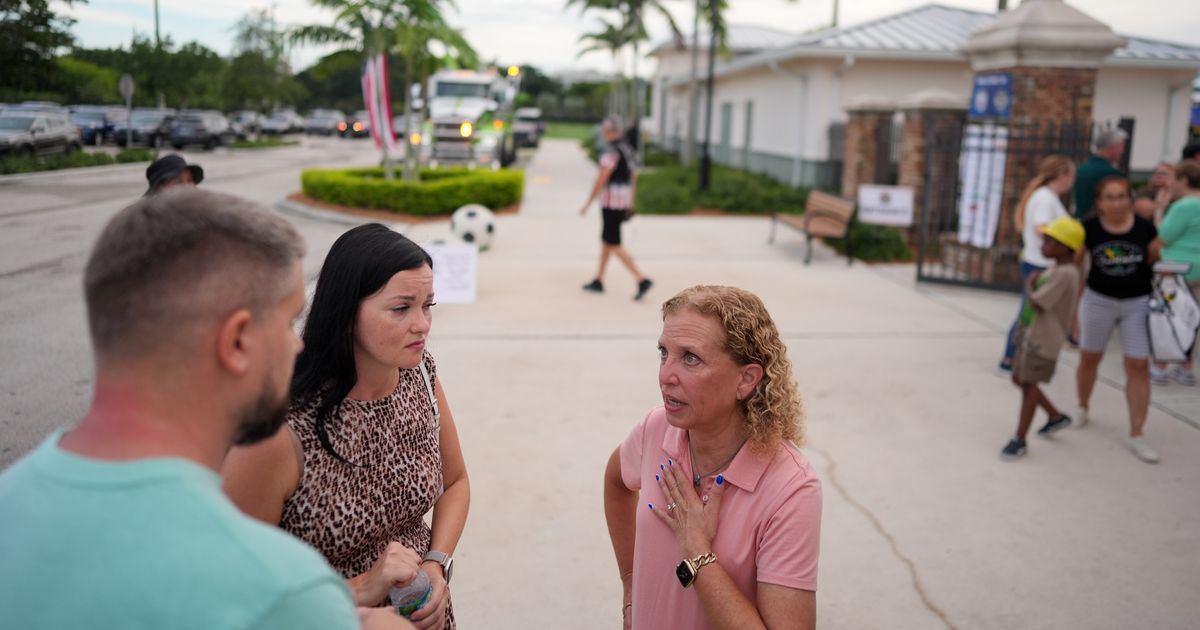
Debbie Wasserman Schultz is a controversy magnet once again.
Photo: Rebecca Blackwell/AP Photo
To an even greater extent than its midwestern counterpart Ohio, Florida is a state that has rapidly transformed itself from a blue-leaning battleground state into a reliably, even fanatically Republican state. After being carried twice by Barack Obama in 2008 and 2012, and then twice quite narrowly by Donald Trump in 2016 and 2024, something clearly happened in the Sunshine State to realign it dramatically with Trump’s winning margin in 2024 ballooning to 13 percent. The same thing happened at the sub-presidential level. Ron DeSantis won by an eyelash in 2018, then by a 19-point landslide in 2022. Republican senators Marco Rubio and Rick Scott both won big in their last reelection bids (in 2024 and 2022, respectively) after tougher earlier outings.
Under DeSantis’s direction and with Trump’s encouragement, Florida’s Republicans have been quick to abuse their newfound power. Thanks to an ambitious and very late 2026 gerrymander, the state will have some highly competitive congressional races in November. The final outcome will heavily depend on the results of the August 18 primaries.
The new congressional map signed by DeSantis in May was designed to improve the GOP’s margin in the Florida U.S. House delegation from 20-8 (already over-representing Republican voting strength in the state) to 24-4. One of the targeted Democratic incumbents, Darren Soto, a five-term incumbent from central Florida, will need some luck and a big Democratic wave in November to survive. Another, ten-term incumbent Kathy Castor, from the Tampa area, has somewhat better odds of returning to Washington, though Cook Political Report rates her race as Leans Republican. A third, Debbie Wasserman Schultz, moved from her newly competitive South Florida district into a race to represent an adjoining deep-blue district whose congressional seat has been vacant since two-term representative Sheila Cherfilus-McCormick resigned under pressure after being indicted for alleged misappropriation of federal disaster payments. And then the fourth, two-term incumbent Jared Moskowitz, chose to run in Wasserman Schultz’s old district; his race is rated a toss-up by Cook.
Primaries in these last two South Florida districts have drawn significant national attention. Wasserman Schultz, a former DNC chairperson who became the object of much progressive rage in 2016 for alleged favoritism to Hillary Clinton, has had a pretty quiet career since then. But she’s sparked a new firestorm by running in a plurality-Black district at the same time that Black representation in Congress is being decimated by GOP gerrymanders.
Wasserman Schultz is the front-runner in a crowded primary because of her name ID, her fundraising, and the inability of multiple Black candidates to unite on a favorite. Cherfilus-McCormick, who still faces felony criminal proceedings, is running for her old seat as is the man she twice defeated in primaries before her legal problems overtook her, former Broward County mayor Dale Holness. But the candidate with the real buzz is 27-year-old substitute teacher Elijah Manley, a self-identified democratic socialist (though not a member of Democratic Socialists of America), who was running against Cherfilus-McCormick before her resignation and was shown by at least one pollster as leading the race more recently. Former 2 Live Crew rapper (and abrasive Wasserman Schultz critic) Luther “Uncle Luke” Campbell rounds out the field.
So Wasserman Schultz is dealing with both racial and ideological complications in her effort to stay in Congress. Manley has brought in squad stalwart Rashida Tlaib of Michigan to campaign with him and excoriate his rival for her history of staunchly backing Israel.
Tlaib has also campaigned with Moskowitz’s primary opponent Oliver Larkin, a union organizer who is indeed a DSA member. Both Moskowitz and Wasserman Schultz have raised enough money to make it unnecessary for AIPAC’s United Democracy Fund to spend resources on their races, but the issue of Israel and its influence lurk in the background of both contests matching Jewish incumbents and their progressive rivals. If Wasserman Schultz wins, she will need to patch up her relationships with Black political activists in and beyond her district. If Moskowitz wins, he’ll face a tough general-election contest against any one of three viable Republicans.
Another Democratic primary with an ideological dimension is in the central Florida district of embattled GOP representative Cory Mills. If Mills survives his own primary, he could face serious general-election competition from either centrist former NASA chief of staff Bale Dalton or progressive Navy veteran Marialana Kinter.
One other Democratic primary race in Florida deserves mention: a U.S. Senate contest between long-time front-runner and former Republican National Security Council member Alex Vindman, who famously testified in Trump’s first impeachment trial, and progressive state legislator Angie Nixon, yet another DSA member with major squad backing. Vindman has a vast financial advantage, but Nixon has benefited from the national progressive resurgence that looked so formidable before last week’s Wisconsin primary, along with publicity over her very visible protests in the Florida legislature over the GOP gerrymander. Whoever wins (and Vindman remains the favorite) will be a decided underdog in November against appointed GOP senator Ashley Moody.
Republicans have their own robust primaries in Florida. For a good while it looked like a cakewalk for Trump-endorsed representative Byron Donalds to become the GOP nominee to succeed the term-limited DeSantis (particularly after DeSantis’s wife, Casey, decided against entering this race). Donalds is still far and away the front-runner, particularly given the lackluster campaign of Lieutenant Governor Jay Collins (who did not have the endorsement of either DeSantis). But a very wild card in the race is James Fishback, the 31-year-old “investor” and political provocateur who has become a national idol for young MAGA extremists who loathe Israel and tech firms and have no problem with overt racism and nativism. Fishback has raised very little money and has no respectable endorsements (though he has been endorsed by white supremacist Nick Fuentes) but has gotten tons of free media in part because of his regular smears of Donalds (who is Black) as a “slave to corporate interests” and a “DEI hire” who would turn Florida into “a section 8 ghetto.” Few expect Fishback to win, but at least one poll shows him with a level of support that would shock the GOP if it materializes on primary day. Donalds would be the favorite against runaway Democratic front-runner David Jolly, a former Republican representative and veteran Trump critic.
The bonanza of new congressional seats has ensured that Republicans will have a bumper crop of primaries for U.S. House seats on August 18. A typical contest, for the nomination to face the winner of the Moskowitz-Larkin Democratic primary in South Florida, features two partially self-funding candidates, former Boca Raton mayor Scott Singer and repeat candidate Dan Franzese, in a race that’s gotten very personal and nasty, as Florida Politics reported:
The [Singer] campaign sent a mailer to voters…set in an ominous color scheme of red and black, with repeat claims that Franzese is a “repeat loser,” a “liar” and a “carpetbagger.” It warns voters, “don’t be fooled by Shady Dan Franzese. …”
Complicating the strife between the two candidates, Franzese’s campaign lawyer sent a cease and desist letter to Singer’s campaign arguing it was misrepresenting information about Franzese’s taxes and his support for “woke” energy policies.
Another GOP primary in a newly red district features not one or two but three self-funders, as Roll Call reports:
Michael Carbonara, a fintech entrepreneur, loaned his campaign $4.3 million through Aug. 12, according to federal filings. University vice chancellor Belinda Keiser gave her campaign $3.7 million over the same period, according to her latest filings. And records show businessman Casey Askar contributing $3.1 million to his campaign and repaying himself $400,000.
Cory Mills is the GOP incumbent in a solidly red district who has managed to earn major primary opposition. This brief timeline of Mills’s problems from Mother Jones is illustrative rather than exhaustive:
May 2025: Army veterans accuse Mills of obtaining a Bronze Star through stolen valor.
August 2025: An ex-girlfriend—whom Mills was cheating on with the partner who accused him of abuse—seeks a restraining order against Mills after the congressman is accused of threatening to potentially share explicit videos recorded during their relationship. …
May 2026: The [House] ethics committee reveals that it has authorized more than 20 subpoenas and obtained thousands of documents as part of its investigation into “serious and complex” allegations against Mills.
July 2026: NBC News reports that Mills is under investigation by the Department of Justice; sources tell ABC News that the investigation is partly about his finances.
Mills, who (of course) has been endorsed by Donald Trump, could lose his primary to former local TV news anchor Ryan Elijah.
One final Florida GOP primary of note is the pièce de résistance: the wild race to nominate a successor to Byron Donalds in a safely red southwest Florida district. It has beend dubbed the “carpetbagger contest” by Decision Desk HQ:
Of the 10 Republicans on the ballot, six (!) previously ran for the U.S. House in other states. And two are even former members of Congress: ex-Reps. Chris Collins of New York and Madison Cawthorn of North Carolina. Both left office under a cloud of scandal — Collins with a resignation and Cawthorn with a primary defeat.
The front-runner is Trump endorsee Catalina Lauf, a MAGA noisemaker who lost two congressional races in Illinois before turning 30 and decamping to Florida. She’s a piker when it comes to carpetbagging losers from Illinois, though, compared to rival Jim Oberweis, a dairy magnate who managed to lose two U.S. House elections, three U.S. Senate elections, and one gubernatorial election in Illinois (earning the sour nickname “Milk Dud”) before snowbirding his way to southwest Florida. Somebody’s clearly going to begin a comeback in this primary.
Sign Up for the Intelligencer Newsletter
Daily news about the politics, business, and technology shaping our world.
Vox Media, LLC Terms and Privacy Notice