
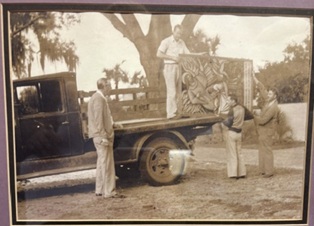
A visit to the History Harvest at Saint Lawrence A.M.E. Church reminded me that Eatonville’s history does not live only in textbooks. It lives in church bells, membership books, family names, neighborhood businesses, schools and stories passed between generations.
At Saint Lawrence, I learned about the church bell associated with Lewis Lawrence of Utica, New York, a Northern abolitionist who helped Black families acquire land before Eatonville was incorporated. I also found familiar names in an old church book — some relatives, others family friends. Eatonville’s history is personal. It is our inheritance.
My generation remembers Mack’s filling station, Reed’s Grocery Store, Miss Ward’s Diner, Vanessa’s Lounge and the Rainbow. These were community landmarks where relationships were formed and generations grew together.
Later generations may remember Charles Kirkland’s gas station, Duncan’s Store, Poncho’s and today’s convenience stores. But many younger residents were never taught about those who came before them. When history is erased, it can disappear. When the complete story is told, it creates healing, belonging and civic pride.
Hungerford School is one of the clearest examples. My generation knew Hungerford like the backs of our hands, from the elementary school I attended to Hungerford High School, where my mother and oldest sibling attended. We watched the campus become Wymore Tech. Many young people know only that later name and never experienced Hungerford’s connection to Eatonville’s identity.
Children who once would have attended school in town now attend Edgewater High School and middle schools outside Eatonville. Eatonville’s children have contributed to America as teachers, scholars, Ph.D.s, entrepreneurs and leaders in business, entertainment and public service. Their success remains part of Eatonville’s legacy, even when other communities receive the recognition.
When a community loses its schools and institutions, it loses more than buildings. It risks losing part of its heart.
 That is why the Hungerford property and proposed museum matter. Dr. Phillips Charities is seeking $60 million in Orange County Tourist Development Tax revenue to help develop the Eatonville Museum of Culture and History and surrounding cultural campus. Before Orange County commits public tourism-tax dollars on that scale, Eatonville’s ownership, operating authority and control over how its history is presented must be guaranteed, not left as a future promise.
The Memorandum of Understanding between Dr. Phillips Charities and Orange County Public Schools provides that land will be set aside for the museum and donated to the Town once construction funding is secured. It also identifies the museum as being owned and operated by the Town of Eatonville.
The $60 million request cannot be separated from that commitment. Any public funding should be conditioned upon enforceable protections confirming when the land will be transferred, that Eatonville will own and operate the museum, and that residents, descendants and local historians will have meaningful authority over its governance and storytelling.
Eatonville should not provide the land, history, artifacts, family stories and community resources while outside organizations control the narrative and receive the benefits. That would be fundamentally unfair. A museum about Eatonville must not simply be located in Eatonville. It must belong to Eatonville.
Too often, outsiders focus on Eatonville’s political disputes while ignoring the town’s accomplishments and remarkable people. Eatonville is more than vacant land and demolished buildings. It is a living community with a history of freedom, faith, entrepreneurship, education, culture and self-determination.
Will our grandchildren someday look at the Hungerford property and ask, “What used to be there?” Will they understand what Hungerford meant, or know only a version selected by outsiders?
There is a secret sauce in Eatonville. It is found in the relationship between our people, our land and our history. We should not rush to erase it. We must understand it by listening to those who lived it.
Historic Eatonville is a one-of-a-kind love affair — America’s first incorporated Black municipality, the Town That Freedom Built. The museum can become a place of truth, healing and civic pride, but only if the agreement is honored and Eatonville is trusted to own, operate and tell its story.
Eatonville should not merely be the subject of the museum. Eatonville must be its steward.
John W. Beacham is a lifelong Eatonville resident and chair of Preserve History of Maitland and Eatonville Inc., a nonprofit dedicated to preservation, advocacy and storytelling.