
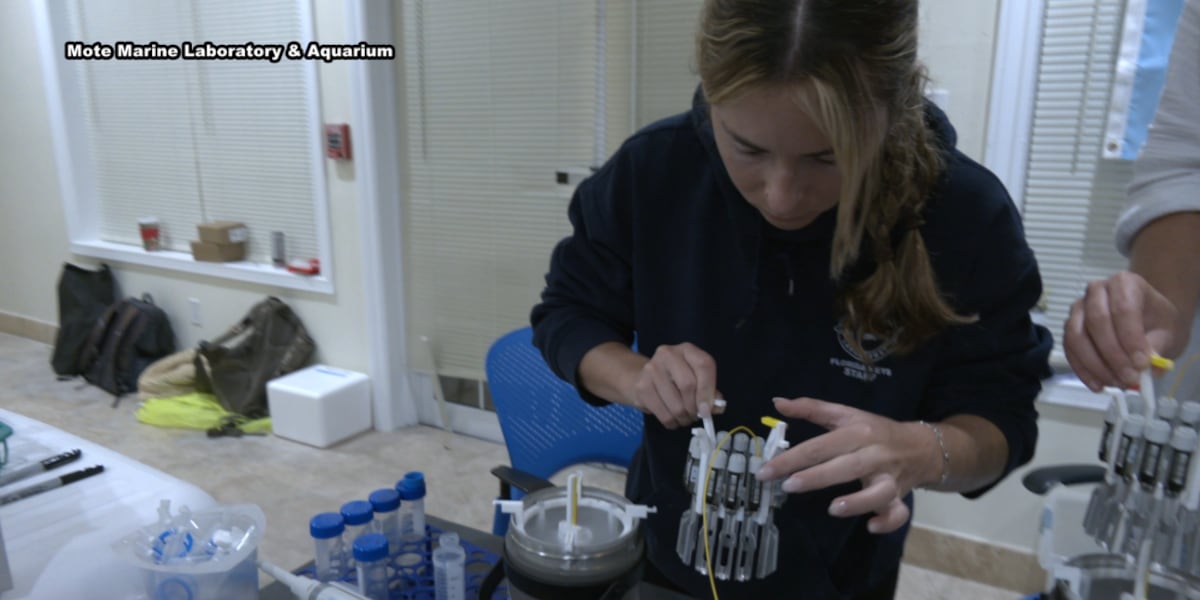
SARASOTA, Fla. (WWSB) – Scientists are working to give Florida’s struggling coral reef a new generation after a rare coral spawning event produced more than 1.5 million embryos.
Throughout the first week of August, 12 organizations, including Mote Marine Laboratory and Aquarium, came together for an unprecedented effort focused on the reproduction and restoration of elkhorn and staghorn corals.
Coral spawning happens once a year during a narrow window guided by lunar cues and environmental conditions. During the event, corals release eggs and sperm, known as gametes, into the water.
For healthy, dense coral populations, those reproductive cells can find one another and fertilize naturally. But Florida’s coral populations have declined so dramatically that natural reproduction has become increasingly difficult.
Celia Leto, Coral Reproduction Laboratory Manager at Mote Marine Laboratory and Aquarium, says some coral populations are now considered functionally extinct.
“Essentially, what that means is that their population is no longer able to sustain itself without human intervention,” Leto said.
Scientists say Florida has lost more than 97% of its coral reefs since the late 1970s or early 1980s.
The 2023 marine heat wave caused another devastating loss, with scientists estimating 99% of the remaining branching corals — including elkhorn and staghorn — were lost.
Leto said that decline is difficult to watch.
“It’s absolutely gut-wrenching,” she said.
But scientists are finding pockets of resilient coral and using those survivors to help create future generations that may be better equipped to withstand today’s ocean conditions.
The Re5, or Resilient Reef Research, Rescue and Restoration, initiative is funded through a four-year NOAA grant spearheaded by the University of Miami Rosenstiel School of Marine, Atmospheric, and Earth Science.
Dive teams collected millions of gametes from elkhorn and staghorn corals at offshore nurseries operated by Reef Renewal USA and Mote Marine Laboratory near Key Largo.
The gametes were then transported to a temporary laboratory at John Pennekamp Coral Reef State Park, where scientists determined genetic crosses and fertilized embryos.
Over seven days, scientists observed 25 elkhorn genotypes and 36 staghorn genotypes spawning.
The effort resulted in 116 unique directional crosses, more than 1.5 million embryos and more than 100,000 larvae now being grown by partner organizations.
Leto said producing that many embryos is especially significant because scientists believe there is little to no successful natural reproduction occurring among these branching corals on Florida’s reef.
“But the fact that we made 1.5 million is incredible,” Leto said. “I can’t even begin to describe how excited we were when we realized how many embryos, we were able to produce.”
The larvae are now being cared for by the University of Miami Rosenstiel School, Mote Marine Laboratory, The Florida Aquarium, The Reef Institute and the Smithsonian Marine Station.
Scientists also cryopreserved 350 vials of sperm during the effort.
The process uses liquid nitrogen and specialized equipment to rapidly freeze sperm, allowing scientists to preserve genetic material for future research and restoration.
The frozen sperm can also be used to create additional genetic combinations.
Because individual corals may spawn on different nights, their reproductive cells might never naturally encounter one another. By freezing sperm from one spawning event and later thawing it, scientists can use it to fertilize eggs from a coral that spawns on another night.
Leto compared the technique to technology used in human IVF.
She said preserving the sperm allows scientists to maximize the genetic diversity they can collect during the brief spawning season.
While much of the restoration work is happening in the Florida Keys, Leto says the health of coral reefs affects people throughout Florida — including those who don’t live near the coast.
“Coral reefs support everybody, even if they don’t live coastally,” Leto said.
About 25% of marine life directly relies on coral reefs for at least part of its life cycle, according to Leto.
Coral reefs also help stabilize coastlines and reduce erosion, making them particularly important as Florida faces hurricanes and tropical storms.
Leto described coral reefs as an “insurance policy” for Florida’s coastlines and said the loss of those natural protections can ultimately affect the cost of living for Florida homeowners and communities.
The newly produced larvae will continue growing in laboratory tanks and coral nurseries.
Within about two years, scientists plan to return the new corals to nurseries before eventually placing them on reef sites, including locations within the Florida Keys National Marine Sanctuary and the Kristen Jacobs Coral Aquatic Preserve.
Scientists are not expecting Florida’s reefs to return to their historic condition overnight.
But Leto says the coral being produced through restoration efforts is showing greater resilience to stresses such as extreme heat and disease.
She believes that resilience could help the new corals survive, grow and eventually reproduce on their own.
“I think that we’re going to see some much more happy, vibrant reefs within the next couple of decades,” Leto said.
The project brought together the University of Miami Rosenstiel School, Reef Renewal USA, Mote Marine Laboratory, The Florida Aquarium, The Reef Institute, SECORE International, the Phillip and Patricia Frost Museum of Science, Nova Southeastern University, Smithsonian Marine Station, John Pennekamp Coral Reef State Park, Biscayne National Park and AECOM.
Scientists say the collaboration demonstrates what is possible when organizations combine their expertise during one of the reef’s most important — and fleeting — natural events.
Copyright 2026 WWSB. All rights reserved.