
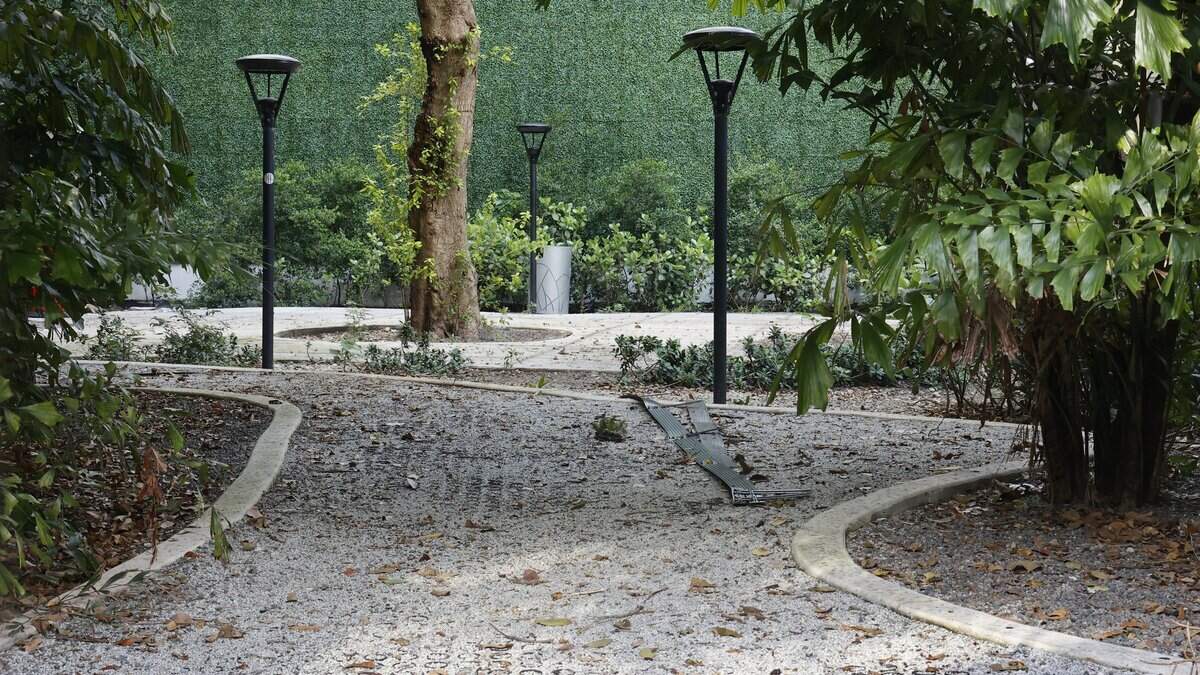
Allen Morris Brickell Park, a tiny urban park, has a tree canopy that includes specimens of black olive, gumbo limbo, banyan and other trees.
Carl Juste
cjuste@miamiherald.com
How is a park in Brickell — one of the few green spaces left in Miami’s financial district — at risk of, one day, becoming a high-rise?
Like a lot of things that go sideways in South Florida, this is a decades-old tale of government mismanagement, in this case by the city of Miami.
Allen Morris Brickell Park has been closed since July, the Herald reported. This isn’t new — the park shut down before, during a protracted legal fight between the family that donated the land to the public and the city, which was accused of misusing the property. The park eventually reopened in 2023, but that was temporary — a bit of fine print few residents noticed.
Thanks to that litigation, the city agreed to upzone the land to allow buildings of up to 48 stories, with an additional 32 floors in exchange for public benefits.
Now residents who value Allen Morris Park are trying to save it, but they are fighting against forces that are beyond their control: Miami developers’ hunger to build and build, and a city government that, over a period of decades, set in motion the events that may lead to the public potentially losing this green space.
The Allen Morris Company, the parcel’s owner, currently has plans for a restaurant headed by a Michelin-starred chef. However, the developer’s lawyer, Javier Fernandez, didn’t rule out the possibility of a future high-rise on the site, the Herald reported. “Nothing is off the table,” he told the Herald Editorial Board.
Brickell has no shortage of ritzy restaurants and modern towers. Allen Morris Park is no Central Park — at the intersection of Southeast 10th Street and Brickell Plaza, it is only a quarter acre — but once that green space is lost, there’s no making up for it.
“This, to me, is a symbol of how out of control development is,” Elena Kasparis, a Brickell resident who’s gathered almost 2,000 online petition signatures to preserve the park, told the Editorial Board.
Kasparis said she hopes to convince the company not to develop the site and, if it does, to at least preserve the trees that are currently there. She said residents have been kept in the dark about what’s happening.
When real estate developer L. Allen Morris donated the land to the city in 1974, the deal was clear: it was to remain a park or the owners could take it back. In 1999, the city asked to allow neighboring restaurant Perricone’s Marketplace to use the space for seating. The Allen Morris Company agreed. Eventually, the city allowed the restaurant to effectively take over the park without the company’s consent.
The Allen Morris Company sued Miami in 2014 to take the land back and won. That’s not surprising: Miami had allowed park space to be commercialized.
After court rulings in favor of the company, the City Commission in 2023 finally decided to drop its legal appeals and put the site “into service for a use other than as a public park,” according to a commission resolution. Miami agreed to rezone the land from “civic space” to T6-48B-O — a type of high-density, urban-core zoning — to be consistent with abutting properties. In exchange, the company allowed the site to reopen as a private park for 18 months, the “first time it had been meaningfully open in nearly a decade,” according to information from the company.
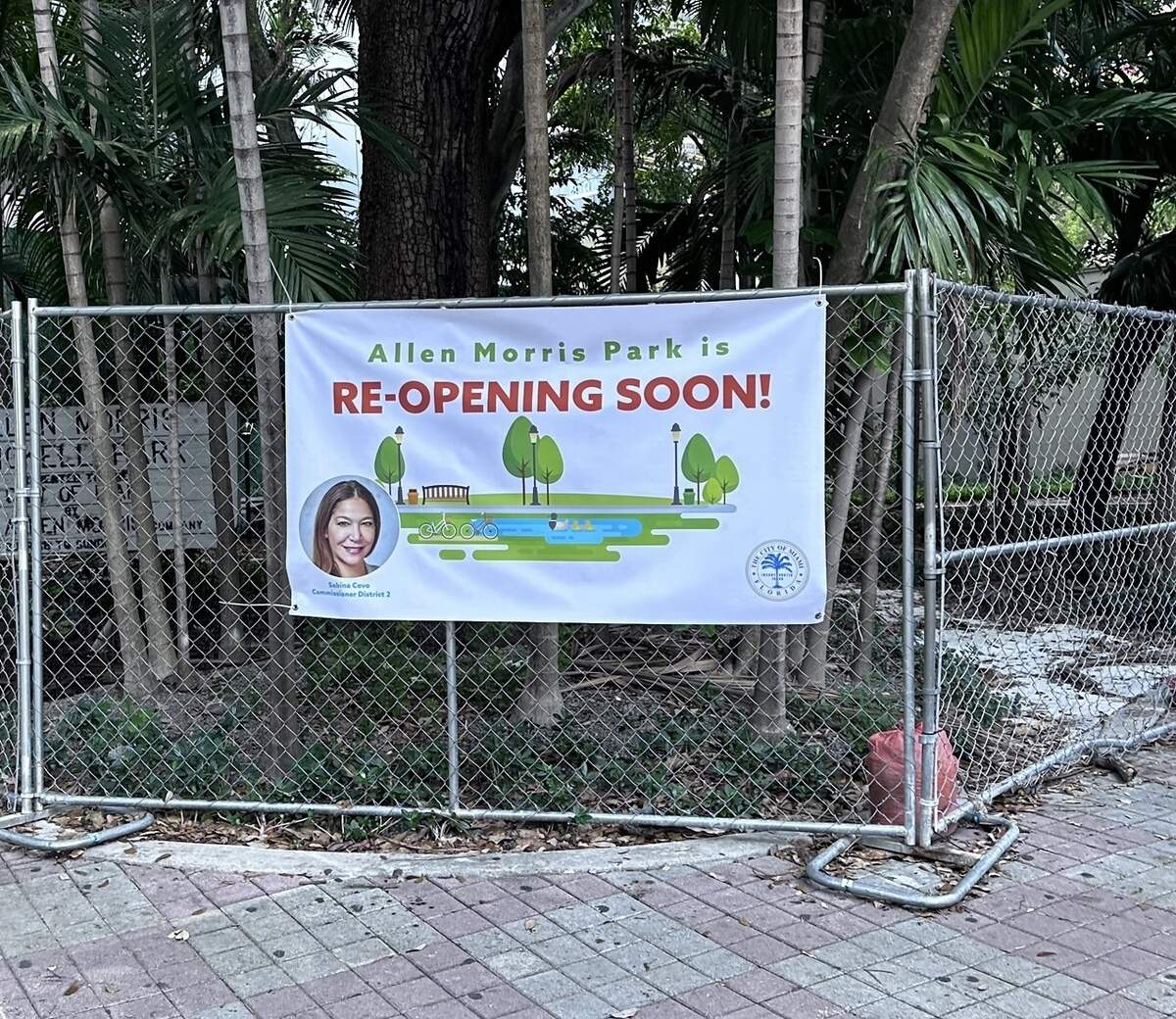 A banner showing then-Miami Commissioner Sabina Covo’s photo was installed outside Allen Morris Brickell Park in 2023 announcing its reopening after years of litigation with the Allen Morris Company. The reopening was temporary and the park shut down to the public again in July 2026. The company plans to open a restaurant at the site and the land is zoned for a high-rise. Provided
Just as Allen Morris was about to reopen in 2023, a “re-opening soon!” banner with then-Commissioner Sabina Covo’s photo appeared at the site. Kasparis said residents were “projected this image” that Allen Morris would reopen permanently.
But even back then, the reopening deal drew controversy, and Covo was criticized for sponsoring it when she ran for reelection in 2023. Covo said at the time that, despite the upzoning, the property was too small for a large development such as a skyscraper, the Herald Editorial Board reported in 2023. The fact that the Allen Morris Company’s own lawyer currently won’t rule out a high-rise seems to contradict her words. Covo lost to Commissioner Damian Pardo, whose district no longer covers the site.
Even while the park was open, some residents complained that it attracted homelessness and trash. The Allen Morris Company said that it fenced off the site in early July because “the space was becoming dangerous” due to construction of a building next door.
In the decades-long battle over this land, the city of Miami has lost the trust of residents and the Allen Morris Company. That makes negotiations to preserve it more difficult. Nevertheless, we hope that a piece of greenery tucked into Miami’s urban core survives.
BEHIND THE STORY MORE What’s an editorial?
Editorials are opinion pieces that reflect the views of the Miami Herald Editorial Board, a group of opinion journalists that operates separately from the Miami Herald newsroom. Miami Herald Editorial Board members are: opinion editor Amy Driscoll and editorial writers Isadora Rangel and Mary Anna Mancuso. Read more by clicking the arrow in the upper right.
What’s the difference between an op-ed and a column?
Op-Eds, short for “opposite the editorial page,” are opinion pieces written by contributors who are not affiliated with our Editorial Board.
Columns are recurring opinion pieces that represent the views of staff columnists that regularly appear on the op-ed page.
How does the Miami Herald Editorial Board decide what to write about?
The Editorial Board, made up of experienced opinion journalists, primarily addresses local and state issues that affect South Florida residents. Each board member has an area of focus, such as education, COVID or local government policy. Board members meet daily and bring up an array of topics for discussion. Once a topic is fully discussed, board members will further report the issue, interviewing stakeholders and others involved and affected, so that the board can present the most informed opinion possible. We strive to provide our community with thought leadership that advocates for policies and priorities that strengthen our communities. Our editorials promote social justice, fairness in economic, educational and social opportunities and an end to systemic racism and inequality. The Editorial Board is separate from the reporters and editors of the Miami Herald newsroom.
How can I contribute to the Miami Herald Opinion section?
The Editorial Board accepts op-ed submissions of 650-700 words from community members who want to argue a specific viewpoint or idea that is relevant to our area. You can email an op-ed submission to oped@miamiherald.com. We also accept 150-word letters to the editor from readers who want to offer their points of view on current issues. For more information on how to submit a letter, go here.