
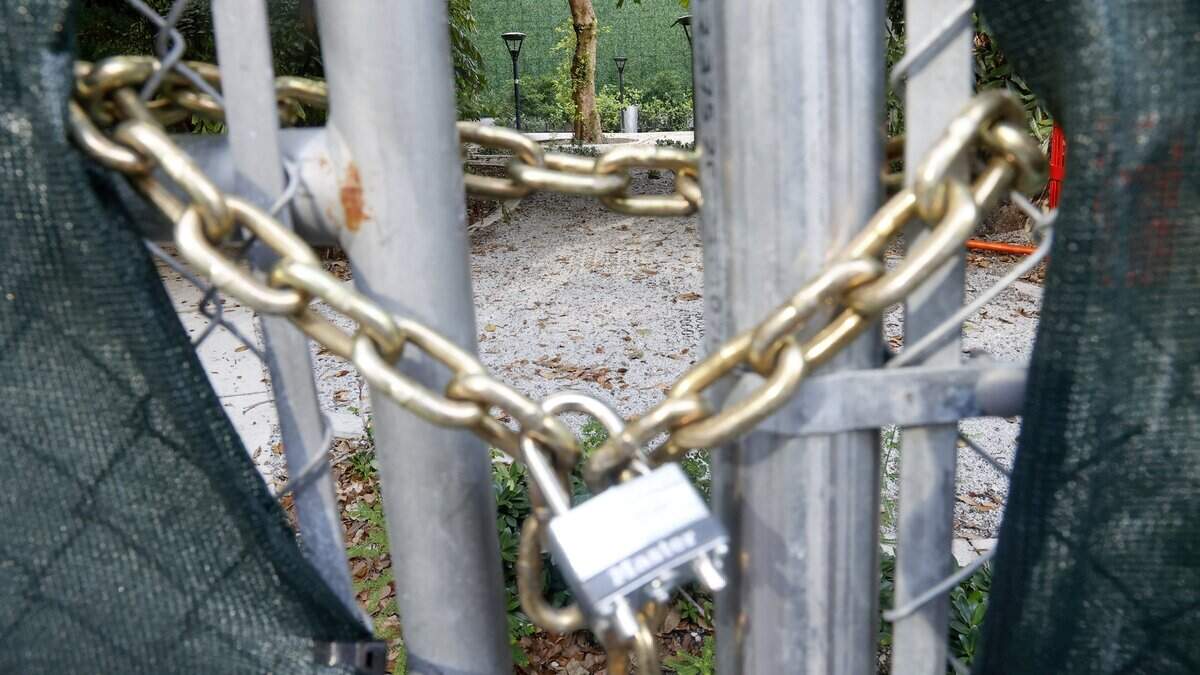
Allen Morris Brickell Park, nestled between high-rise luxury condominiums and hotels in Miami’s Brickell neighborhood, has remained fenced and chained since the July 4 weekend.
Carl Juste
cjuste@miamiherald.com
Bricking over Brickell
With the “activation” of Allen Morris Brickell Park (the Allen Morris Company’s euphemism for destroying a public park), Brickell may be about to see its second public park become a sales center for a luxury super-tall building. We already lost Southside Park to the Mercedes-Benz project, which shut us out of a park, including a children’s playground (literally becoming a developer’s playground) and demolished a fire station.
Decades ago, L. Allen Morris donated this park “with the specific goal of preserving the canopy in an area he envisioned would become highly urbanized,” a direct quote from the company. Well, Brickell is now officially “highly urbanized,” and we’ve never needed a park more than we do now. Ironically, the Allen Morris Company wants to cash in on this tiny park and is not operating with its founder’s original vision.
I originated the Change.org petition against this, which has nearly 2,000 signatures. Brickell clearly has had enough of being a developers’ playground.
Elena Kasparis,
Miami
Avarice in Aventura
To say that society favors the wealthy is nothing new. If wealth is achieved through honest work, it is well deserved. What distinguishes our time is that there are no limits to the greed of some powerful people or the unlawful means they use to achieve their goals.
Through Trump Media Truth API, Wall Street firms now pay $100,000 a month to buy a millisecond head start on the president’s market-moving public announcements. The Trump family’s net worth has nearly tripled to $6.5 billion since his return to power.
The same concentration of wealth and influence that shapes national policy can be seen in local development battles. Turnberry Isle condo associations filed a federal lawsuit accusing the City of Aventura of rewriting development rules under “unrelenting pressure” from Jeffrey Soffer, whose father was the developer of Turnberry.
Soffer wants to build two additional 24-story towers in an already congested piece of real estate that has only a small bridge for access, without the consent of hundreds of Turnberry’s residents.
We have two and a half more years of Trump’s greed, but I’m rooting for the residents of Turnberry Isle to win this lawsuit.
Betty Heisler,
Aventura
End of cash?
Miami Herald columnist Mary Anna Mancuso continually comes up with new material to write her always interesting columns. In her Aug. 6 column, “My laundromat accepts Apple Pay. Why won’t they take cash?” she asked what must be on the minds of so many who just accept a transforming trend without question, out of sheer convenience or tolerating change or inconvenience.
All Americans, especially the less fortunate who cannot qualify for a credit card due to their low-income status, are entitled to rely on common U.S. currency.
Recently, I ordered a cup of coffee and Danish at UHealth’s Sole Mia lobby café and jokingly asked, “Is cash still good?” I was not surprised when she said no. Humorously, I said, “Your employer must not trust its employees.”
Not unlike many laws tweaked by our legislators and politicians, either to please their donors for economic or political benefit or just plainly for convenience, the less fortunate (or every Jane or John Q. Citizen) should be entitled to have a choice as to how we spend our cash.
H. Allen Benowitz,
Miami
Trash troubles?
Annie Lord’s Aug. 4 op-ed, “Eliminating property taxes will make Miami less affordable for most residents,” raises important concerns about how property tax cuts could affect Miami residents. One critical issue deserves attention: trash and the cost of keeping our communities clean.
Miami generates enormous amounts of garbage annually. We already face overflowing landfills and a broken incinerator, while litter remains a persistent problem. Too many people think nothing of throwing trash out their car windows, leaving garbage in parks, or dumping it anywhere.
If property tax cuts lead to reductions in municipal services, what happens to street cleaning, park maintenance and other sanitation services?
Unless municipalities find another reliable source of funding, we could see trash piling up in public spaces. Keeping Miami clean is not a luxury, it is an essential public service and a matter of public health and quality of life.
Any discussion of property tax cuts should consider not only how much homeowners might save, but which essential services could be reduced and who will ultimately pay the price.
Suzanne Nasca,
Miami
Marine stadium
A seminal work by architect Hilario Candela, Miami Marine Stadium is an iconic work of modern architecture, a strong statement by a rather young Cuban immigrant and architect, only 28 at the time the stadium was built in 1961. His firm gave rise to the multiple campus constructions of Miami Dade College, of which I was proud to be a part for 34 years.
The stadium’s design was and can be again quite bold and fresh. It’s part of the architectural history of Miami and a design of which the city can be proud. There are too few buildings surviving to present any kind of historical significance, or continuity, much less such an early work.
The stadium also holds memories of concerts: Jimmy Buffett, of course and, unusual for its time, entertainer Sammy Davis Jr. campaigning with former President Richard Nixon. Like other historically significant buildings, Miami Marine Stadium’s history was rich, vibrant and meaningful. It can be that again. I look forward to attending its restoration.
Edward D. Levinson,
architect,
Miami Dade College professor emeritus,
Pembroke Pines
Be accountable
In his Aug. 12 op-ed, “As a House speaker from Miami, here’s what made me proudest,” Florida House Speaker Daniel Perez obviously has a very high opinion of himself, but was it really in our best interest to read this self-serving vanity piece?
He takes credit for positive developments but should also take responsibility for negative ones. For example, the ever-increasing price of homeowners insurance pinned on fraudulent or unnecessary litigation rather than the siphoning of insurance company profits to subsidiaries. The shadowy path of $10 million into Hope Florida and then on to campaigns to defeat marijuana and abortion amendments championed by Republican state officials — in violation of state laws. Additionally, there is the gutting of home rule and government in the Sunshine; Alligator Alcatraz; and the Trump Library land transfer.
Perez is only one man and there were a few times he even spoke up in opposition to some of these travesties, but if he wants to claim credit, he must also take responsibility. Further, the Miami Herald should not be helping anyone pat themselves on the back.
Linda Conner,
Miami
Off to college
A child’s departure for college is one of those great milestones celebrated with pride, but at home it coexists with a silent sense of loss. The routine shifts: a room falls silent, vacations are planned around the return and nights are filled with growing uncertainty.
Far from the old idea of the “empty nest” — the child is there, will return and maintains a constant presence — I prefer to call it a jumbled nest. It demands reorganizing life, rediscovering spaces and learning to build a new bond from a distance.
For the son, the challenge is monumental: managing his loneliness, fears and newfound freedoms while seeking his equilibrium. In this process, video calls serve as a bridge to understand his emotions and offer him refuge.
The challenge for parents is to find the subtle balance between letting them know they will leave a void and giving them explicit permission to fly without guilt. Closing our eyes and trusting they will do their best is our true act of surrender.
María Crespo,
Miami