
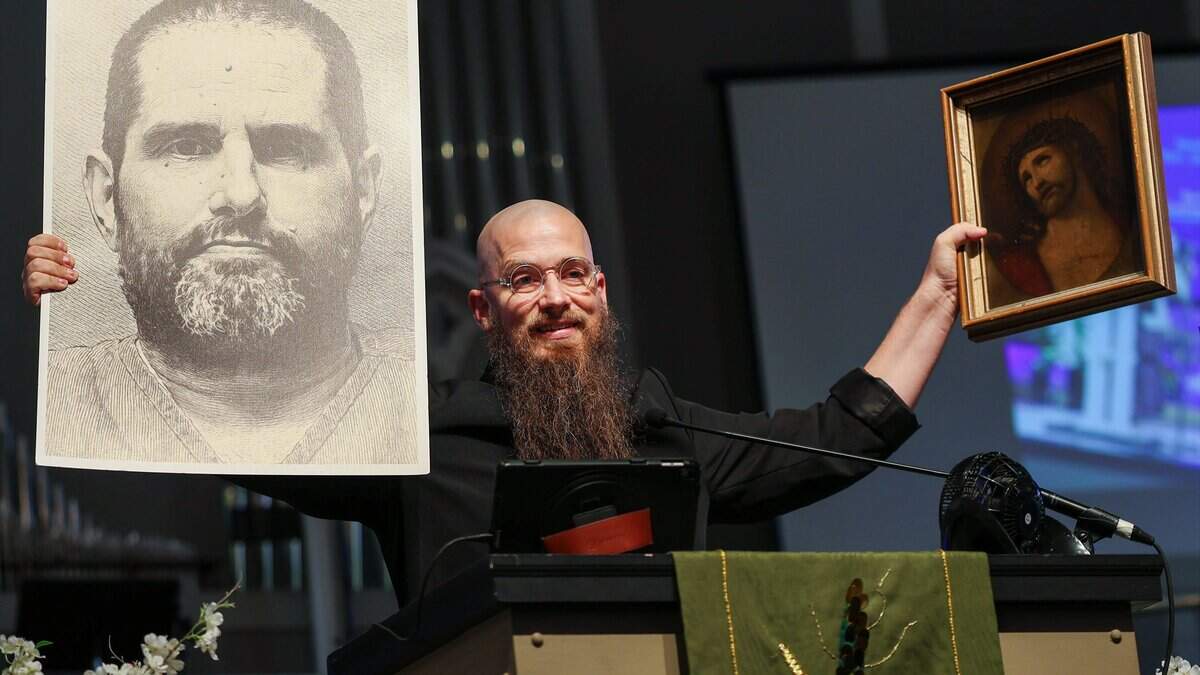
Rev. Jeff Hood, the spiritual advisor who counsels inmates on death row, holds a picture of William Silvia, who was executed on Aug. 18, and Jesus Christ during Sunday service at Sunshine Cathedral ahead of Silvia’s execution.
Carl Juste
cjuste@miamiherald
Sleep did not come easily the night before Rev. Jeff Hood witnessed his 13th execution.
Sometime after midnight, Hood felt a sense of dread that didn’t let up until the early morning hours. The clock in his hotel room just miles outside Florida State Prison in Raiford, Fla., read 4:53 a.m.
The pastor prayed for sleep, but the impending execution of William Frances Silvia Jr. weighed heavily on him throughout the night. As a spiritual advisor to people on Death Row, Hood is used to confronting death.
But the night before an execution never gets easier, he said.
“What you’re being called to do in that room is to stand there and comfort someone as they’re murdered,” Hood told the Miami Herald. “My job is to die with them. There is a piece of me left inside the chamber every time.”
In less than 12 hours, Hood would accompany Silvia, 61, into the prison chamber as he faced execution via lethal injection — an execution the Miami Herald also witnessed on Tuesday. In 2008, Silvia was found guilty of first-degree murder in the death of his estranged wife Patricia Silvia and the attempted first-degree murder of Patricia’s mother Betty Woodard.
A jury found Silvia guilty of showing up to the Woodard’s Orlando-area home in 2006 and shooting Patricia in the back of the head and Woodard in the face during a family cookout after an unsuccessful attempt to reconcile with Patricia. Patricia died and Woodard survived, but she lost her left eye, part of her nose, her sense of smell and hearing in one ear. The jury recommended Silvia get the death penalty.
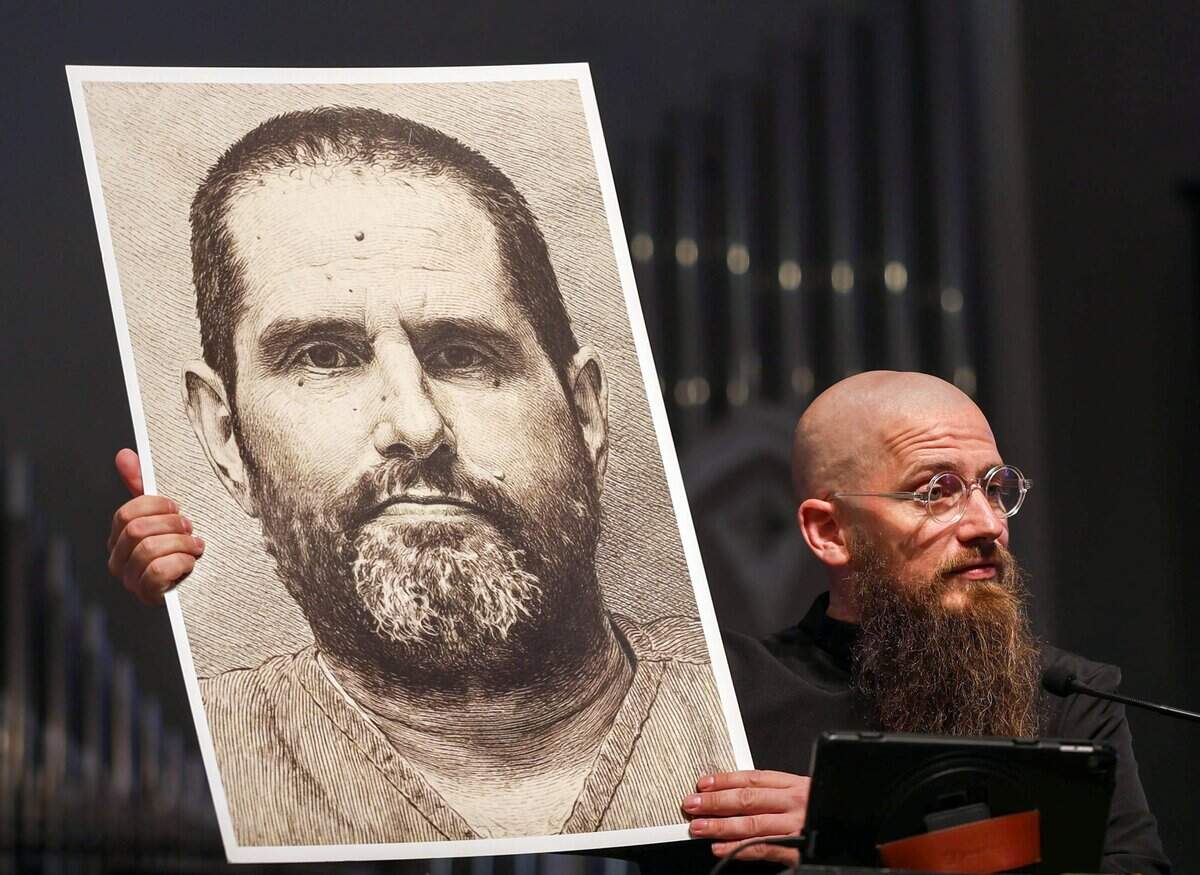 Rev. Jeff Hood, a “Death Row” spiritual advisor, holds a picture of William Silvia, who was executed on Aug. 18, during Sunday service at Sunshine Cathedral in Fort Lauderdale. Carl Juste cjuste@miamiherald
Hood, a 42-year-old pastor based out of Little Rock, Arkansas, works with inmates all over the country, but he’s been busier than usual in Florida, a state that has reached a record-breaking number of executions under Gov. Ron DeSantis.
In the past 20 months, Florida has executed almost as many people as all other states combined. That’s 32 people since the beginning of 2025, while the rest of the United States has carried out 38 over the same time frame, according to data from the Death Penalty Information Center.
Silvia was Florida’s 13th execution in 2026. At least two more death warrants have been signed for 2026 — with more anticipated.
READ MORE: Florida executed 19 death row inmates in 2025. That caused unusual national uptick
The sheer number of executions — and the speed at which they are carried out — has drawn national attention from abolitionists and advocates, but also from a number of religious groups who are morally opposed to the death penalty.
Last month, the Florida Conference of Catholic Bishops released a letter urging Florida elected officials to end capital punishment, arguing that the practice is against the moral teachings of the church and impractical to society. The open letter — signed by the state’s top Catholic clergy including Miami’s Archbishop Thomas Wenski and Deacon Edgardo Farias — called out Florida for its “alarming” rate of executions.
A stark opponent of the death penalty, Hood said he’s worried that the increasing number of executions in Florida will cause people to be desensitized to taking lives.
“I think that there’s going to come a time where we have to talk to our grandchildren about what were you doing, like why were you sitting back and letting this happen? Close to 40 people being executed in Florida, what were you doing?”
‘My job is to share the horror’
Death Row inmates often meet with a spiritual advisor the day before or the morning of their execution, where they are given their last rites. The spiritual, like Hood, believe this is the last opportunity for someone’s soul to be saved before crossing over into the afterlife.
Hood works a bit differently. He normally spends months, sometimes years communicating with people waiting to be executed. He forms friendships with the inmates — whom he refers to as “his guys” — and acts as a spiritual liaison between the incarcerated and the outside world. Hood arranges pen pals, tracks down family members on the outside and facilitates commissary funds so he can bring them their favorite beverages.
“My job is to become their best friend, so that their best friend is with them when they’re executed,” Hood said.
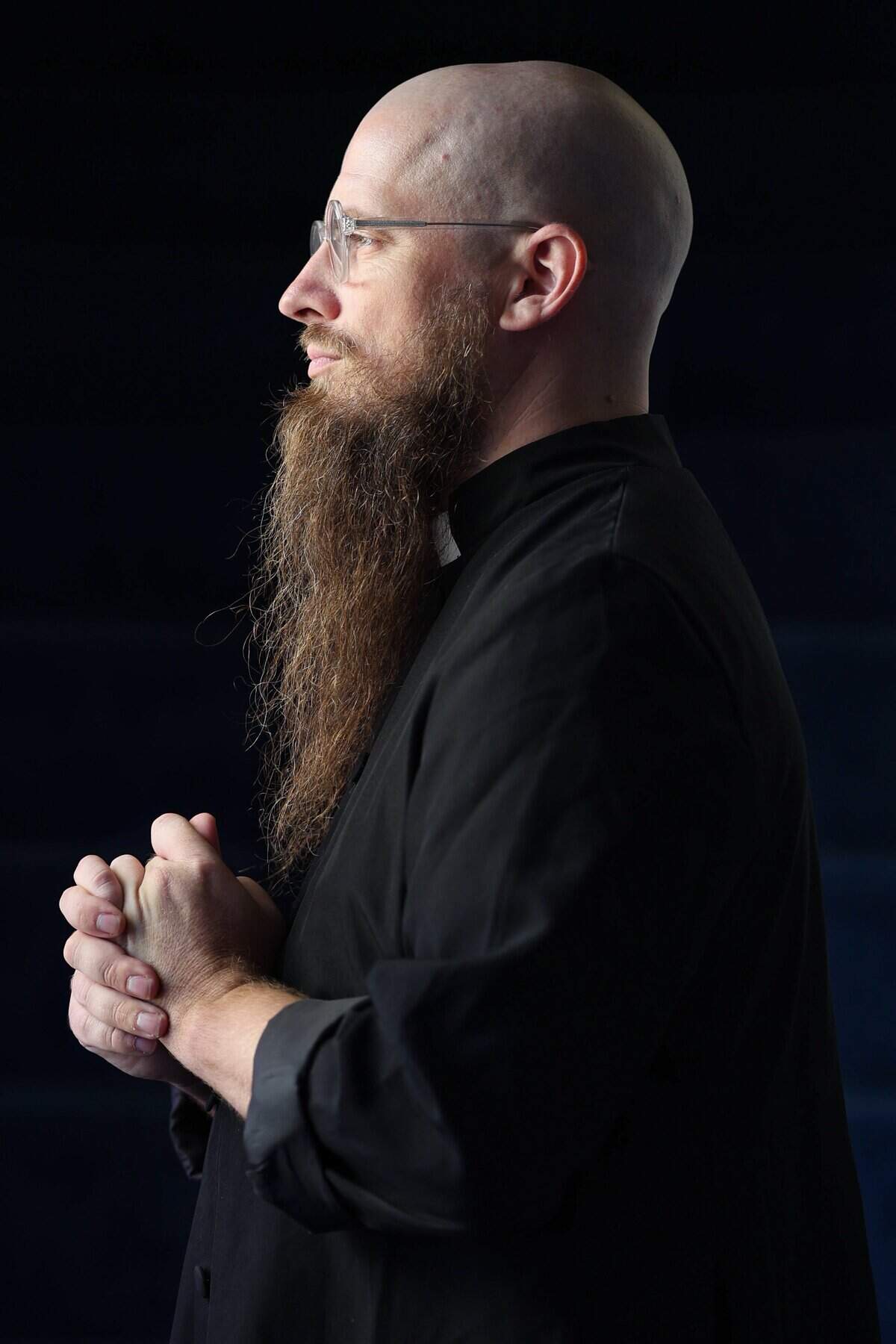 Rev. Jeff Hood, the spiritual advisor who counsels people on death row, has been busier than usual this year, particularly with inmates in Florida, a state that has reached record-breaking execution numbers under Gov. Ron DeSantis. Carl Juste cjuste@miamiherald
Over the past 15 years, Hood has communicated with hundreds of condemned inmates — through letters, phone conversations and meetings in person as inmates get closer to their execution date.
With a long beard reaching halfway down his cassock, clear round glasses and a shaved head, Hood’s image is akin to a scholarly wizard. Last year, he founded a nonprofit, The Execution Intervention Project, which helps provide spiritual and tangible resources to those on Death Row. He’s authored over 100 books and articles advocating against the death penalty and has been present for more than a dozen executions.
When he is not beside inmates for their final moments, Hood works from his attic home office in Little Rock, where he is surrounded by hundreds of books, magazine clippings and antique framed photos of assassinated bishops and priests.
Hood said he’s been called to minister to those on the outskirts of society ever since his mentor at Southern Baptist Theological Seminary, a seminary school, came out to him as gay on his deathbed.
That experience “killed Jesus” for Hood, forcing him to reject the rigid conservative beliefs he grew up with and discover a new understanding of God — one rooted in grace and empathy.
“I very much began to connect with the Jesus that is the outcast,” Hood said, referring to the Bible verse Matthew 25. “‘What you’ve done to the least of these, you’ve done to me. I was in prison, and either you visited me or you didn’t.’ And I began to be able to take those things very literally.’”
After seeing his own religious mentor live “behind the curtain,” Hood said he was prompted to build a ministry for outcasts — LGBTQ+ people, incarcerated people and those on Death Row.
Hood said the men he works with now “are not just a part of my faith. They are the source of my faith.”
Hood’s testimony about the horrors he witnesses in the chamber has helped bring public awareness to one recent controversial issue. In 2024, Hood witnessed the country’s first nitrogen execution in Alabama, an experience he said was like watching a goldfish out of water, but far worse.
Then, in June, the U.S. Supreme Court prohibited Alabama from executing a man using nitrogen gas on the grounds of cruel and unusual punishment — a decision Hood sees as his biggest concrete “win” so far.
“My job is to bring people as close as possible, as close to the chamber as possible to tell the stories, to tell what I see,” he said. “My job is to share the horror.”
‘Who are we when we do this?’
On a virtual vigil Hood organized the night before Silvia’s execution, a few dozen advocates and people from around the country log in to pray for Silvia. His deteriorating mental health comes up as a topic of discussion.
Through Hood’s conversations with Silvia in the weeks leading up to the execution, Hood learned that Silvia often hears voices and speaks to others who are not there.
Ruth Longenecker, the publicist for The Execution Intervention Project, unmutes herself to pose a question: “Who are we when we do this?”
Her hope in his final moments, she says, is that the transition will be “gentle.”
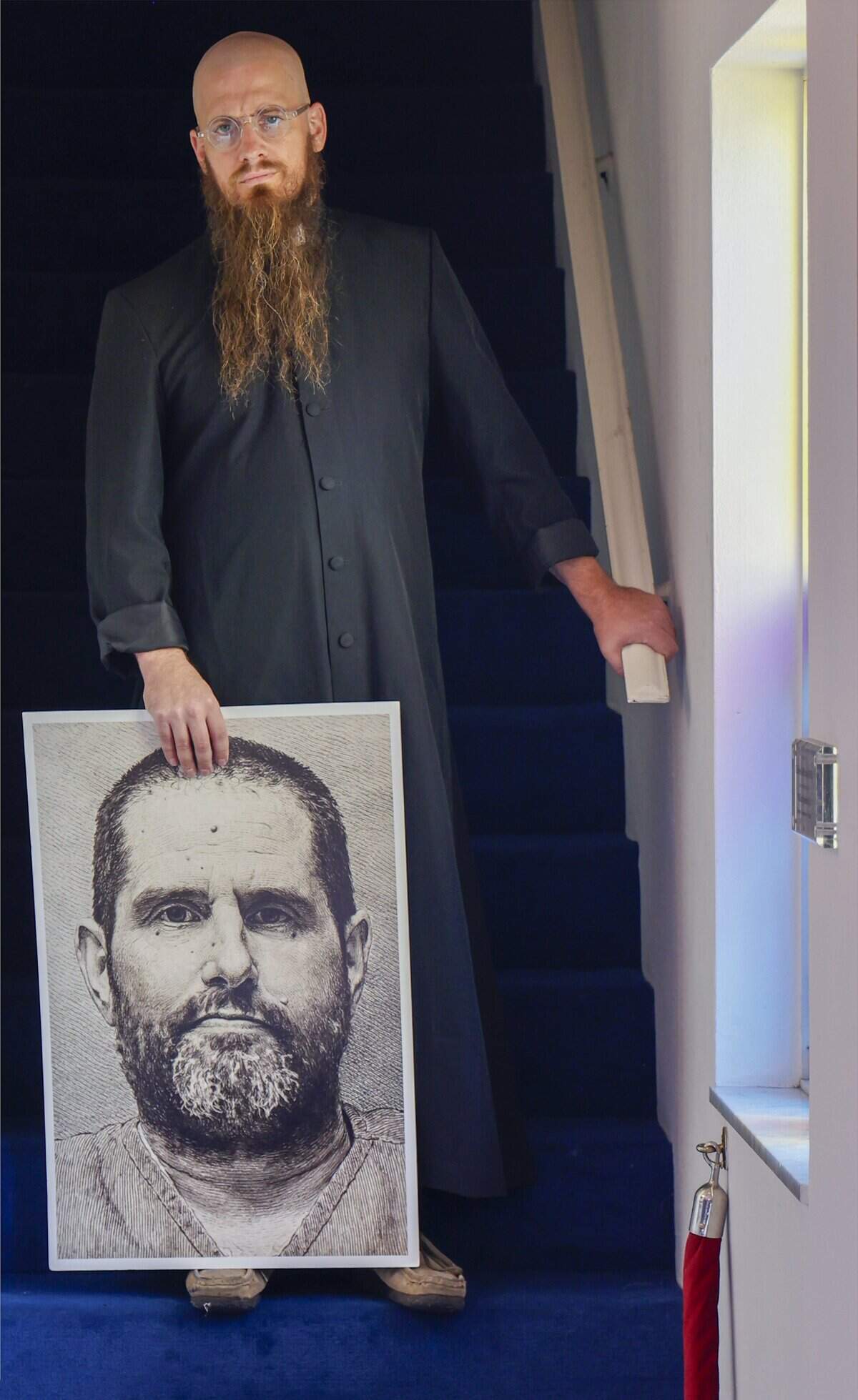 Rev. Jeff Hood, the spiritual advisor who has dedicated his pastoral career to counseling inmates on death row, holds a picture of William Silvia, who was executed on Aug. 18. The reverend has ministered to 13 Death Row inmates who were executed. Carl Juste cjuste@miamiherald
Florida’s three-drug protocol for lethal injection isn’t exactly a gentle way to die, said Corinna Lain, a law professor at the University of Richmond School of Law who has researched the death penalty for 20 years.
The first drug is a fast-acting anesthetic, called etomidate, which wears off in about five minutes. The second drug is a paralytic that freezes the body from the outside in, creating the effect that the person is peacefully asleep. Lain said the practical role of this drug is cosmetic — to hide signs of pain or struggle from witnesses. The last drug is potassium chloride, sometimes called “liquid fire,” which is a caustic salt that burns through the veins to cause cardiac arrest.
The majority of autopsies of people who were executed by lethal injection in Florida show the cause of death as acute pulmonary edema — a sudden, severe buildup of liquid in the lungs — which “would feel like drowning from within,” Lain said.
“These people are being waterboarded to death. The only question is, can they feel it?” Lain said.
‘Florida is bloodthirsty’
The day of Silvia’s execution also happens to be primary election day, so campaign signs litter the sides of the highway on the drive over to the Florida State Prison. One sign from a Republican candidate running for governor reads “Pro-Life. Pro Second Amendment.”
Florida has touted itself as the most faith friendly state in the nation. In his first years in office, DeSantis, a Catholic, created a Faith and Community initiative which partners with thousands of faith institutions across the state. The state’s Hope Florida program, a controversial initiative spearheaded by first lady Casey DeSantis, has promoted CarePortal, a platform that connects faith organizations with people in need. Florida’s attorney General James Uthmeier has a track record of using his Catholic faith to inform his work as the state’s chief legal officer.
The Catholic faith morally opposes the death penalty, yet many of the state’s top Catholic leaders have supported measures to expand it.
Florida has the largest Death Row roster of any state — 238 inmates, according to data from the Florida Department of Corrections.
“It’s important to realize that’s a lot of people that the state of Florida is trying to kill,” said Hannah Gorman, the director of the Balanced Justice Project at Florida International University’s College of Law.
In 2016, the Supreme Court found Florida’s state sentencing method to be unconstitutional because it allowed judges to consider additional evidence beyond jury recommendations. The change resulted in nearly 146 people getting their death sentences vacated and new penalty proceedings given to them, according to research from FIU’s Balanced Justice Project.
That’s basically 146 trials to “redo, which is nuts,” said Gorman.
Of those 146 cases, 96 have been removed from death row and resentenced to life in prison, according to Gorman’s research. At least 66, almost 70 percent, of those are uncontested by the state, meaning the state did not try to fight for a new death sentence.
In 2023, DeSantis signed a law allowing juries to recommend a death sentence with an 8-4 vote instead of unanimously. The governor pushed for the change after the Parkland school shooter, who killed 17 students and faculty members at Marjory Stoneman Douglas High in 2018, was spared from the death penalty in 2022.
More recently, Florida has expanded death penalty offenses to include sexual battery of minors under 12 years old and has mandated the death penalty for undocumented immigrants convicted of capital crimes.
“Florida is bloodthirsty in a way that no other modern death penalty state is,” said law professor Lain.
Florida also has the highest death row exoneration record out of any other state — 30 since 1973, according to the Death Penalty Information Center. That means the person was falsely convicted and sentenced to death, but was later cleared of their crime and proven innocent.
In the past, DeSantis has said that the surge in executions can be explained in part because of the pause on all capital punishment during COVID and that the state has a duty to help bring justice to the victims’ families.
Speaking at the Florida Sheriffs Association conference on July 28, the day of the double executions, the governor said “I don’t take joy in doing that. “It’s a weighty thing,” he said.
“Some of the victims’ families have been waiting a long time. Some of them are like ‘when are we going to get justice?’” DeSantis said.
Inside the execution
In the minutes before Silvia’s execution, rain hammers down on the roof of Florida State Prison.
Patricia Silvia’s family fills the first two rows of the small viewing room attached to the execution chamber. Many of them are wearing purple ribbon pins on their chests with the words “Forever in our hearts Patricia Ann” and a smiling photo of the woman Silvia murdered 20 years ago.
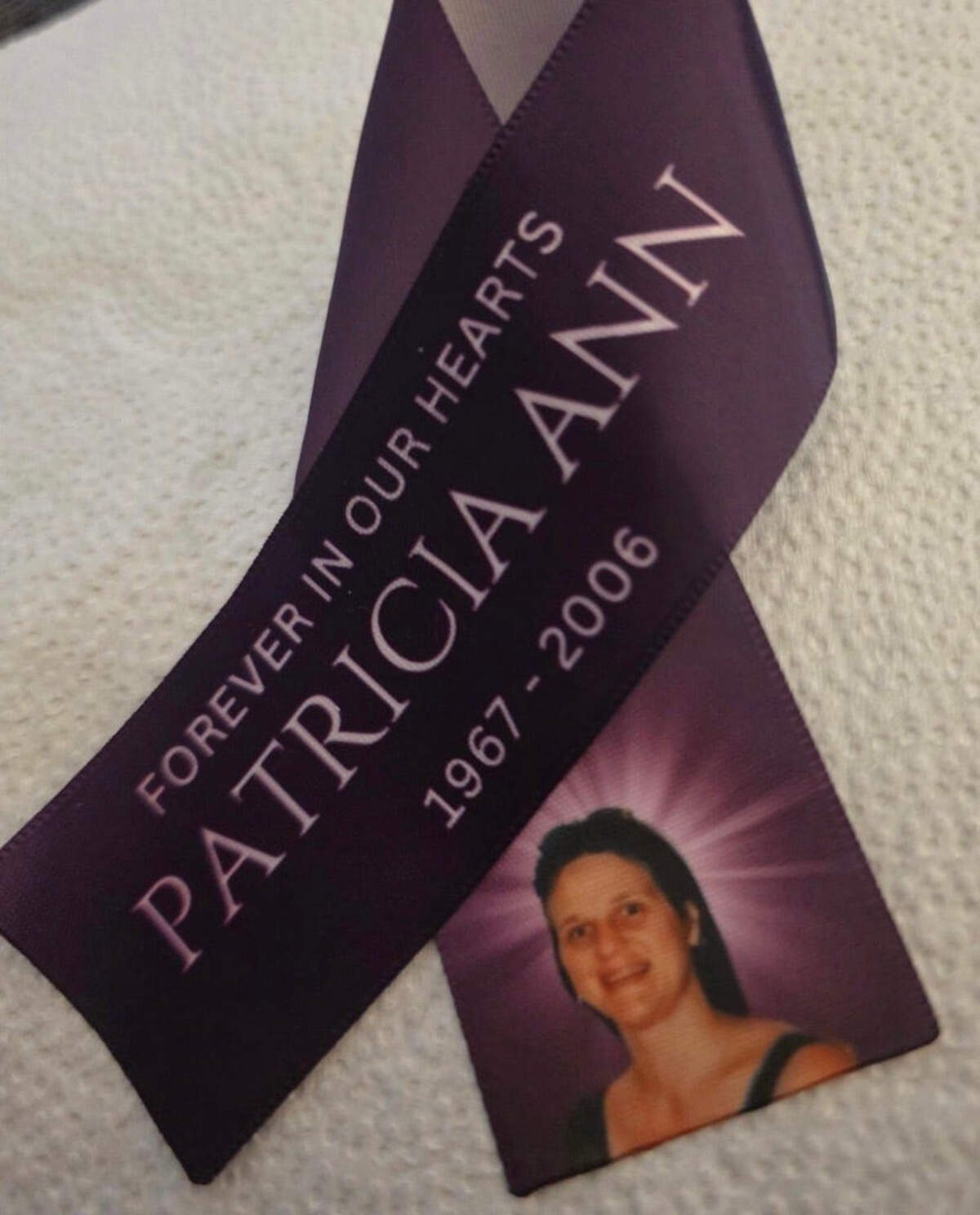 Patricia Ann Wyatt’s family created this ribbon to honor her memory. Courtesy of Pam Wyatt
Pamela Wyatt, Patricia’s sister, sobs as she blows a kiss to the sky. “She knows,” she whispers to her elderly mother, Woodard, who survived but suffered grave injuries from Silvia’s attack.
Thunder crashes as the storm roared outside. The fluorescent lights flicker on and off. Hood will later say the intensifying storm was “an SOS from heaven,” as if the Earth itself was rebelling against what was happening.
On the other side of the window, Hood asks Silvia if he repents all of his sins. Then he begins to give Silvia his last rites in Latin — a request from Silvia.
At 6 p.m. sharp, the curtain lifts to reveal Silvia strapped to a gurney with an intravenous line in his left arm on the other side of the window. Beside him, a prison worker uses the chorded telephone to call the governor for the final go ahead. Silvia looks calm, his eyes open and head propped up slightly as Hood prayed furiously over him.
Silvia is given a moment to share some last words, which he utters quickly: “I’m sorry all of this happened. It was an accident. I never meant to hurt her.”
Wyatt, Patricia’s sister, lets out a big sigh as she puts her arms around the backs of the family members sitting beside her. She is sobbing.
In the chamber, Hood extends one shaking hand over Silvia, his other hand lightly bracing Silvia’s leg as the three drugs are being administered in sequence. He said later that he does this so that Silvia doesn’t feel alone.
“Even though I walk through the valley of the shadow of death, I will fear no evil,” Hood says later, recounting the Scripture he read from Psalm 23. “And I got him to start saying that with me — even though I walk through the valley of the shadow of death, I will fear no evil. I will fear no evil. I will fear no evil.”
Silvia begins to breathe heavily, his eyes still open and his lips fluttering slightly. The sheet in front of him breathes with him as he takes his final, somewhat powerful, breaths. Then, after a few minutes, it stops moving. Silvia’s eyes are still open, but all the color has drained from his face.
Hood makes the sign of the cross with his shaking hands and removes his glasses to wipe away a tear.
“I’m almost out of breath, I’m feeling like I was suffocating in that moment,” Hood said later.
The time of death is announced: 6:11 p.m. In a Biblical fashion, one last boom of thunder crashes at the viewing curtain lowered.
The moment that Patricia’s family had been awaiting 20 years for is finally complete.
After Silvia’s execution, the family spoke to reporters in honor of Patricia Silvia.
“Patricia was so much more than the circumstances surrounding her death. She was a person with hopes, dreams, love and a future that should have been hers to live,” Wyatt said.
“Nothing that happens today can give us those stolen years. No execution can return Patricia to her children or give her the grandchildren she dreamed of knowing. But today can be an opportunity to remember that Patricia’s life was bigger than the terrible act that ended it.”
‘The death penalty is a scam’
As someone who counsels and advocates for people who have been convicted of the worst crimes imaginable, Hood often faces criticism from the victims’ families.
He’s gotten nasty letters, even death threats on social media photos of his family.
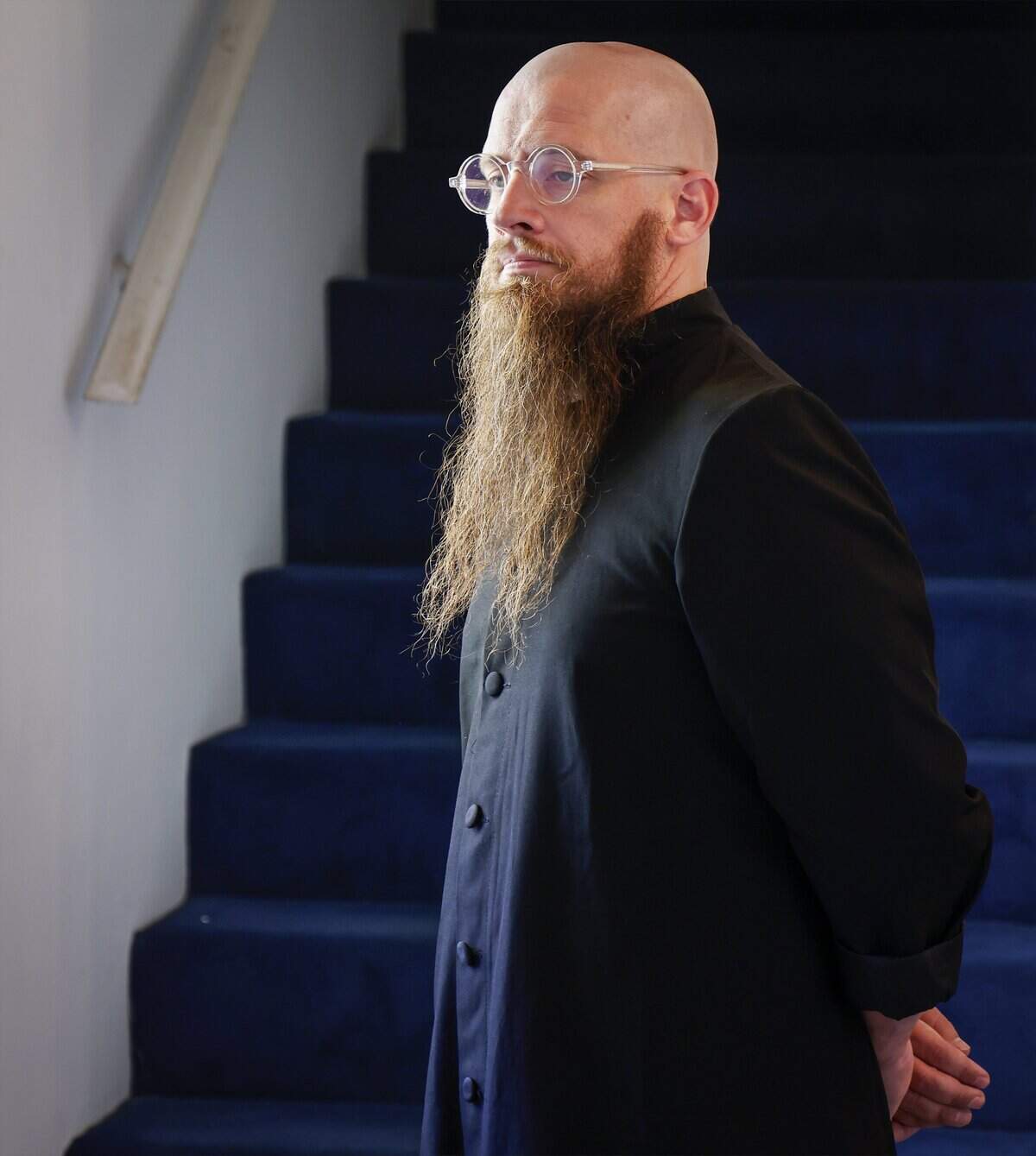 Rev. Jeff Hood is photographed before traveling to North Florida to be with William Silva, who was executed on Aug. 18. Carl Juste cjuste@miamiherald
Hood said he understands the family’s pain, but ultimately, believes the death will not bring the closure they are seeking.
“The death penalty is a scam. It promises things. It promises things that it will never be able to give. Protecting the memory of Patricia Silvia. Justice. This is justice. This is closure. I mean, we know these things are not true,” he said.
Though his work is tough and often takes a toll on his own mental health, Hood said his choice to continue walking with society’s condemned is one that is firmly rooted in this faith, and he likely isn’t going to stop anytime soon.
“My faith tells me that my path is the redemptive suffering of the cross, and so the only thing I know to do is to keep walking towards the cross,” Hood said. “Which means that I keep walking into the execution chamber over and over again.”
This story was produced with financial support from Trish and Dan Bell and donors in South Florida’s Jewish and Muslim communities, including Khalid and Diana Mirza and the Mohsin and Fauzia Jaffer Foundation, in partnership with Journalism Funding Partners. The Miami Herald maintains full editorial control of this work.
Miami Herald
Lauren Costantino is a religion reporter for the Miami Herald funded with financial support from Trish and Dan Bell and from donors comprising the South Florida Jewish and Muslim Communities, in partnership with Journalism Funding Partners. The Miami Herald retains editorial control of all work. Since joining the Herald in 2021, Lauren has worked as an audience engagement producer, reaching new audiences through social media, podcasts and community-focused projects. She lives in Miami Beach with her cocker spaniel, Oliver.