
For Democrats in Florida, this is going to be extremely difficult. But it’s not impossible.
It happened before — 44 years ago. That’s how long it has been since the Democrats in Florida won races for Senate and governor in the same election.
Mike Stocker/Sun Sentinel
Steve Bousquet began reporting from Broward County in 1981. The 1982 election was the first one he covered in Florida.
As it happened in 1982, contests for Florida Senate and governor fell on the same ballot. That doesn’t happen very often, because senators serve for six years and governors for four.
The fact that both races are on this year’s ballot is an oddity in itself.
It’s only because Marco Rubio resigned his Senate seat to become Donald Trump’s Secretary of State and Gov. Ron DeSantis appointed Ashley Moody to replace him.
By law, the vacancy is filled until the next statewide election. This Senate election is until 2028, when voters will re-elect a senator to a full six-year term.
Back in 1982, Florida was a vastly different place.
The biggest political difference was that Democrats were totally in charge. The major issues? They were not so different: crime, a refugee influx, overdevelopment, lack of water.
Democratic Sen. Lawton Chiles got 62% of the vote in defeating Republican Van Poole, a state senator from Fort Lauderdale. Democratic Gov. Bob Graham won even bigger, by 64%, against Republican L.A. “Skip” Bafalis, a congressman from Fort Myers who spoke with a heavy Boston accent.
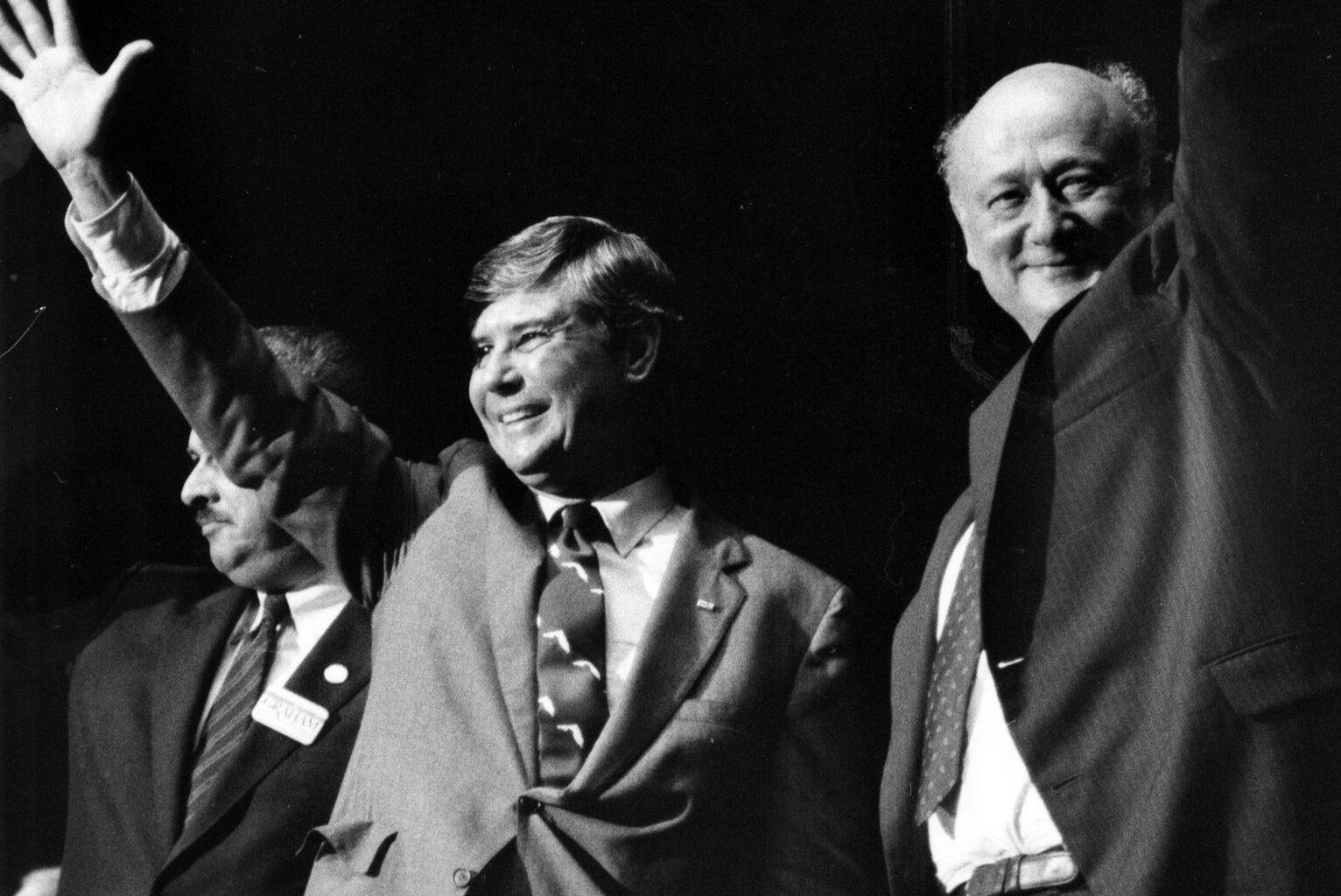
It was so long ago that the most relevant photo I could quickly find was one of Graham campaigning in Broward, of course, with a crowd of retirees at Sunrise Musical Theater and a special guest: New York City Mayor Ed Koch.
“If you agree with me on nine out of 12 issues, vote for me,” Koch used to say. “If you agree with me on 12 out of 12, see a psychiatrist.”
That wisecrack could apply perfectly to Angie Nixon, the Democrats’ nominee for Senate.
Whether you like her or not, she is a stellar grassroots organizer who proved it in dramatic fashion Tuesday by getting 56% of the vote against Alex Vindman despite raising very little money.
In the first 24 hours after her victory, Nixon doubled her total take and raised $1 million with an average donation of $38, Bloomberg reported. She’s quickly building a national profile, and TV appearances are a key to her ability to raise money.
“We did it,” Nixon said in a fundraising text Wednesday. “We won this primary without taking a dime of corporate PAC money.”
Republicans will label Nixon a socialist from now until the polls close, and she will face a serious challenge with a critical constituency — Jewish voters in South Florida. She calledIsraeli Prime Minister Benjamin Netanyahu a “war criminal” on “Morning Joe,” and favors ending unconditional aid to Israel.
But take a close look at her priorities (at angienixon.com): a higher minimum wage, Medicare for all, free child care, affordable housing, closing private for-profit prisons and detention centers, abolishing ICE, and raising taxes on the wealthy.
She is pro-worker and pro-consumer, and she’s against construction of any new data centers until federal guardrails are in place.
To many voters, that’s an easy nine out of 12, as Ed Koch would say.
For Democrats to repeat the feat of 1982, they’ll need to get behind the ticket of Nixon, a movement progressive and state legislator from Jacksonville, and David Jolly. A moderate former Republican congressman from Tampa Bay, Jolly is seeking to be the first elected Democratic governor since Chiles in 1994.
And oh, yes: Forty-four years after the Graham landslide, his daughter Gwen is Jolly’s running mate for lieutenant governor.
The law of averages, the reality of the Republicans’ massive advantage in voter registration in Florida, and the plain fact of the Democrats’ losing streak in statewide elections all suggest that a 1982-style two-fer is impossible.
A more likely scenario — to me anyway — is that one of them will win, but not the other. But who?
Jolly will have to beat Byron Donalds, the Republican nominee for governor who won his nomination Tuesday in a decidedly unimpressive fashion, with about 48% of the vote — considering he owned a prized endorsement from Donald Trump, more than $100 million and had campaigned for a year-and-a-half.
These are the Democrats’ two great possibilities for 2026.
Steve Bousquet is Opinion Editor of the Sun Sentinel and a columnist in Tallahassee and Fort Lauderdale. You can contact him at 850-567-2240 or at sbousquet@sunsentinel.com.