
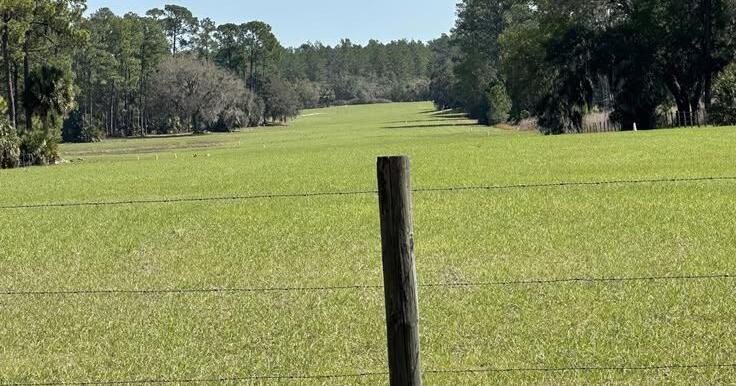
The Ocala National Forest is one of most magnificent ecosystems in the United States. Yet a Florida college wants to cut down a bunch of its trees and pave over part of it.
Embry-Riddle Aeronautical University in Daytona Beach is best known for training pilots. Flyboy U, as I like to call it, has bought 118 acres within the Ocala National Forest, an area called Deep Woods Ranch that contains a grass airstrip.
Embry-Riddle officials have proposed some big changes. The school wants to use the strip for lots of training takeoffs and landings. To make it work, though, school officials want to chop down nearly 40 acres of trees – but not on the college’s property. The trees are part of the national forest.
A few other people live in this enclave near the town of Paisley. They do not like this proposal and have made their objections plane – er, I mean plain. The same goes for people who enjoy the forest and are appalled at the idea of altering it.
Opponents have brought up the increased noise of the training flights, pollution from all the fuel, oil and rubber used by the planes, and damage to wildlife habitat.
“Nobody that’s heard about it is happy about it,” said Susan Fetter, president of the Lake County Conservation Council. She told me Embry-Riddle officials “think they can sneak something into a rural area and get away with it.”
One opponent says the biggest risk lies with the precedent being set.
“If we allow our forest to be stolen from the public for private users,” warned Richard Graham, who lives at one end of the air strip, “there will soon be thousands of companies lining up to make their case on why the public lands should be made as an exception as well for them to utilize.”
The 387,000-acre Ocala National Forest is the largest national forest east of the Mississippi. This forest contains the largest existing stand of sand pines in the world and more than 600 swamps, lakes, rivers and springs, not to mention the largest population of Florida scrub jays in the state.
About 650,000 people visit Ocala National Forest every year, according to the U.S. Forest Service.
Last year, National Geographic named the Ocala National Forest one of the best travel destinations in the world. The magazine praised its natural beauty, diverse ecosystems and recreational opportunities like swimming in crystal-clear springs.
Although the forest is mostly owned by the federal government, there are a few privately owned enclaves. One sliver of private land, about 220 acres, was owned by a retired Illinois banker. He put in some cattle and named it Deep Woods Ranch.
The retired banker had a small plane. Even though the DeLand Municipal Airport was just nine miles away, he wanted to take off from his own yard. In 1987, he persuaded Lake County to grant him permission to create a grass-covered, 2,000-foot landing strip there.
The banker specified it was for family and friends – no outsiders. However, there are stories floating around Lake County that the airstrip was occasionally used by the Cocaine Cowboys transporting goods from South America. Either way, a plane used to take off or land there maybe once every couple of weeks, tops.
In subsequent years, the ranch was cut into three pieces, according to Graham, whose 55-acre parcel is one of them. Then, with no notice to the neighbors, Embry-Riddle popped up as the airstrip’s new owner.
Suddenly, sleepy Deep Woods Ranch was scheduled for a major makeover.
The Embry-Riddle college campus, now located at 1 Aerospace Boulevard in Daytona Beach, trains thousands of pilots a year.
A key part of pilot training is practicing your takeoffs and landings. From its Deep Woods Ranch property, Embry-Riddle expects to launch 300 or so takeoffs seven days a week, 50 weeks a year, according to an analysis by Alan and Louise Chen, two engineers working with Fetter who have pored over the plans.
Somehow, the Chens said, nobody has done a noise analysis about what that will do to the forest’s abundant wildlife. That includes such imperiled species as gopher tortoises, roseate spoonbills and migratory swallowtail kites.
The Chens spotted scores of kites nesting three miles from the airstrip. Their foraging range is 15 miles, so they often fly over the runway.
“One day,” Louise Chen told me, “there were five of them circling above the runway.”
It’s not just wildlife that would be disturbed. Among Embry-Riddle’s neighbors is a 64-acre religious institution called Deerhaven Retreat and Conference Center in the forest near Paisley. It’s celebrating its 60th anniversary.
People seek out Deerhaven for its tranquility, said chairman Charles Greenberg. Embry-Riddle will ruin the very thing that makes it so appealing.
“The frequent drone of aircraft means groups using the center might not return, and Deerhaven would not survive,” he told me. “That would destroy our campgrounds.”
What does the U.S. Forest Service think of all this?
After all, that’s the federal agency managing our national forests. When the banker asked to build his airstrip, the feds specified that he wasn’t allowed to cut down any of their trees.
Now Embry-Riddle wants to chop down nearly 40 acres of trees that belong to the American people. Surely, I thought, the folks in the Smokey Bear hats are jumping up and down screaming, “No way!”
The answer, I was surprised to learn, is nope. The U.S. Forest Service, much like other federal regulatory agencies, has been converted into a virtual rubber stamp by our profit-first, protection-last presidential administration.
In fact, The New York Times recently reported that the Trump administration is trying “to open nearly 45 million acres of wilderness in national forests to road construction and logging, removing protections that had been in place for a quarter century.”
As for the Ocala National Forest, in April, a spokeswoman for the Forest Service promised WMFE-FM that the agency was studying Embry-Riddle’s proposal and would decide “once all environmental and regulatory reviews are complete.”
But in July, the agency decided it didn’t need any reviews, because Embry-Riddle was exempt from all that nitpicky stuff. If there are no requirements to meet, then there’s no problem meeting them, right?
Fetter and the Chens met with a forest service supervisor Aug. 18 and presented some information that the agency folks were apparently unaware of, Fetter told me.
“The permit is now on administrative hold,” she said.
Among other things, they pointed out flaws in the college’s own cursory environmental report.
The forest supervisor “found it somewhat amusing that the report mentioned it wasn’t a suitable habitat for sandhill cranes, which we followed up with the picture of a couple families of sandhill cranes running across the grass runway,” Alan Chen told me.
However, Fetter said, the forestry official said, “the county is the only agency that can stop it.”
Lake County officials learned what Embry-Riddle wanted to do long before the neighbors or forest fans did.
In 2024, county records show, an Embry-Riddle vice president invited Commission Chairwoman Leslie Campione and other county officials to the college’s Daytona Beach campus to discuss the Deep Woods Ranch airstrip.
The college vice president, Tyler Siroise, is in charge of “government relations” at Embry-Riddle. He is also a member of the state House of Representatives. In 2024, he was midway through his term as the House majority leader.
You can see how county officials would want to accommodate someone in the legislative leadership corps. The desires of Rep. Siroise would count for more than the desires of a bunch of tree huggers, rural neighbors and religious campers.
There’s nothing wrong with county officials helping an economic development project, the Chens said. But “who was independently identifying and evaluating the risks to Lake County, neighboring property owners and the surrounding national forest?”
The college initially submitted an elaborate plan that included not just paving the airstrip but also building hangars, classrooms and research facilities. The county staff recommended approval. In its report, the county referred to the surrounding national forest as “vacant land.”
I can’t tell you how much I loathe hearing nature preserves referred to as “vacant” simply because they hold nothing manmade.
The college applied for a change in the zoning. Opponents lined up to point out the many flaws in its plans. But on the day the county was supposed to hold a public hearing, Embry-Riddle abruptly withdrew its application.
As a result, “there has never been a public hearing on this project,” Greenberg said.
What changed? The county attorney agreed with the college’s attorney that the main thing the college wanted, paving the grass airstrip, wasn’t expressly forbidden by the zoning already in place.
Presumably, they could use that justification for other questionable stuff. How about a Deep Woods Ranch shopping mall? Gas station? Nuclear plant? Hey, there’s nothing to forbid it!
Despite that abrupt turn of events, the Embry-Riddle plan has yet to take off, primarily because of Graham.
Graham, a former Navy Seal, has been using his property for a veterans’ charity and sniper training. It’s not that Embry-Riddle is afraid he’ll shoot down their planes. It’s that he’s repeatedly pointed out that Embry-Riddle has not considered the rights he holds to an easement across its property.
I tried repeatedly to get Siroise or someone else from Embry-Riddle to talk to me. The best I could get was a boilerplate response: “Embry-Riddle continues to work closely with Lake County and other regulatory agencies as we develop a limited footprint in the area.”
The main question I wanted to ask was: Why did the college need to build on THIS inappropriate site? A quick Google search turned up 11 other airports in Florida that are for sale right now.
One major rule of aviation is, “What goes up must come down.” If an Embry-Riddle trainer goes down, there’s nowhere outside of that airstrip to land safely. A falling plane is going to collide with many, many pines.
“Why are they training kids in a forest?” asked conservation council member Cindy Newton. “It’s a safety issue. That’s baffled me.”
Maybe Embry-Riddle couldn’t see the trees for the forest.
I think if its leaders are smart, they will sell this property to the national forest and look elsewhere for training. Rather than try to fly a craft this flawed, they should just bail out.
Craig Pittman is a native Floridian. In 30 years at the Tampa Bay Times, he won numerous state and national awards for environmental reporting. He is author of six books and co-host of the “Welcome to Florida” podcast. In 2020 the Florida Heritage Book Festival named him a Florida Literary Legend.
This article is a shortened version republished from Florida Phoenix under a Creative Commons license. Visit https://floridaphoenix.com.
Florida Phoenix is part of States Newsroom, the nation’s largest state-focused nonprofit news organization.