
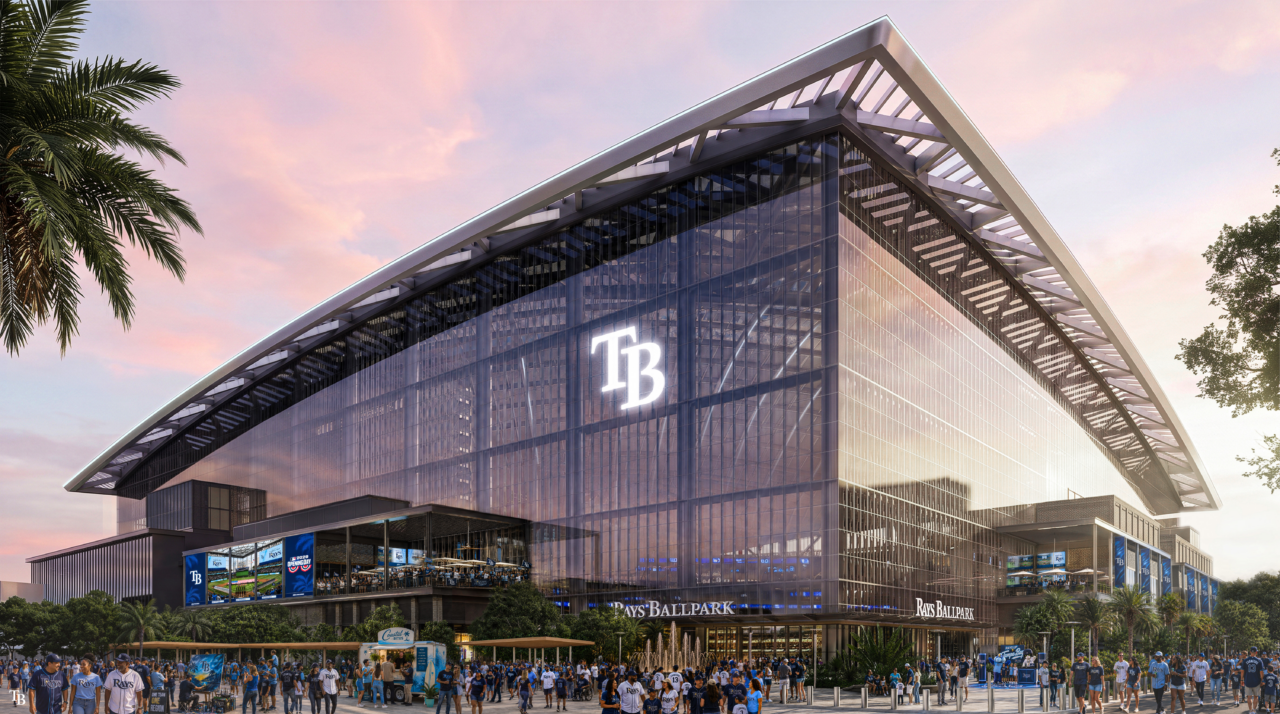
The Tampa Bay Rays’ proposed new home in Hillsborough County is no longer being negotiated through broad strokes.
Hundreds of pages of definitive agreements released Friday put legal terms behind the roughly $2.36 billion ballpark project, cutting the direct local public contribution by $100 million and replacing a controversial Community Redevelopment Area (CRA) contribution with a new financing structure tied to future development around the stadium.
The documents also put firmer protections around that public investment. The Rays would cover cost overruns and design or construction defects, public money would flow through a construction trust, and the team must demonstrate that its own financing is available before taxpayer dollars can be released.
Tampa City Council Chair Alan Clendenin said the result represents the culmination of months of negotiations over a project that had to work for more than the baseball club.
“I’ve said from the beginning that this had to be a win-win-win. It has to be a win for the Rays, it has to be a win for the people that live in the City of Tampa and a win for people who live in Hillsborough County,” Clendenin told Florida Politics.

Tampa Mayor Jane Castor described the mood Saturday as “guarded excitement.”
“It’s been quite a journey,” Castor told Florida Politics. “You have to commend everybody involved — the County, the Rays, the City — everybody really working together collaboratively and, I think most importantly, compromising along the way.”
How the money works
Under the earlier memorandum of understanding, Hillsborough County was expected to contribute up to $796 million while Tampa and its CRA would provide up to $180 million.
The definitive agreement keeps the county contribution at roughly $796 million but reduces Tampa’s direct contribution to $80 million, bringing the city and county contribution to about $876 million.

Against the roughly $2.36 billion project budget, that works out to about 37% of the cost. The Rays would be responsible for the remaining project costs and cost overruns under the agreement.
Hillsborough’s share comes from roughly $303 million in Tourist Development Tax (TDT) funding — including about $263 million in bonds and a $40 million reserve — $360 million in county Community Investment Tax (CIT) dollars, $103 million in other county funds and $30 million in federal disaster-recovery reimbursements for eligible stormwater improvements. The TDT bonds include an initial $228 million tranche and a later $35 million tranche dependent on available bonding capacity.
The county CIT money would come in four $90 million installments. If the state does not fully deliver a separate $100 million pledge for improvements to Lithia Pinecrest Road by the end of 2031, Hillsborough may reduce its CIT contribution by the same shortfall.
Tampa would provide its $80 million in four $20 million installments beginning in 2027. The Rays’ financing summary says no city CIT money would be used, and the city contribution is restricted to eligible infrastructure rather than construction of the ballpark itself.
Castor said the city has not yet settled on how it will raise that money upfront.
“We have yet to land on the funding structure for that. It may be a line of credit,” Castor said, adding that the funding ultimately “would be repaid through the TIF.”
A new path for the City of Tampa
Tax increment financing, or TIF, would use future property-tax growth generated by the redevelopment. That structure became pivotal after Tampa city officials moved away from an earlier plan for the Drew Park CRA to contribute directly to the project.
Under the new structure, the former $100 million CRA contribution would be replaced with debt sold to private investors through a new Community Development District, or CDD. Future property-tax growth from the development would help repay that debt.
Money flowing to the district would first go toward debt service and reserves, and could later reimburse eligible infrastructure costs and pay for other public infrastructure and capital expenses.
Council Member Bill Carlson said the CDD was designed to keep that financing tied to public infrastructure rather than privately used portions of the development.
“In this case, there’s extra protection for the public by going through a CDD,” Carlson said. “Also, it can only be used on government-owned infrastructure. They can’t use it on the for-profit areas.”
The package calls for extending the East Tampa, West Tampa and Drew Park CRAs to the maximum period allowed under state law. Hillsborough County would stop contributing its share of tax increment during the extension periods.
The legal documents released Friday omitted the Drew Park extension, but Carlson said a Rays attorney told him Saturday the omission was an oversight and would be corrected. The team also included the extension in its public summary.
“Everybody had agreed on it verbally, but they forgot to put it in,” Carlson said.
The stadium property itself would be carved out of Drew Park to become part of the new financing district. Tampa’s contribution to the Downtown CRA would also be reduced by 50%, subject to protections for existing bonds and other obligations. Those funds could then be spent on infrastructure or capital improvements throughout other parts of the city, rather than being locked into the downtown area.
Votes are next, but not the last step
Tampa Council Members Naya Young, Luis Viera, Carlson and Clendenin voted Thursday to place the Rays funding agreement on the City Council’s Aug. 27 agenda, while Lynn Hurtak, Charlie Miranda and Guido Maniscalcoopposed the move.
If that lineup holds, the agreement appears to have the four City Council votes necessary for approval. The Hillsborough County Commission is expected to take up its portion of the deal after Tampa acts.
But favorable votes next week are not guaranteed, and even favorable votes would not finish the financing.
The agreement targets mid-December for TIF and CDD ordinances and Jan. 15, 2027, for an interlocal agreement, with June 30, 2027, as the outside date for all required CDD approvals. City Council also must address CRA boundary changes and a comprehensive plan amendment.
“There’s a great deal of legal work that needs to be done,” Castor said. “There’s all kinds of details that go into bringing this all to fruition, so it really is a great day, but there’s still a lot of work to do.”
Protections around the public money
Before public construction money can be released, the Rays must show that their financing is ready, including access to at least $150 million through Major League Baseball’s infrastructure financing facility, available owner equity, and firm commitments for other credit facilities needed to cover the team’s share.
City, county and Rays funds would be managed through a construction trust, with payments tied to documented project costs. Tampa and Hillsborough also retain rights to examine, copy and audit the financial records of StadCo, the Rays’ stadium entity, related to the agreement.
“This isn’t a blank check,” Clendenin wrote in a Saturday morning social media post. “The public contribution is capped, the Rays take the construction overrun risk, and public dollars come with significant accountability requirements.”
The $80 million cap applies to Tampa’s project contribution. A future interlocal agreement would separately require the city and county to fund certain capital maintenance and repairs at the ballpark, with the amounts to be set later.
The agreement says neither Tampa nor Hillsborough is responsible for cost overruns and makes StadCo solely responsible for design and construction defects. The Rays’ parent company, Florida Baseball Partners, would separately guarantee StadCo’s payment and performance obligations to both governments.
A non-relocation agreement would also generally bar the Rays from pursuing a move outside Hillsborough County during the ballpark agreement’s 35-year initial term, subject to limited exceptions.
Beyond the ballpark
Final approval votes have not been cast, but supporters argue the project’s significance extends beyond the ballpark itself.
The Rays envision the ballpark anchoring roughly 120 acres around Hillsborough College’s Dale Mabry campus, with plans for up to 8 million square feet of office and mixed-use development. The team’s economic analysis projects 11,900 permanent jobs and $55.5 billion in economic impact over three decades.
Castor said she has visited The Battery in Atlanta, the roughly 60-acre mixed-use development surrounding the Atlanta Braves’ Truist Park, and sees it as a model for the type of district the Rays are trying to create in Tampa — but on a much larger, roughly 120-acre footprint.
“That really is what the Rays organization has built the vision off of,” Castor said.
She said the project could also strengthen Tampa’s “Champa Bay” identity by putting the Rays near the Buccaneers and giving the city a signature sports-anchored district of its own.
“Everyone that has been there knows there’s a great deal of just barren, flat asphalt parking lots,” Castor said. “To be able to create, in essence, something along the lines of a Water Street or a Gas Worx or a Midtown that puts three sports stadiums all in one geographic area. Really, the opportunities are endless.”
Castor acknowledged that the scale of public involvement will continue to draw skepticism, but said large projects rarely move forward without opposition.
“People are going to have reservations, and I certainly respect that, but no large visionary project has been completed in our city — or frankly in any city across the nation — without naysayers,” Castor said.
Clendenin said the broader transformation is also what drives his support.
“It’s funny, but you don’t hear me talk much about baseball,” Clendenin said. “Because to us, as politicians, we’re looking at this as a driver for job creation, housing creation and recreation for the city.”
After months spent negotiating how to pay for it, that argument now moves to the dais Aug. 27.