
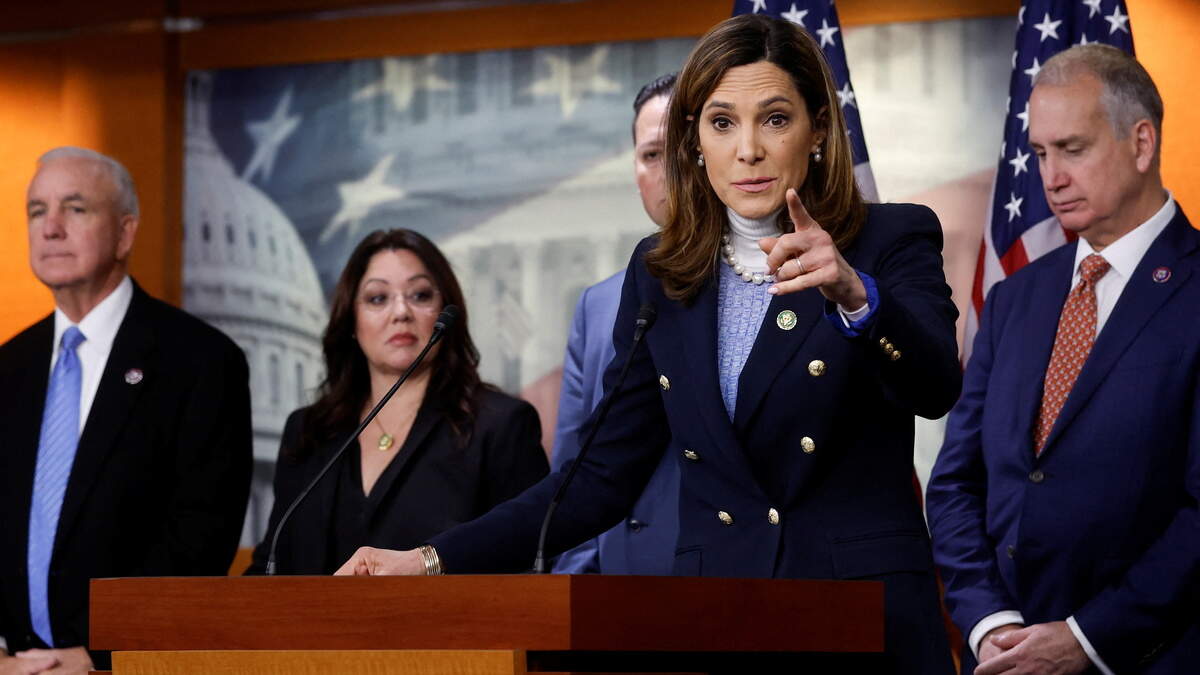
U.S. Rep. Maria Elvira Salazar (R-FL) speaks to reporters during a news conference with members of the House Hispanic Conference on Capitol Hill in Washington, D.C. on Feb. 1, 2023. She’s flanked by Miami U.S. Reps. Carlos Giménez (far left) and Mario Diaz-Balart (far right).
JONATHAN ERNST
REUTERS
Miami Republican U.S. Rep. Maria Elvira Salazar has become increasingly blunt in her disagreement with President Donald Trump’s mass deportation efforts and how she believes they hurt Republicans among Hispanic voters: “Mr. President, listen to what I’m telling you, sir: You’re a smart guy — you are playing with fire,” she said during an interview with the New Yorker Radio Hour podcast in late July.
Salazar remains a staunch Trump supporter. Her criticism of his immigration policies could be a matter of principle — or simply survival. Although she’s favored to win reelection, she’s the most vulnerable Republican member of Congress in Miami’s November midterms. Her constant plugging of her Dignity Act immigration reform legislation, even during a Vatican visit to Pope Leo this month, is often cringeworthy.
Salazar may be posturing, but she shouldn’t be one of the few Republicans in a community largely built by immigrants who’s willing to break with Trump on immigration, as she did in July. She was one of only two Republicans who signed a “discharge petition,” a procedure to force a U.S. House vote on a bipartisan immigration bill she co-sponsored called the “American Dream and Promise Act.” The legislation would give eligible TPS holders permanent status and protect Dreamers, people brought to the U.S. illegally as children.
There are practical reasons for her signature: Salazar’s District 27 is 73% Hispanic, according to the U.S. Census, and, arguably, there’s no other district more affected by deportations and the termination of Temporary Protected Status for Venezuelans and Haitians.
The discharge petition needs 218 signatures from House members to force an up-or-down vote on the legislation. So far, there are 210 signatures. Pennsylvania U.S. Rep. Brian K. Fitzpatrick is the only other Republican who’s signed it.
This bill, to be clear, will probably never become law. But it’s the second recent bipartisan effort to try to force Congress to address the looming calamity of deporting hundreds of thousands of Haitians, Venezuelans and others who had their TPS revoked by the Trump administration and risk returning to countries in turmoil.
“I am co-leading the Dream and Promise Act and was the first Republican to sign the discharge petition because the situation is dire, and we cannot allow Congress to keep avoiding the issue,” Salazar told the Herald Editorial Board in a statement. “Congress must act because we cannot keep governing immigration through temporary executive actions that change every time the White House changes hands.”
A previous measure to extend TPS through 2029 for Haitians cleared the House with support from Salazar as well as Miami’s two other GOP congressmen, Carlos Giménez and Mario Diaz-Balart. The legislation has so far failed in the U.S. Senate and Florida’s Republican Sens. Rick Scott and Ashley Moody have not committed to supporting it.
The “American Dream and Promise Act” may be even less palatable to conservative Republicans, who might see it as “amnesty” for immigrants. (Salazar’s Dignity Act, has also faced that accusation, which she denies.) But wouldn’t it be nice if Congress at least discussed some type of reform to address the immigrants who contribute to the country’s economy?
First introduced in 2021, The American Dream and Promise Act would grant eligible Dreamers a 10-year “conditional permanent status” that would later allow them to qualify for permanent status if they study, serve in the military or work for at least three years. TPS holders who were eligible for TPS by July 1, 2024, could apply for lawful permanent status within three years of the bill’s enactment if they pass a background check. The bill’s main sponsor is Rep. Sylvia Garcia, D-Texas.
Adelys Ferro, co-founder of the Venezuelan American Caucus, told the Editorial Board that she’s encouraging people to write to their members of Congress asking them to support the discharge petition. Notably absent from the list of petition signers are Giménez and Diaz-Balart. “The majority of their districts have been built by immigrants,” Ferro said.
Salazar said at a July 21 news conference outside the U.S. Capitol that her efforts are meant to send a “message to our Republican Party, who should be leading on this topic because we have the majority in Congress and in the Senate.”
Both parties have squandered the opportunity for immigration reform when they controlled Congress. But under Trump, the Republican Party has succumbed to an anti-immigration fever, so Salazar’s efforts will probably fall on deaf ears. But at least she is trying.
BEHIND THE STORY MORE What’s an editorial?
Editorials are opinion pieces that reflect the views of the Miami Herald Editorial Board, a group of opinion journalists that operates separately from the Miami Herald newsroom. Miami Herald Editorial Board members are: opinion editor Amy Driscoll and editorial writers Isadora Rangel and Mary Anna Mancuso. Read more by clicking the arrow in the upper right.
What’s the difference between an op-ed and a column?
Op-Eds, short for “opposite the editorial page,” are opinion pieces written by contributors who are not affiliated with our Editorial Board.
Columns are recurring opinion pieces that represent the views of staff columnists that regularly appear on the op-ed page.
How does the Miami Herald Editorial Board decide what to write about?
The Editorial Board, made up of experienced opinion journalists, primarily addresses local and state issues that affect South Florida residents. Each board member has an area of focus, such as education, COVID or local government policy. Board members meet daily and bring up an array of topics for discussion. Once a topic is fully discussed, board members will further report the issue, interviewing stakeholders and others involved and affected, so that the board can present the most informed opinion possible. We strive to provide our community with thought leadership that advocates for policies and priorities that strengthen our communities. Our editorials promote social justice, fairness in economic, educational and social opportunities and an end to systemic racism and inequality. The Editorial Board is separate from the reporters and editors of the Miami Herald newsroom.
How can I contribute to the Miami Herald Opinion section?
The Editorial Board accepts op-ed submissions of 650-700 words from community members who want to argue a specific viewpoint or idea that is relevant to our area. You can email an op-ed submission to oped@miamiherald.com. We also accept 150-word letters to the editor from readers who want to offer their points of view on current issues. For more information on how to submit a letter, go here.