
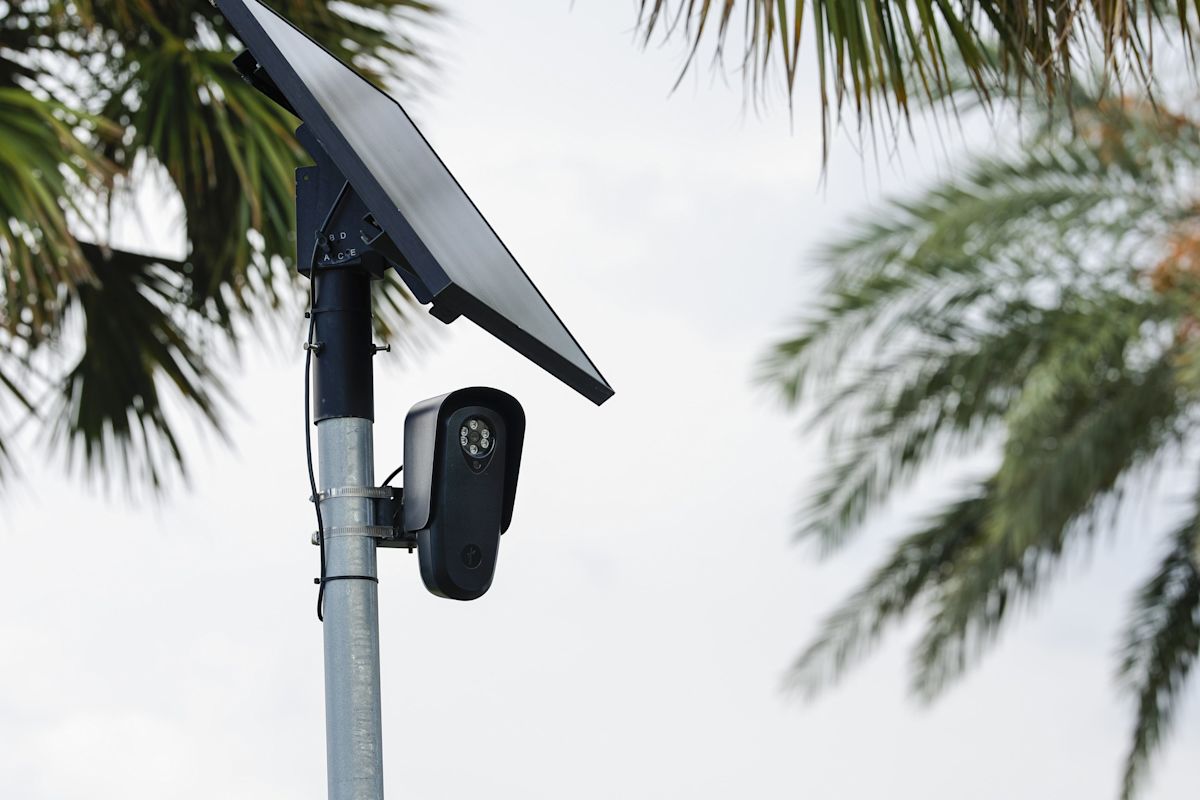
Pay attention while you’re driving, and somewhere in your neighborhood you might spot a tall, black pole with an oval-shaped camera hanging beneath a small solar panel.
Those are Flock cameras. They’ve popped up on streets across the country — including in Tampa Bay — recording license plate information from vehicles and sparking concerns about government surveillance.
Last Saturday, more than 100 people filled the largest meeting room at the President Barack Obama Main Library in St. Petersburg to learn about the cameras from an activist group called DeFlock St. Pete. A flurry of recent news stories have documented misuses of Flock technologyby police officers, including stalking and harassment.
Here’s what to know.
What are Flock cameras?
Flock Safety, founded in 2017, is a surveillance technology company best-known for selling automated license plate reader cameras.
The software is powered by artificial intelligence, which scans passing vehicles for plate information and adds it to a searchable database that’s accessible by law enforcement.
Police agencies can choose to share data with each other and can access private businesses cameras when given permission, creating a vast network of vehicle information. The company says its technology helps law enforcement solve crimes by tracking suspects.

A Flock camera watches drivers entering a Home Depot parking in Pinellas Park.
Flock isn’t the only company that uses license plate reader technology. Axon, the multibillion-dollar firm that manufactures Tasers and body cameras, also sells license plate readers that can be installed in police cars.
License plate readers have been around for years. The United States Border Patrol used them in the late 1990s, and they were introduced to local law enforcement in the early 2000s. Back then, officers had readers mounted in their cars and would choose which plates to run.
Now, artificial intelligence methods used by Flock and other companies have supercharged the technology. Cameras today read every plate and feed databases that log enormous amounts of information.
Why is Flock drawing backlash?
Private citizens and policy experts are concerned about mass surveillance. Unlike traditional speeding cameras, Flock’s technology constantly captures vehicles that pass a camera’s field of view, recording details like make, model and color. That information is stored in a database, which law enforcement can search, often without a warrant.
Flock says the technology isn’t meant to surveil people, but a new tool they’re offering allows searches of video based on personal characteristics such as clothing and jewelry, further fueling concerns about privacy.
Chad Marlow, a lawyer at the American Civil Liberties Union, said the backlash against Flock is uniquely bipartisan because it taps into concerns about government overreach.
“Even the politically non-engaged, they just have this overall ick factor to the idea that they’re being watched and tracked everywhere they go, even though they’re not accused of doing anything wrong,” he said.

A protester in Los Angeles holds up an anti-Flock sign. The technology has sparked backlash across the country, including in Tampa Bay.
Over the past several months, news reports and activists have found that police officers across the country, including some in Florida, have used Flock tools to stalk people.
The company announced new accountability features last week. Those include a recommendation to purge data after seven days instead of 30 and a requirement that police enter a case code linked to a criminal investigation when searching for a license plate.
Getting records that show how officers and deputies in Tampa Bay search Flock databases has proven difficult. Several agencies contacted byTimes reporters did not fully respond to questions or records requests, citing public records exemptions that protect police surveillance methods.
Who is using the cameras in Tampa Bay?
A map published by the national DeFlock activist group shows roughly 800 cameras scattered across Pinellas, Hillsborough and Pasco Counties — some of which are owned by private businesses.
Times reporters asked law enforcement agencies about their use of Flock technology and other license plate readers. Most did not answer questions, including the Hillsborough County Sheriff’s Office and Polk County Sheriff’s Office.
The St. Petersburg Police Department said it has 50 cameras, and about a third of its officers are able to search Flock’s network across more than 1,000 agencies. Every patrol car is also equipped with an Axon license plate reader.
The Pasco County Sheriff’s Office says it leases about 70 Flock cameras and can search data from other agencies. But the office is in the process of switching to Axon, which it expects will be cheaper.
The Tampa Police Department currently has 25 cameras.
It’s difficult to know who runs a Flock camera just by looking at it. In some cases, installing a camera might require a permit from a government agency such as a state transportation department. Permits may reveal the location and the owner.
Activist organizations like DeFlock have also crowdsourced locations, with members reporting the cameras thatthey see while out driving.
How much do the cameras cost?
Flock doesn’t publicly post the cost of a camera on its website. The company operates on a subscription model — pay a yearly fee and Flock handles installation, maintenance and software updates.
In 2024, St. Petersburg police renewed a contract with Flock for five years at a cost of $730,250. The agency said it has 50 cameras, so the math comes out to about $2,900 per camera, per year.
Other departments that answered the Times’ survey reported similar costs — the Gulfport Police Department said it pays $3,000 per camera, per year.
How can I spot the cameras?
The cameras typically sit atop a pole, next to a rectangular solar panel. They’re commonly found in parking lots and alongside busy intersections. Sometimes, a sticker on the back will bear the company’s logo.

The back of a Flock camera in Brandon has a QR code label with details about the technology.
Do the cameras use facial recognition?
Flock says its cameras do not use facial recognition.
Who has access to camera data?
Law enforcement can share their data with each other. Police departments can access information from agencies far outside their jurisdiction in Flock’s database. For example, St. Petersburg police have access to data from 1,039 agencies nationwide.
Homeowners associations, gas stations and other businesses can also acquire Flock cameras, although those groups do not have the same data-sharing abilities as law enforcement, according to the company. That means they can search their own cameras and pass information to law enforcement, but they typically aren’t able to tap into the larger network.