
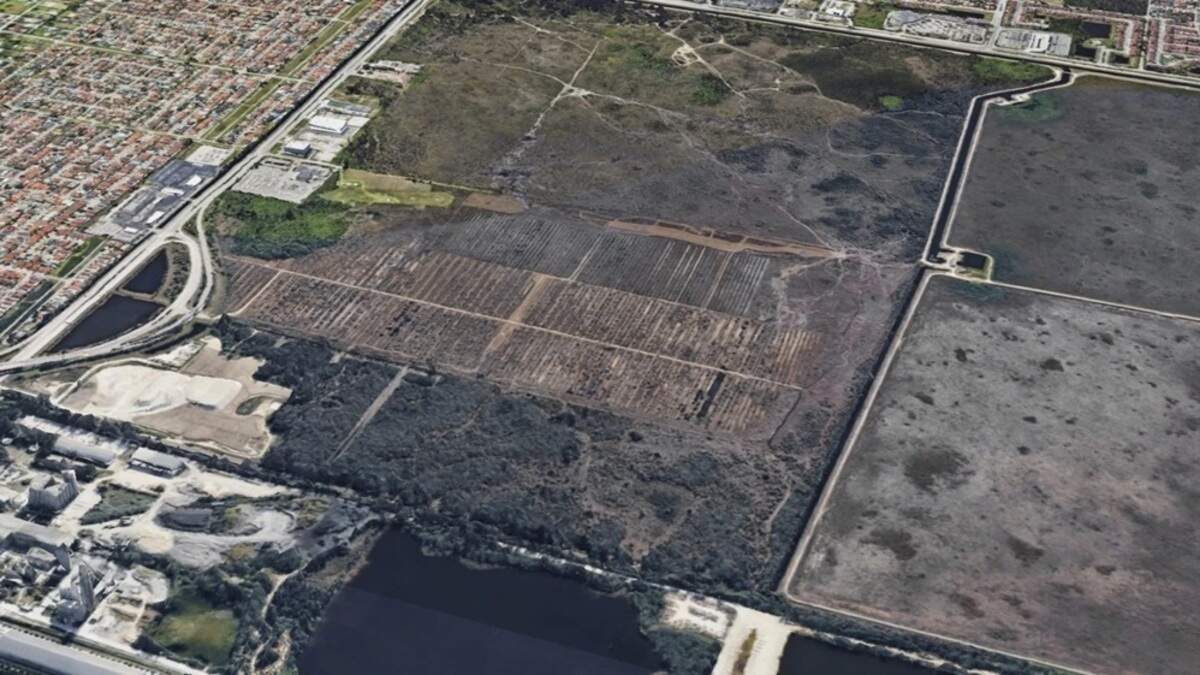
Kelly Tractor has asked Miami-Dade to amend its county growth plan to make way for buildings covering 2.2 million square feet on wetlands outside the Urban Development Boundary and west of Sweetwater. The company says it wants to move its headquarters, where it sells, leases and repairs heavy equipment.
Google Earth
Miami-Dade should flatly reject the Kelly Tractor application to build new headquarters outside the county’s Urban Development Boundary, or UDB.
The proposal would enable intensive industrial development on approximately 246 acres outside the UDB, including approximately 162 acres of regionally significant wetlands, an area roughly equivalent to 120 football fields. That alone warrants serious concern. But the stakes are even higher because approving the application through a planning mechanism that sidesteps the traditional process for moving the UDB would establish a damaging precedent for future development beyond the boundary.
The Urban Development Boundary separates suburban development from the county’s environmentally sensitive and agricultural lands. It is one of Miami-Dade County’s most important growth-management tools. Along with the Comprehensive Development Master Plan (CDMP) — the county’s long-range blueprint for growth — it provides a predictable framework for directing development and balancing growth with infrastructure and long-term community needs.
This framework only works if exceptions do not become the rule.
Unlike most proposals outside the UDB, which would require moving the boundary itself, the Kelly Tractor application seeks backdoor approval via a text amendment to the county’s comprehensive plan.
The distinction is important. If the county allows a major industrial project outside the boundary through an alternative mechanism, future applicants could point to that decision when seeking a similar outcome. A boundary line meant to guide growth loses its meaning if it can be circumvented project by project.
The environmental consequences are also substantial. The 162 acres of wetlands the proposed development would affect is not vacant land available for a higher use. These wetlands are nature’s infrastructure, absorbing and storing stormwater, reducing flooding, filtering pollutants, recharging groundwater and providing critical habitat for fish and other wildlife. They are also part of the interconnected system that sustains the Everglades and Biscayne Bay, helping move, store and clean the water that ultimately supports South Florida’s iconic ecosystems.
In a region already investing billions to restore the Everglades, improve Biscayne Bay’s health and address flooding and water quality, we should strive to prevent the loss of wetlands that provide these essential services naturally. The stakes are high and the potential adverse environmental impacts deserve scrutiny.
Mayor Daniella Levine Cava deserves credit for vetoing the County Commission’s initial approval of the Kelly Tractor application and pushing for improvements to the proposal. Her intervention provided an important opportunity to address concerns raised about the detrimental project. Yet the revised application still requires careful public and scientific scrutiny.
Shortly before the July 21 public hearing, the administration released a memorandum containing 131 pages of new information and revisions to the proposal. Commissioners, technical experts, community organizations and residents had little time to review the changes before the hearing.
While we appreciate the mayor’s strong opposition in vetoing the initial proposal and attempting to improve the application, adequate time to review this proposal is critical.
Projects of this magnitude deserve careful evaluation and meaningful public input before a final decision is reached. Transparency means more than posting documents online. It means providing adequate time for residents, experts and officials to review new information and understand the implications of changes before casting a vote.
When a proposal changes substantially, the public should have an opportunity to comment on the updated version that’s actually being considered. This is a fundamental principle of good government.
For these reasons, this is about so much more than one application and one property.
It’s about whether Miami-Dade will continue to honor and uphold a planning framework designed to manage growth responsibly. It’s about whether wetlands will be treated as essential natural infrastructure. And it’s about whether the public can trust that major land-use decisions at the county level will be made openly, deliberately and with time for meaningful scrutiny.
The Miami-Dade County Commission should deny Kelly Tractor’s application.
Approving it would threaten wetlands and open a Pandora’s box that would create a troubling precedent of building outside the UDB. Allowing consequential revisions to move forward without adequate public and scientific review would set another ill-considered precedent.
Lauren Jonaitis is the Tropical Audubon Society’s executive director.