
For people experiencing homelessness, finding help can be difficult. For those struggling with complex behavioral health needs, seeking out that help can feel even more overwhelming.
A new initiative in St. Petersburg is trying to remove some of those barriers by bringing services directly to people living on the streets.
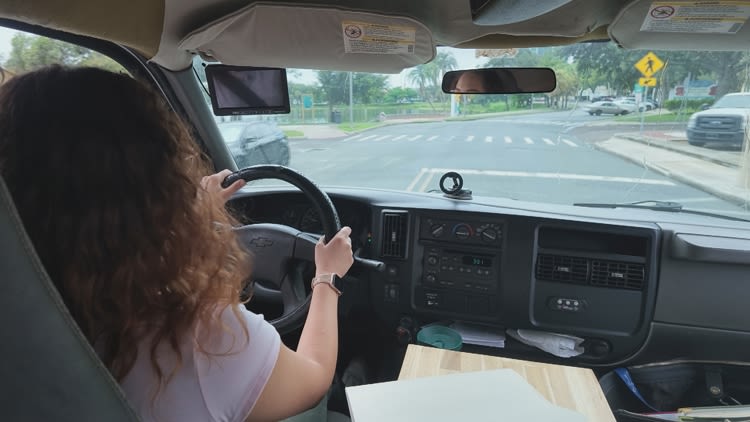
The Firefly Project, operated by Boley Centers, began running earlier this month. The program uses a retrofitted 12-passenger van to provide outreach and behavioral health services to people experiencing homelessness throughout the city.
The bus is equipped with a shower, bathroom, kitchen, air conditioning and a sitting area. Staff also provide food, clothing and other basic necessities while working to connect people with longer-term services and housing.
Kiroglu said the goal is to meet people where they are rather than expecting them to navigate the existing system on their own.
“If you are someone who struggles to wake up and take a shower and get something to eat, I can’t expect you to wake up and come make it to your appointment at my office, or come take your meds, or whatever the situation might be,” said Sev Kiroglu, manager of the Firefly Project. “I have to be able to come to you with those services and the support that we’re offering.”
Boley Centers has specialized in housing for people with severe and persistent mental illness for about 50 years. The team now spends Tuesday through Friday, from 8 a.m. to 6 p.m., on the bus, traveling to areas where people experiencing homelessness are known to gather, including parks, churches and other organizations that provide homeless services.
Staff average about five or six people served on the bus each day. On Mondays, when staff operate from an office, they see about 15 to 20 people.
The project began earlier this year using an apartment complex as an interim location before the mobile unit began operating at the start of August.
Kiroglu said the mobile approach fills a gap she saw in the existing system.
“I think it’s the one piece that’s been missing,” she said.
The city of St. Petersburg is funding the Firefly Project with $350,000 over two years. That funding currently limits the project to serving people within St. Petersburg.
More than half of the people experiencing homelessness in Pinellas County are staying in St. Petersburg, according to the county’s latest Point-in-Time count.
Kiroglu said the organization hopes to secure additional funding to expand the program throughout Pinellas County.
For now, the team is focused on building relationships with people who have struggled to connect with services.
Kiroglu said about one-third of the people the organization has worked with since January had already been receiving homeless services in St. Petersburg for more than 10 years.
To her, that highlights how difficult it can be to break the cycle of homelessness for people with complex needs.
“Our belief is in order for healing to begin and in order for long-term stability to be found, we need to understand where you came from and how you ended up in your current situation,” Kiroglu said.
And while the Firefly Project is still in its early stages, Kiroglu said she is already seeing signs that the approach is working.
“It’s helping. It’s helping,” she said.