
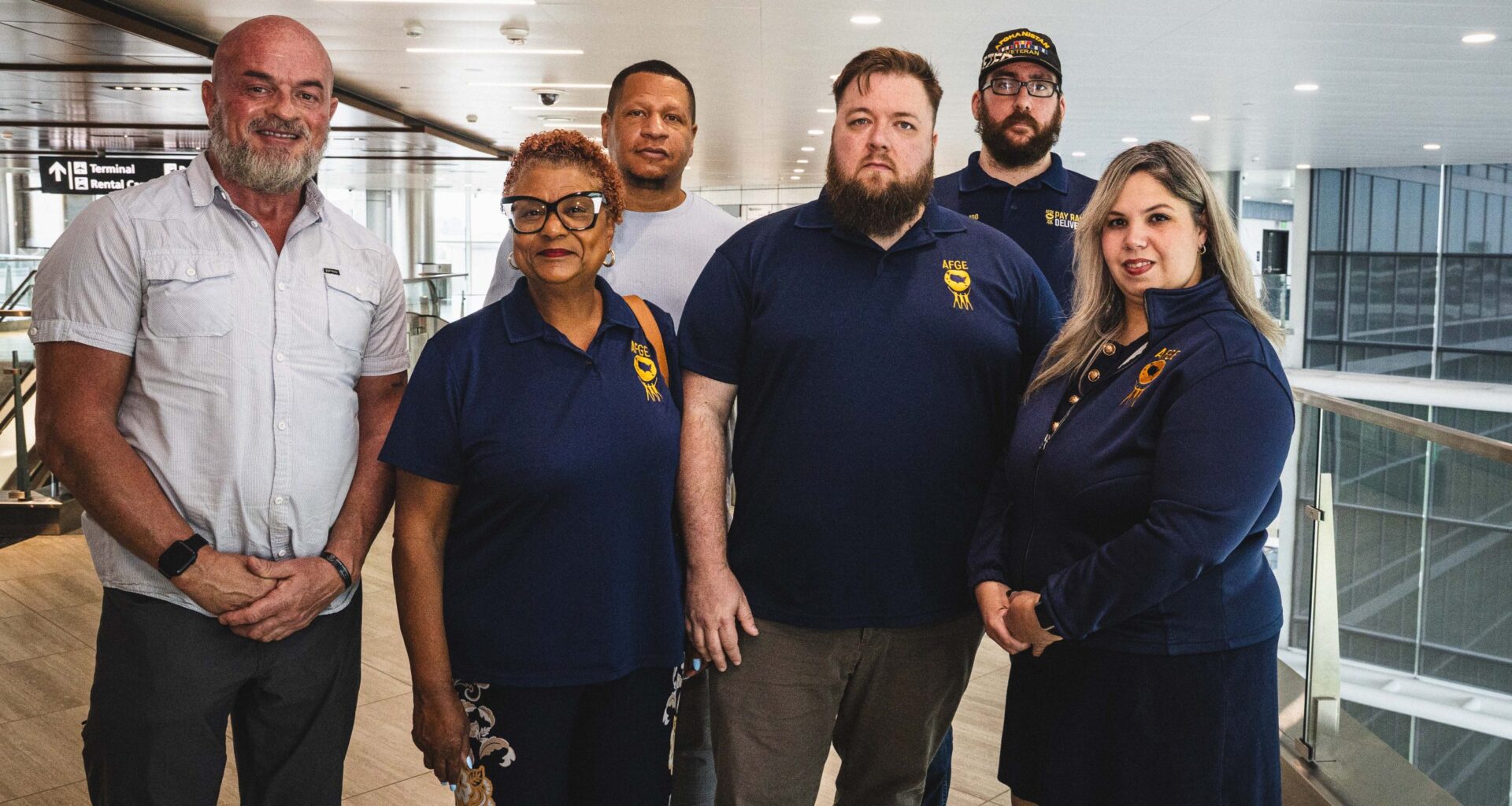
 Members of the American Federation of Government Employees at Tampa Airport International Airport on Aug., 6, 2026. Credit: Dave Decker / Creative Loafing Tampa Bay
Tampa International Airport has decided to drop its interest in the TSA Gold+ program—a controversial security program that would have put a private contractor in charge of passenger screening and screening equipment. The news, announced in a press release this morning, comes after the airport faced immense public pushback. The Transportation Security Administration also faced a Freedom Of Information Act lawsuit from the labor union that represents federal TSA officers.
“The Airport conducted an extensive review and evaluation over several months, which resulted in its decision to keep screening operations exclusively with the TSA, and not adopt the Gold+ model,” a news release from TPA states.
“We have worked closely with our TSA team through record passenger growth, severe weather, federal funding disruptions, and peak travel periods. We value their professionalism and commitment to security and service, and look forward to continuing our strong partnership,” said TPA CEO Michael Stephens.
The shift to TSA Gold+ — a program allegedly developed in secrecy outside of the public eye —would have privatized the jobs of more than 700 TSA officers at TPA.
Officers at the airport who stood to be directly affected by the move saw the shift as prioritizing “profit over security.”
The TSA, a federal agency within the U.S. Department of Homeland Security, was created nearly 25 years ago in the wake of the Sept. 11, 2001 terrorist attacks, and employs more than 700 security officers at TPA alone.
On July 20, however, the Tampa airport announced it was one of three airports nationwide — along with Des Moines and Charleston—that would be rolling out TSA Gold +. It’s similar, but not identical to a program already in place in about 20 airports, where a private contractor is in charge of staffing only.
“To replace these federal officers with a private contractor is to risk public safety, place profit above people and jeopardize the livelihoods of those who have served us faithfully,” wrote U.S. Congresswoman Kathy Castor, in a letter to TSA officials earlier this month. “This proposal arrives as we approach the 25th anniversary of the 9/11 attacks—a painful reminder of what happens when airport security is left to private firms with high turnover and inconsistent training.”
Michael Gillis, a three-year TSA officer at TPA, criticized the threat. “Honestly, it felt like a stab in the back,” he told Creative Loafing Tampa Bay.
“We’re here, we’re showing up, doing our job, doing what we need to do—and here’s their solution,” he stated. “Not, ‘Hey, let’s make sure Congress funds us … it’s, ‘no, we’re gonna get rid of you as federal workers.’ And that just is wrong to me.”
A rep for TPA told CL that the airport has “called for congressional funding of this critical function several times,” including at a recent board meeting.
According to TPA, the proposed shift to TSA Gold+ had been intended to help prevent disruptions to security screenings during government shutdowns, where federal TSA officers are left unpaid as they are, nevertheless, expected to continue to show up to work and do their jobs.
The last partial government shutdown, affecting DHS funding earlier this year, lasted more than 75 days. The Tampa airport had one of the lowest call-out rates by TSA officers in the U.S.
The rep for TPA added that “voluntary departures by TSA officers nearly doubled after the last shutdown.”
Citing TSA officials, CBS News recently said that the agency’s nationwide rate of unscheduled absences by frontline officers rose to an average of 6% during the shutdown, compared with about 2% before government funding lapsed.
“The shutdown was a governmental funding problem,” argued Mark Harris, a longtime TSA officer at TPA. “That’s what you exposed—not a security issue.”
Harris, a former police detective from New York, left retirement nearly a decade ago to work at the Tampa airport as a TSA officer. Initially, he began at the airport part-time because of medical bills—he needed a way to help pay for his son’s Type 1 diabetes treatment.
“I went there because of the benefits at the time,” Harris told CL. “I was paying probably a little over $1,000 a month just for insulin.”
The health benefits he received, even as a part-time officer at the time, was no generous gift from his employer, the federal government. His job, and that of roughly 700 other TSA officers at TPA, are represented by the American Federation of Government Employees, a labor union that advocates for nearly one million government workers’ pay, benefits, and other rights on the job.
Harris himself is a steward for his union, the AFGE Local 556, meaning he’s a union leader at TPA. Last week, he met with Tampa mayor Jane Castor—a member of the Hillsborough County Aviation Authority board that oversees TPA—to share his concerns about TSA Gold+. He also planned to meet with St. Pete mayor Ken Welch and State Sen. Brian Nathan, D-Tampa.
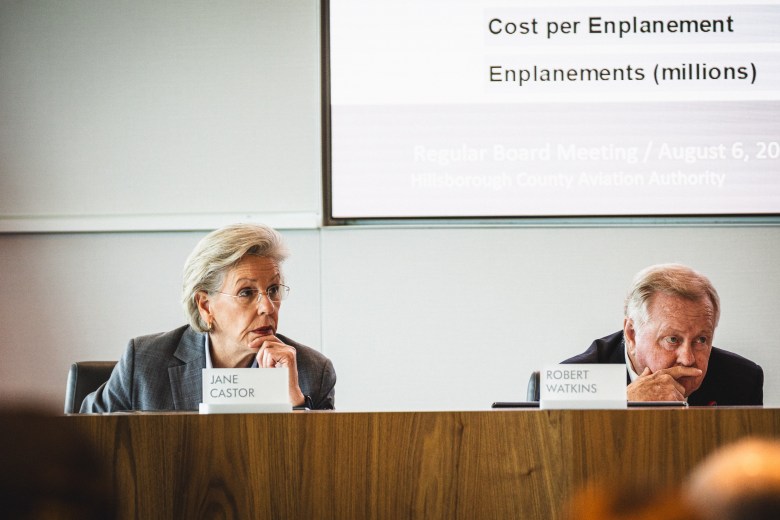 Jane Castor (L) and Robert I. Watkins at Tampa Airport International Airport on Aug., 6, 2026. Credit: Dave Decker / Creative Loafing Tampa Bay
“I’ve been the mouthpiece for everyone at Tampa airport because they’re scared to speak up,” Harris admitted. Chris Finlay, who serves as president of AFGE Local 556, told CL that TSA officers were merely informed of the TSA Gold+ program by email in late July. “There was no discussion. There was no vote done by the Aviation Authority’s board. We were told it was a business decision,” he said.
The “business decision,” as Finlay described it, wasn’t final. Still, Tampa airport officials said they expected that TSA would choose its private security contractor by the end of September, with an expected launch of TSA Gold + next May. That’s obviously not happening anymore.
Had Tampa airport privatized its TSA jobs, the federal benefits Harris and his coworkers received as union members—including health benefits—would have been lost.
“You have 700 officers that will lose all of their federal benefits,” Harris stated plainly. “There is no [union] contract, there is no AFGE. We are gone.”
Blue-collar maintenance employees at the University of South Florida recently went through their own version of this privatization scheme after losing their union representation in 2024, as collateral damage of Florida’s controversial anti-union law, SB 256, passed the year before.
Those workers at USF, now employed by Southeast Services Corporation, organized new unions at the university as private employees shortly after—but Harris believed that would be a difficult feat at TPA.
“Could the private people unionize? Yeah, but they would never let that happen,” he predicted. His union, the AFGE, filed a lawsuit against TSA earlier this month over its secrecy surrounding the TSA Gold+ privatization plan, accusing TSA of secretly planning this transition outside of the public eye.
The union also filed a Freedom Of Information Act Request (FOIA) with TSA about potential privatization plans in May, after a TSA-branded flyer touting a “new public-private partnership” was discovered at Orlando International Airport. The union believes that TSA has been making inquiries with vendors since August 2025.
“AFGE’s members and the public have a right to everything TSA has spent months lavishing its vendors with about lucrative contracts while keeping its sworn officers in the dark,” said Kevin Bell of the Free Information Group, which is representing the AFGE in its lawsuit. “A layer of Gold+ paint will not cover up the rust of privatization.”
Harris similarly got the “business decision” justification from TPA on why the airport had opted into TSA Gold+. But its true intention, he believes, is a manifestation of Project 2025, a conservative policy agenda circulated during the 2024 presidential cycle that, in part, called for the privatization of TSA.
Over half of the policy proposals in the 900-page pamphlet have already been implemented, according to its publisher, the right-wing Heritage Foundation.
“Privatizing TSA was a Project 2025 goal, and here we are, all of a sudden, with a major push to do it,” Gillis pointed out.
Other Project 2025 policy proposals pursued by the Trump administration include the elimination of diversity, equity, and inclusion initiatives; stripping federal employees of their union rights; downsizing the federal workforce; and abolishing the Department of Education.
“I give the guy a lot of credit. He said he was going to do it, and he’s trying to do it,” Harris said of Trump.
Before 9/11, U.S. airlines generally hired private contractors to handle security at airports, where measures were comparatively lax. “Before 9/11, security was almost invisible, and it was really designed to be that way,” aviation security expert Jeff Price told NPR in 2021.
“It was designed to be something in the background that really wasn’t that noticeable and definitely did not interfere with aircraft or airport operations.”
As federal employees, Harris said that TSA officers have the opportunity to build a career they can be proud of, instead of just feeling like they have a job. He believed that would be lost if TPA privatized.
“They’re making people think that, oh yeah, it’s just going to be this transition. But no, not only might you get less pay, but you’re also going to lose all the things that you acquired over your federal career.”
TPA recently told the press that they wouldn’t eliminate jobs, and the AFGE’s lawsuit states that TSA officers would have had the option of “accepting employment” with the chosen contractor. But without union representation, or their union contract, the benefits and salaries that officers currently receive wouldn’t be guaranteed.
According to federal documents obtained by CL, the private security contractor chosen by TSA would’ve been required to pay officers at least “minimum compensation.” Currently, that’s about $40,000 a year, according to Harris.
“If I go down to $40,000, do you think I’m going to be able to do the things I do with my family? Go to the movies? Am I going to be able to go to a Bucs game, a [Tampa Bay] Lightning game, a concert? No, not on 40 grand, I’m not,” said Harris, who currently makes $65,000 annually.
“If you have 700 officers going down to that, what is the economic effect, the trickle-down effect of the entire community?” he asked.
TPA was one of just three airports nationwide that would’ve opted into TSA Gold+ as part of an early pilot program. But the Trump administration ultimately wants to fully move TSA toward privatization through TSA Gold+ and an existing similar program, the Screening Partnership Program (SPP).
Pitch in to help make the Tampa Bay Journalism Project a success.
Subscribe to Creative Loafing newsletters.
Follow us: Google News | NewsBreak | Reddit | Instagram | Facebook | BlueSky
UPDATED 08/24/26 12:44 p.m. Updated to clarify that it’s The Transportation Security Administration, not Tampa International Airport, that faces a Freedom Of Information Act lawsuit from the labor union that represents federal TSA officers.
This article appears in August 20 – 26, 2026.
Related