
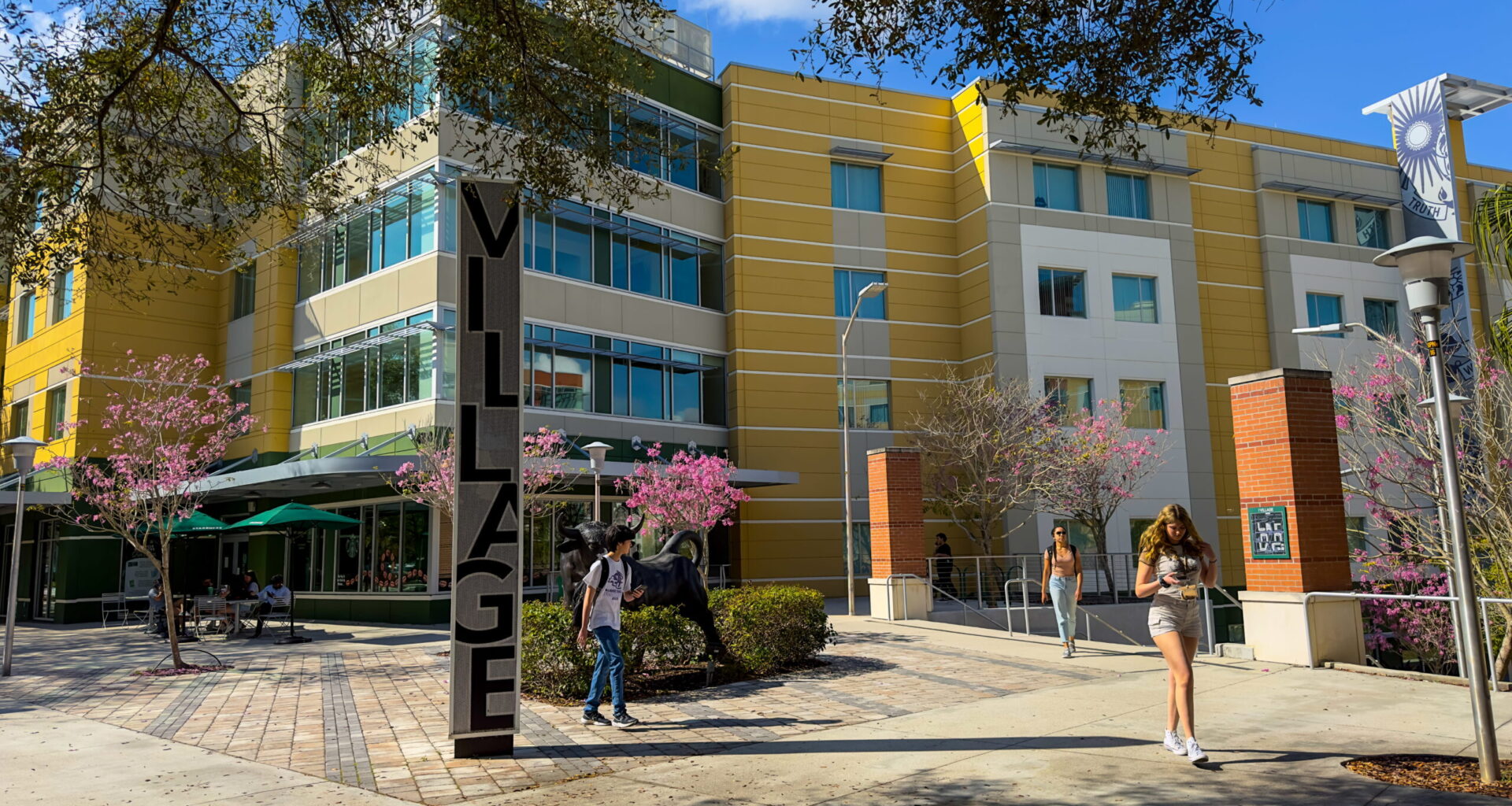
 After two violent incidents involving students at off-campus housing near campus raised safety concerns, the university built an Off-Campus Housing Resources website. ORACLE PHOTO/JUSTIN SEECHARAN
In June, USF launched a new Off-Campus Housing Network after two violent incidents involving students at housing properties near campus raised safety concerns.
In April, two months prior to the launch, a former USF student was arrested and charged with first-degree murder connected to the disappearance and deaths of two USF doctoral students.
Only two months later, a former USF student was identified as the suspect in a double stabbing involving one USF student and a roommate at an off-campus housing near the university.
Both incidents happened at off-campus housing complexes near the university and involved USF students.
In response to the incidents, USF President Moez Limayem said in a message to the USF community in June that the university contacted nearly 50 off-campus housing providers to invite them to adopt safety practices for student residents.
“This outreach is a critical first step because while the university cannot control conditions in properties that are not owned or operated by USF, we can encourage property owners to work with us by voluntarily adopting elevated standards of safety and communication,” Limayem said in the message.
Related: USF student found dead, roommate facing murder charges
The president also said that off-campus property owners who adopt the university’s standards will be able to market themselves as part of the USF’s Off-Campus Housing Network.
The network includes a Safety Review Resource developed by the USFPD, which outlines safety standards related to building access, lighting, surveillance and emergency communications, according to the president’s message.
The university also launched an Off-Campus Housing Resources page to help students evaluate housing options, select roommates, ask landlords questions and find support if they have any concerns regarding roommates or housing, according to the president’s message.
The Off-Campus Housing website lists properties near USF, but has a disclaimer that users of the website are responsible for their own decisions and encourages students to use caution when communicating with potential roommates.
The website also provides students with a USF Housing Search Checklist, which outlines key concerns students should have when searching for a place to live.
Students said the recent incidents have made them reconsider their off-campus housing choices and what they expect from properties.
Related: USF vigil for two doctoral students brings together community, friends and colleagues
Adele Boritzki, a junior majoring in biomedical sciences, spent her freshman year on campus in the Village, and said she decided to move off-campus for her sophomore year to have easy access to a kitchen.
Boritzki said she had considered moving to a different apartment in hopes of finding roommates she connected with better, but the recent incidents changed her mind, leading her to stay with her current roommates rather than risk an uncertain living situation.
“I’m just a little more paranoid now, for sure,” she said. “[The incidents] definitely deterred me because… I could [potentially] get some really negative experiences rather than my neutral right now.”
Boritzki said she believes apartments near USF should require residents to be students or at least be more transparent about housing non-students.
“I know a lot of apartments don’t really require them to be students, but especially the apartments that are really close to campus, a lot of the students gravitate towards those,” Boritzki said.
She also said that she thinks that off-campus apartments should not place students with non-students.
“[Complexes should] at least not house people that are students with people that aren’t,” she said.
Boritzki said background checks for residents would make her feel safer, and the housing complex should just listen to people when they say that something’s off.
“There definitely should be some support for students that feel like their roommates are a little cuckoo; I feel like that’s a big thing,” she said.
Alejandro Lopez, a junior majoring in electrical engineering, also used to live on campus in the Village during Summer B in 2024, the first semester of his freshman year.
For the 2024 fall semester, he decided to move out to have more privacy.
Lopez said that in his off-campus housing, he had safety concerns because a previous roommate would bring non-students into their apartment.
“It definitely has me worrying, because I would rather live somewhere that’s more secure,” Lopez said.
Lopez also said he believes off-campus housing providers should consider whether residents are students and prioritize safety.
“Really focus on those background checks and making sure that the students, the people who are living off campus, are actually students,” Lopez said. “As it says, off-campus housing for students, not just for anybody,”
Lopez said he hopes USF’s Off-Campus Housing Network can improve student safety by encouraging properties to adopt stronger safety practices.
“I think just starting with small things like that could definitely increase the safety of students,” he said.