
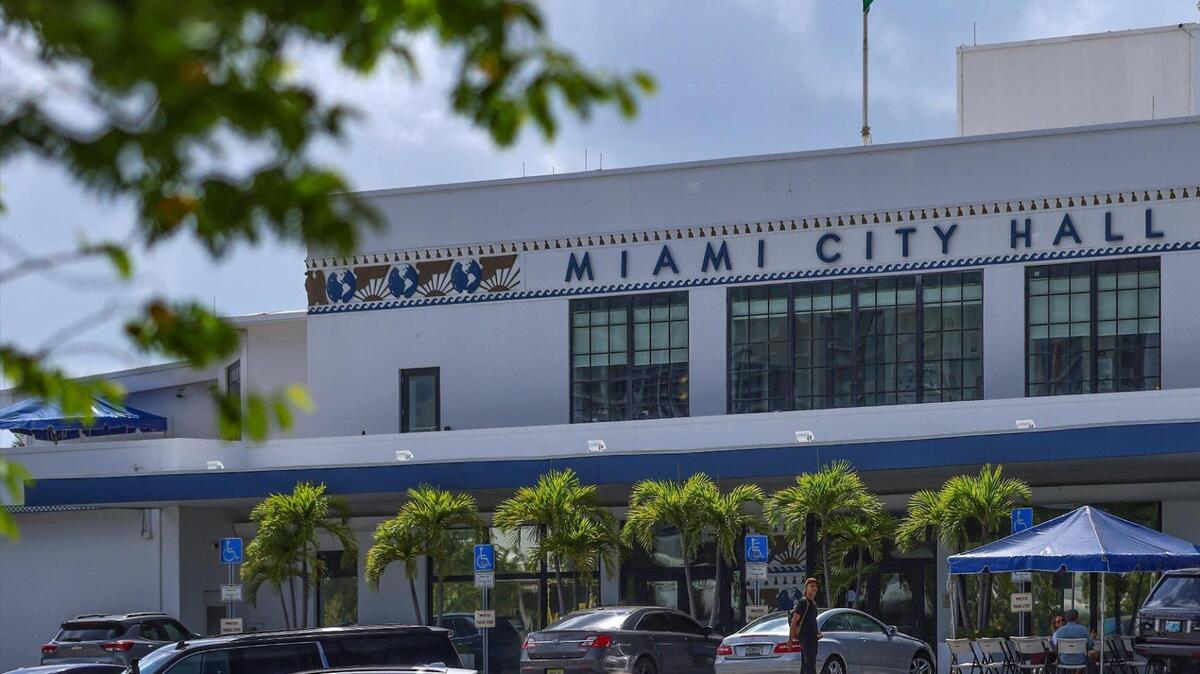
The exterior of Miami City Hall is photographed on Thursday, April 24, 2025, in Coconut Grove, Florida.
Carl Juste
cjuste@miamiherald.com
Since 1954, Miami city government has been headquartered in the old Pan Am building on Biscayne Bay in Coconut Grove, a location with such old-Florida charm, it’s “almost like you’re on vacation when you go there,” as one former mayor recently said.
Now, though, there are plans to move the government to a new building being constructed on 37th Avenue next to Miami Freedom Park, the new soccer stadium and commercial complex by Miami International Airport. The relocation, tentatively set for 2028, will mean a roomier, more modern and more centrally located space for city administrators, commissioners, the mayor and the public.
What will the move mean for the historic Pan Am building where commission meetings have been held for decades? No decision has been made yet. But it’s not too early to talk about this unique public asset. Voters must have a voice in any decision. Click here to share your ideas for the site.
Loading…
The current Miami City Hall building holds a special place in South Florida’s history. It once housed Pan American Airways, whose “Flying Clipper” seaplanes splashed down and took off from Biscayne Bay in the 1930s, connecting South Florida to places like Havana, Rio or New York. Its ceilings are painted with celestial zodiac figures and restored murals that depict great moments in aviation history. Its beams are supported by stylized wings, another nod to a golden era of international flight. It’s listed on the National Register of Historic Places.
And its tropical-postcard location on the bay, flanked by palm trees, has helped define Miami’s local government identity for decades.
At least one commissioner, Damian Pardo, has said the city hall move isn’t a done deal. Pardo — in whose district the current city hall is located — is putting a proposal on the Sept. 10 commission agenda to keep City Commission meetings and elected officials’ offices in the Pan Am terminal on Dinner Key. He told the Editorial Board he sees symbolic importance to staying put in a building that, after more than 70 years of government meetings, amounts to “ancestral grounds” for the city.
There are logical arguments for moving. In the current city hall, the commission chambers are small. Crowds sometimes wind up waiting outside — hot in a Miami summer. Also, city operations currently are split, with city administration located at the downtown Miami Riverside Center and elected officials in Coconut Grove. Efficiency would no doubt be improved with everything under one roof and with public transit nearby.
Pardo says there are ways to address those concerns:.Virtual meetings help alleviate issues with a government located in two places, he said, and overflow city hall crowds can be kept cool with tents and cooling units. He said it may be possible for commissioners and the mayor to keep their offices in the Pan Am building and lease any empty space.
He also struck a note of caution: If all city officials leave the building entirely, future commissions may be tempted to sell the property if the price is right. That’s not out of the realm of possibilities.
Allowing the property to suffer from “demolition by neglect” — remember the Dupuis Drugstore in Little Haiti, the Deauville Beach Resort in Miami Beach, the Coconut Grove Playhouse? — would be unforgivable. Too often in South Florida, our leaders have allowed precious public assets to wind up in developers’ hands by waiting until a historic structure was too decrepit to save. Coconut Grove residents are very engaged, though, and would no doubt fight for the preservation of the Pan Am building.
Former Mayor Xavier Suarez, who served in the ‘80s and ‘90s, is another voice pushing against the move. Suarez — he’s the ex-mayor who said the current city hall feels like going on vacation — told the Herald that moving to Freedom Park is “the worst possible site” due partly to traffic. By contrast, in the Pan Am building, “…you feel like you’re in the Caribbean, and the views are spectacular.”
Our belief: The building at 3500 Pan American Drive on Coconut Grove’s Dinner Key must be preserved, one way or another. It was a key part of Miami’s history, and it must remain open to the public. That means the waterfront, too.
Ideas being floated for what the building could become, if the city truly moves out, include: a museum showcasing Miami’s early aviation history, a public cultural space, an international sailing center or a welcome center for Biscayne National Park. A nonprofit organization called Miami Heritage Park wants to create a continuous park that runs from Peacock Park to Kennedy Park, with the City Hall property included.
We want to know what you think. What should be done with Miami City Hall if the city relocates?
Loading…
BEHIND THE STORY MORE What’s an editorial?
Editorials are opinion pieces that reflect the views of the Miami Herald Editorial Board, a group of opinion journalists that operates separately from the Miami Herald newsroom. Miami Herald Editorial Board members are: opinion editor Amy Driscoll and editorial writers Isadora Rangel and Mary Anna Mancuso. Read more by clicking the arrow in the upper right.
What’s the difference between an op-ed and a column?
Op-Eds, short for “opposite the editorial page,” are opinion pieces written by contributors who are not affiliated with our Editorial Board.
Columns are recurring opinion pieces that represent the views of staff columnists that regularly appear on the op-ed page.
How does the Miami Herald Editorial Board decide what to write about?
The Editorial Board, made up of experienced opinion journalists, primarily addresses local and state issues that affect South Florida residents. Each board member has an area of focus, such as education, COVID or local government policy. Board members meet daily and bring up an array of topics for discussion. Once a topic is fully discussed, board members will further report the issue, interviewing stakeholders and others involved and affected, so that the board can present the most informed opinion possible. We strive to provide our community with thought leadership that advocates for policies and priorities that strengthen our communities. Our editorials promote social justice, fairness in economic, educational and social opportunities and an end to systemic racism and inequality. The Editorial Board is separate from the reporters and editors of the Miami Herald newsroom.
How can I contribute to the Miami Herald Opinion section?
The Editorial Board accepts op-ed submissions of 650-700 words from community members who want to argue a specific viewpoint or idea that is relevant to our area. You can email an op-ed submission to oped@miamiherald.com. We also accept 150-word letters to the editor from readers who want to offer their points of view on current issues. For more information on how to submit a letter, go here.
T
The 6,500-pound painted steel globe originally commissioned for the Dinner Key terminal was acquired by Miami Worldcenter for public display.