
Social media posts contrasting the speed of ballot counting in the US states of Florida and California are claiming that results reported more slowly leave elections vulnerable to fraud. But experts told AFP that while election laws in the two states differ greatly — with California’s resulting in a much longer period of vote counting — both have safeguards to protect the process.
“California took over a month to count 95% of its ballots. Florida did it in an hour and a half,” says an August 19, 2026 Facebook post. “Explain that without saying failure or fraud.”
The post includes headshots of California’s Democratic Governor Gavin Newsom and Florida’s Republican Governor Ron DeSantis, who have supported vastly different policies on election administration.

Screenshot of a Facebook post taken August 19, 2026
Similar posts spread across platforms — including X, TikTok and Instagram — after Florida’s August 2026 primary election.
The posts follow US President Donald Trump’s efforts to restrict the use of mail ballots — a method he himself chose to vote in the Florida primary.
They also come after weeks of false fraud allegations dogged California’s June primary elections, and particularly the race for Los Angeles mayor that saw incumbent Democrat Karen Bass and progressive candidate Nithya Raman advance (archived here).
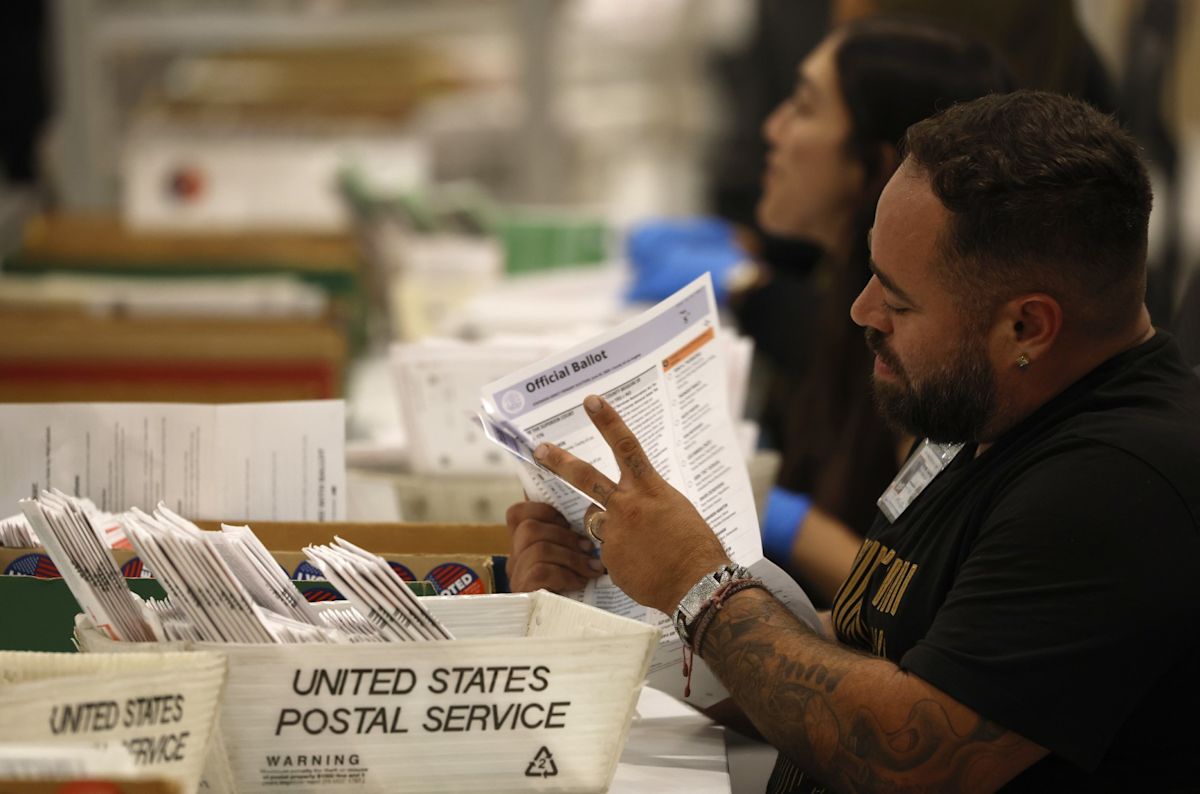
California does take more time to count ballots than Florida, in part because it has a larger voting population and a far higher percentage of voters opting to cast mail ballots (archived here and here).
But observers from all eligible political parties are permitted to monitor the process, and experts said there is no evidence the state’s voting system has left it open to widespread fraud (archived here, here and here).
“It would be a much more accurate conclusion to say that it takes a long time because they are being careful and they are preventing fraud,” said Melissa Michelson, a political scientist at Menlo College in California, told AFP on August 19, 2026 (archived here).
Different deadlines
Congress sets Election Day for federal races, but each state passes its own rules for election administration, including regulations about voter registration, the use of mail ballots and when election officials can begin processing materials (archived here and here).
The biggest difference is that in California, a ballot is counted so long as it was postmarked on or before Election Day and arrives within seven days (archived here). By contrast, Florida requires ballots to be received by 7 pm on Election Day (archived here).
Republicans had challenged a Mississippi statute that was similar to California’s, but the Supreme Court ruled 5-4 in June to uphold the law, leaving decisions about ballot receipt dates in the hands of the states.
The non-partisan California Voter Foundation celebrated the preservation of the grace period for mail-in votes, citing the 406,132 ballots — or 2.5 percent of the overall turnout — that were received after Election Day in the state’s 2024 general election (archived here).
Another difference is that California permits registration on Election Day, with ballots only processed and counted once officials complete a voter verification process (archived here). Florida has a registration cutoff 29 days before Election Day (archived here).
Both California and Florida let officials open and process mail ballots ahead of Election Day, including validating the voter’s signature against one on file and contacting those with missing or mismatched signatures to “cure” their ballot (archived here and here). But here again, California offers a weeks-long window to correct the issue, while Florida requires voters to do so by “5 pm on the 2nd day after the election” (archived here and here).
Michelson, from Menlo College, said that California could dedicate more money to hiring temporary staff to process ballots, but that the Golden State releases results slower than Florida primarily because the processing job is bigger.
“They are delayed by a week because of the different laws, and it’s a resource allocation issue,” she said.
Michael Morley, director of the Florida State University Election Law Center (archived here), added: “At virtually ever step of the process, the system in Florida is structured in a way that facilitates the development of election results much more rapidly, much more efficiently than California’s system.”
Florida made significant changes to its election administration following the 2000 presidential election, in which a poorly designed ballot had officials recounting votes for weeks, leaving the race to eventually be decided by the Supreme Court (archived here and here).
“A well structured election system is going to try to balance ensuring that every eligible citizen has the opportunity to cast their vote and have it counted while also bolstering public confidence in the system,” Morley told AFP on August 20, 2026.
Officials should seek to avoid unnecessary delays, he said, but when results take time to be released, it “doesn’t mean that anything nefarious is afoot.”
In 2023, California passed a bill aimed at helping speed up counting (archived here). The legislation has seen some counties adopt “Sign, Scan & Go” — a process that allows a voter to fill out a mail ballot at home and then bring it to a vote center to be scanned, so that it can be included in results announced on election night (archived here).
Read more of AFP’s reporting on misinformation targeting the 2026 elections here.