
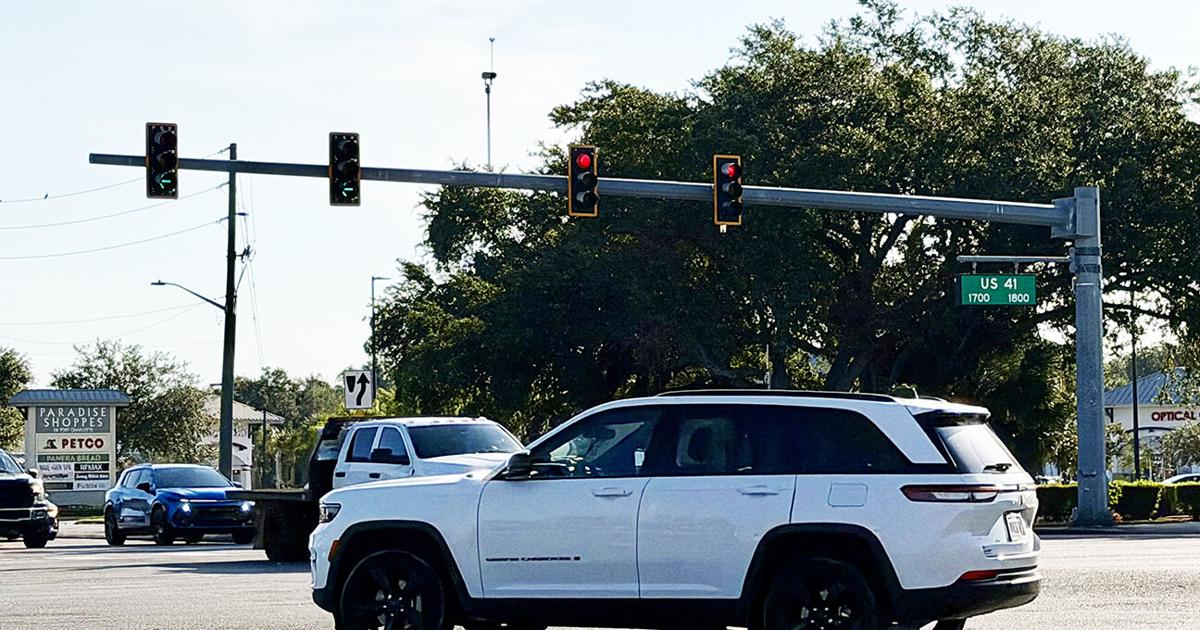

Four Motorola Solutions license plate reader cameras are posted at the intersection of Tamiami Trail and Cochran Boulevard in Port Charlotte.
PHOTO BY NICOLE DROEGER
PORT CHARLOTTE — In Charlotte County, law enforcement not only uses cameras it owns but also works with residents who have volunteered to have their home camera footage or live stream viewed by police.
Most of the law-related cameras in Charlotte County are automated license plate reader cameras — known as LPRs — that law enforcement can use to find vehicles and motorists.
Just at the intersection of Tamiami Trail and Cochran Boulevard are four Motorola Solutions LPRs.
As automatic LPRs like Flock Safety grow in popularity and public scrutiny, Charlotte County primarily uses two brands to track vehicles.
A map of the Motorola LPRs posted at Tamiami Trail and Cochran Boulevard in Port Charlotte.
MAP PROVIDED BY DEFLOCK MAPS
According to DeFlock Maps, an open-sourced, volunteer-powered project for identifying and documenting automated license plate readers, 73% of LPRs in Charlotte County are Motorola. The camera locations can be seen at the DeFlock Maps website at:
Radio One/CSE Crosscom partners with Motorola to post LPRs across Florida. Radio One specializes in audio, video and data wireless technologies.
A Motorola LPR facing Cochran Boulevard in Port Charlotte.
PHOTO BY NICOLE DROEGER
Morgan McLenighan, an inbound sales representative with Motorola, said LPRs use specialized image processing and machine learning algorithms to capture clear images of moving vehicles and read a plate’s text.
“System data is strictly owned and controlled by the operating user or agency,” McLenighan said. “System administrators can configure secure data-sharing rules, enabling seamless collaboration with local law enforcement — such as county sheriff’s offices — or neighboring agencies when investigating incidents or tracking watchlists.”
McLenighan said data is encrypted while in transit and when dormant with “enterprise-grade” security protocols.
According to a grant application packet from the Florida State Board of Immigration Enforcement on June 9, the Charlotte County Sheriff’s Office requested:
88 L5F Motorola LPRs18 L6DLicensing and monitoring for two years
The total came to about $1 million.
According to a 2025 law enforcement annual agency report, the CCSO technical surveillance team expanded its coverage by purchasing additional LPRs and camera software systems.
The report said LPRs “have been strategically deployed based on crime analysis to increase solvability. The agency has solved several investigations due to enhanced technology. Members received formal training and obtained certifications in compliance with their discipline.”
A 2025 911 report from CCSO states that the 911 office uses its IP network and core services through Motorola.
Alongside Motorola LPRs, the county uses a different LPR provider to record vehicles speeding in a school zone.
School Zone Speeding Violations
The county started using RedSpeed automatic LPRs on Feb. 27. By April 1, owners of vehicles in violation of school zone speed limits were mailed citations.
The RedSpeed camera pointed at Cochran Boulevard near Port Charlotte High School records vehicles and license plates speeding in a school zone.
PHOTO BY NICOLE DROEGER
RedSpeed LPRs were installed as a part of the county’s School Zone Speed Detection Program. Cameras only operate during school days, 30 minutes before breakfast, 30 minutes after school is in session and 30 minutes after school ends.
Violations are sent to vehicles that exceed 10 miles above the school zone speed limit. Flashing lights are not required to signal when a school zone is active.
RedSpeed LPRs record:
Violation date, time and locationVehicle color, model and tagSpeed limit and recorded speed
A traffic enforcement officer collects and organizes information collected by RedSpeed to send a vehicle’s owner a citation through the mail. A special magistrate hearing is held on the first Wednesday of each month for citation appeals.
Using Private Home Footage
The Charlotte County Sheriff’s Office is asking residents with home security cameras to voluntarily register with the Sheriff’s Office. Doing so does not give deputies access to the home cameras, but allows law enforcement to contact a homeowner if a crime occurs in the area.
“Registering your cameras does not allow the Charlotte County Sheriff’s Office access to your live video stream,” the Sheriff’s Office website states. “It only enables investigators to know a camera is present at your location and easily request video evidence should an incident occur.”
But residents can agree to integrate their cameras in the Sheriff’s Office system, meaning deputies could then access a live stream when necessary. Residents who agree to having their camera(s) integrated can also set up rules for how the stream can be viewed.
More details about the two camera programs are at:
So far, 2,237 cameras have been registered.
‘A Critical Tool’
The Daily Sun reached out to the Charlotte County Sheriff’s Office about its use of LPRs.
Public Information Officer Christopher Hall said Sheriff Bill Prummell was not interested in being interviewed about the topic.
The Daily Sun was not informed about specific LPR systems the Sheriff’s Office uses.
But Prummell has previously written about the systems.
“The use of camera systems in law enforcement is a critical tool in intelligence-led policing, a strategy on which the Charlotte County Sheriff’s Office has put its focus,” he stated in July.
Prummell said the purpose of the LPR system is to locate suspects.
“Our agency does use cameras such as license plate readers (LPRs) and some artificial-intelligence capable systems in our efforts. These systems are used only for law enforcement purposes and the usage of them is extremely limited and tracked internally — meaning that an individual would not be able to access the systems with anonymity for unethical use,” Prummell stated.
Prummell said that only suspects of a crime are being tracked using LPRs.
He stated people who join the Citizen’s Police Academy program can receive a tour of the Real-Time Intelligence Center and question a member of CCSO’s Intel United “who can answer your questions.”
The Daily Sun requested to speak with someone in the Sheriff’s Office. Hall responded Prumell “is not interested in any interviews by our agency on this matter.”