
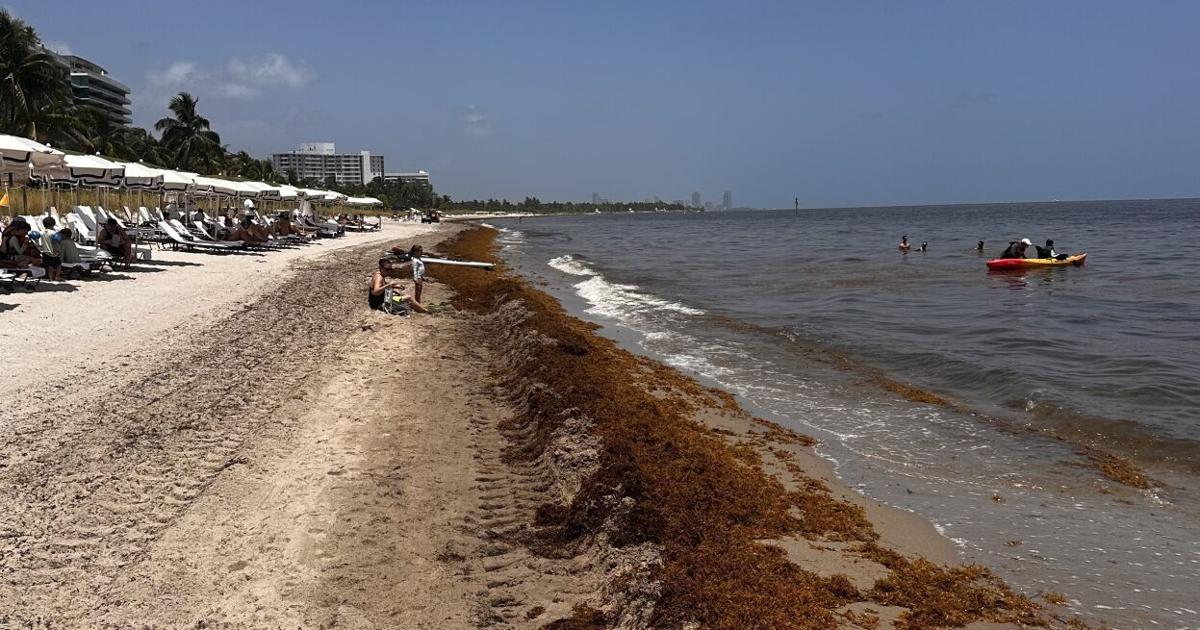
Record amounts of sargassum are washing up on beaches across Key Biscayne and Miami-Dade County, increasing cleanup costs and raising concerns about the effects of the decomposing seaweed on beachgoers and coastal ecosystems.
Miami-Dade crews removed 9,000 tons of sargassum from county beaches in July, the largest amount collected in a single month, according to Chris Bumpus, chief of conservation for the county’s Parks, Recreation and Open Spaces Department.
“July is always the worst,” Bumpus told The Guardian. “It’s been a heavy season.”
Bumpus said officials hope the volume will ease by October.
The county is responsible for maintaining 17 miles of beaches and spends approximately $3 million annually removing sargassum, more than any other Florida county, Bumpus said. The work is funded through tourist development taxes collected from hotels and short-term rentals.

For Key Biscayne, the issue is especially visible at Crandon Park, which is one of six areas where the county holds a state permit to use mechanical equipment to remove concentrated sargassum.
In July, county commissioners approved a resolution directing the administration to seek greater flexibility from the Florida Department of Environmental Protection to add cleanup hot spots without going through a separate approval process each time.
Cleanup crews must work around sea turtle nesting restrictions. Nests are identified before tractors and beach-raking equipment begin operating. Heavy machinery is also prohibited during nighttime nesting hours.
The surge is part of a much larger Atlantic phenomenon.
Sargassum traditionally accumulated in the Sargasso Sea, a region of the North Atlantic encircled by ocean currents. In 2011, however, scientists began observing the Great Atlantic Sargassum Belt, which stretches from West Africa through the Caribbean and into the Gulf of Mexico.
Satellite estimates placed this summer’s belt at approximately 33.5 million tons, second only to the 38 million tons recorded in 2025.
The University of South Florida’s Optical Oceanography Lab reported that sargassum amounts began declining in most regions during July. However, the Gulf remained at a record level for the month, while other regions trailed only the records set in 2025.
The lab’s July outlook predicts that beaching will continue along southeast Florida and throughout the Caribbean, although likely at lower levels than during June and July. Researchers expect 2026 to finish as the second-largest sargassum year on record. Scientists have linked the massive blooms to several factors, including nutrients carried into the ocean by major rivers, warmer water and changes in ocean circulation.
Floating sargassum provides important habitat for fish, crabs, shrimp and sea turtles while offshore. Problems begin when large quantities collect and decay along the coast, potentially lowering oxygen levels in the water and damaging seagrass and coral habitat.
Decomposing sargassum also releases hydrogen sulfide, the gas responsible for its rotten-egg odor. The Florida Department of Health says the gas can irritate the eyes, nose and throat. People with asthma or other respiratory conditions may be more sensitive. Beachgoers should avoid touching accumulated seaweed or swimming through it because small organisms living inside it may irritate the skin.
NOAA provides a daily sargassum inundation risk map showing the likelihood of seaweed reaching coastlines across Florida, the Caribbean and the Gulf.
Para la versión en español, pulse aquí.