
This article expresses the views of its author(s), separate from those of this publication. Readers are encouraged to comment or submit a Letter to the Editor to share their opinions. To submit a Letter to the Editor, follow the instructions here.
In 2002, before UNF’s Student Union had even been built, a group of Jewish students gathered
around a menorah on the Green. It was Chabad’s first menorah lighting at UNF and one of our
earliest public events on campus. I had already been working with Jewish students for a year,
but that evening offered one of the first glimpses of the visible Jewish community beginning to
take shape at UNF.
In those early years, my wife, Chana, and I were not much older than the students. We related
to them like an older brother or sister. We were building something together, figuring things out
as we went and creating a place for Jewish life at a university that was itself growing and
changing around us.
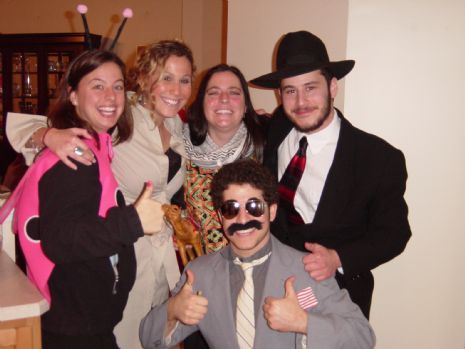 A group of students pose for a photo at Chabad’s annual Purim celebration in 2007. (Photo provided by Rabbi Shmuli Novack)
Twenty-five years later, today’s incoming freshmen are close in age to our own children. Without quite realizing when it happened, the older-sibling role gradually became something closer to a parental one. That is not just a description of age. The concern we feel for our students truly reflects the concern we have for our own children.
That shift becomes clearest in the moments when a student is most vulnerable. Years ago, my phone rang in the middle of the night. One of our students had been seriously injured in a
motorcycle accident, and his parents were several hours away, desperately driving to Jacksonville from Southwest Florida. Hearing the pain and fear in their voices, I immediately got
dressed and rushed to the hospital. He was unconscious, but I sat by his side until his parents
arrived. Thank God, he went on to make a full recovery, and he and his parents remain dear
friends of ours to this day. In that moment, there was no question of whether I should go. I
needed to know that until they arrived, he would not be alone.
In 2010, Chabad’s building was built on Alumni Way, giving students a permanent home where
they could walk in, sit down, study quietly and simply be themselves. Within those walls,
Shabbat dinners have stretched far beyond their scheduled endings, friendships have begun
around crowded tables and conversations have unfolded that might not have happened
anywhere else. Some students came every week for four years. Others walked in only once, but
perhaps on the one day they most needed somewhere to go.
A home is also where someone can turn when they are frightened, ashamed or unsure. I recall
one student who came to us after scammers had taken a significant amount of her money and
were blackmailing her. She was terrified to tell her parents, but she knew she could come to
Chabad without being judged. We listened, helped her explain what had happened to her family
and supported her as they worked through the situation together. What she needed first was not
a program or an organization. She needed somewhere she could turn without fear of judgment.
Moments like these create relationships that extend far beyond any individual program or event.
That is one of the most beautiful and difficult parts of working with college students. You become
close to them during a formative chapter of their lives. You watch them grow in confidence,
wrestle with big questions, discover who they are and form relationships that might shape the
rest of their lives. Then, almost suddenly, four years have passed, and they are gone.
Some remain closely connected, calling Chana and I with life updates or returning years later
with spouses and children. Others move on, and we may rarely, if ever, hear from them again.
That is simply the reality of campus life. Each year brings a new group of students through the
door, while another group graduates and begins the next chapter of their lives.
Our care has never depended on how observant a student is, how much Jewish knowledge they have or whether the problem they face is specifically Jewish. A home away from home must be a home before it’s anything else. The door must always be open and every student must know that their presence matters.
That is part of what it means to serve as a university chaplain. Students don’t experience life
according to an office calendar, and a crisis doesn’t wait until morning. Sometimes they need
guidance. Sometimes they need practical help. Sometimes the most meaningful thing Chana
and I can offer is being someone to talk to and a shoulder to lean on.
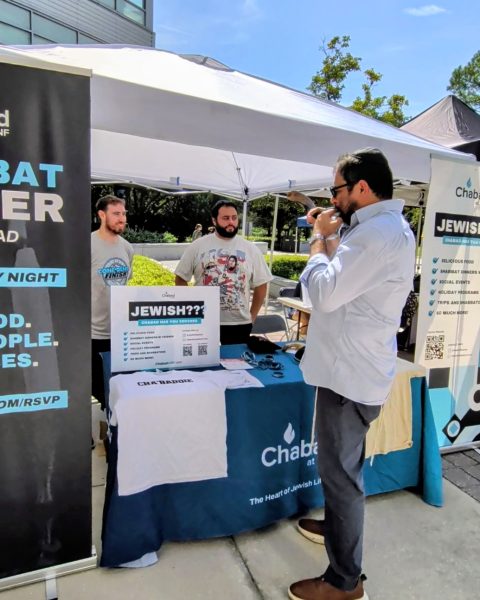 Rabbi Novack blowing the shofar at the UNF Block Party in 2026. (Photo provided by Rabbi Shmuli Novack)
When I reflect on 25 years at UNF, I think of our first menorah lighting in 2002, establishing our permanent home in 2010, gathering with students during the painful days following October 7 in 2023, and campus-wide events that brought together thousands of people throughout the years.
But the best measure of these years can’t be found in the largest events or the most visible moments. It’s found in the individual students, the student who found a community, the student who called when they had no one else to turn to and the student who simply needed a place where they could feel at home during their college years.
Looking back on the past 25 years only makes me more excited for what comes next. As we’re welcoming students back for the fall semester and beginning our 25th-anniversary year, Chana and I feel just as energized as we did in the beginning. In many ways, we’re just getting started.
Rabbi Shmuli Novack is the co-director of Chabad at UNF and serves as UNF’s rabbi chaplain. Together with his wife, Chana, he has spent the past 25 years building Jewish life on campus and supporting Jewish students.
___
For more information or news tips, or if you see an error in this story or have any compliments or concerns, contact [email protected].