
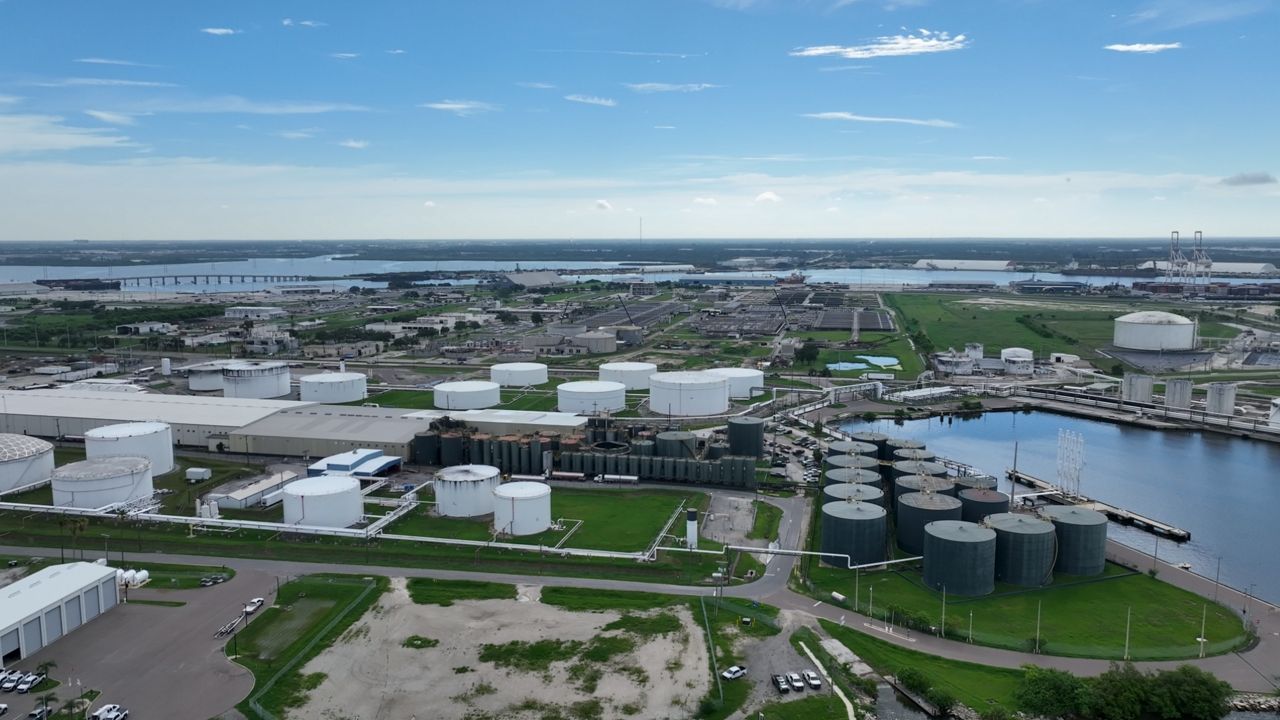
TAMPA, Fla. — Tampa has reached a nearly $590,000 settlement with the Florida Department of Environmental Protection after state regulators documented unauthorized discharges, permit violations and odor-related problems at the Howard F. Curren Advanced Wastewater Treatment Plant south of downtown.
Under the settlement, Tampa opted to fund stationary generators for two pump stations instead of paying the fine. The project, known as an “in-kind project,” must be worth more than 1.5 times the penalty and was approved by state regulators.
Carlos Carillo, a member of the Palmetto Bay Community Association, says he’s lucky to live in what he calls a hidden gem.
But Carillo says there’s something else hidden in his east Tampa neighborhood.
“Residents for years have dealt with very unpleasant smells,” Carillo said. “When you’re out on a walk, and you get a whiff of it, it just smells like raw sewage.”
Documents reviewed by Spectrum News show FDEP inspectors visited the facility twice in 2025 and found “odors … emanating offsite as a result of Digesters #2 and #5 not functioning as intended.”
Eric Weiss, wastewater director for Tampa, said the city believes someone illegally dumped waste into the sewer system near the plant, interfering with equipment and creating the odor issue.
“What happened is those digesters soured,” Weiss said. “We’ve done a ton of improvements of looking for illegal dumpers here, and we’ve added a lot of upstream chemicals that have made significant improvements in the odor.”
The smell is just one part of the six-figure state settlement.
It also says that between 2022 and 2025, Tampa did not meet quality standards for water it treated and released into Hillsborough Bay more than 80 times. According to the settlement, those issues have since been resolved.
State regulators also cited the city for wastewater discharged during the 2024 hurricanes. According to the settlement, nearly 13 million gallons of untreated wastewater were discharged from the facility into Hillsborough Bay. During Hurricane Milton, another 2.9 million gallons of partially treated wastewater also entered the bay.
Tampa was also cited for roughly 250,000 gallons discharged into the bay unrelated to the named storms.
“Helene was unique with the storm surge. It actually flooded out seven of our low-lying pump stations, which led to a wastewater overflow,” Weiss said. “The next one was Hurricane Milton. We lost about 100 wastewater pumping stations, which resulted in overflows until we could come out with portable generators or TECO restored it.”
The settlement says 11 discharges during Milton “were not reported timely” to the state. Weiss attributed the delayed communication with the state to a clerical error.
Sarina Ergas, a wastewater expert and professor at the University of South Florida, said large wastewater overflow numbers during hurricanes must be viewed in the context of major stormwater impacts.
“Even though the numbers look quite large, they’re often a small portion of the total amount of nutrients that enter the bay,” Ergas said. “On the other hand, these regulations are in place for a reason.”
Ergas said allowing Tampa to use the money for infrastructure improvements instead of a direct fine is a win-win for the state and the city.
“What benefit is it for the city to pay a fine to FDEP?” Ergas said. “It’s much better for them to use that money towards rectifying the situation.”
As part of the April settlement, Tampa agreed to pay fines if future overflows occurred. In the three months after the settlement, the city was fined $32,000 for discharging more than 500,000 gallons of reclaimed water and nearly 15,000 gallons of partially treated and untreated wastewater into the bay.
Weiss says some overflows will happen because of things like residential grease, third-party construction, and even aging infrastructure.
Weiss says 60% of Tampa’s pipes are 60 years old or older.
“I just want to make sure that none of it is on the city’s side of it: aging infrastructure or any operator error,” Weiss said. “I think one of them was [aging infrastructure]. Believe it or not, it was aging infrastructure from 2006 on a reclaim main.”
Carillo says that after learning of the settlement, he has more questions than answers.
“It almost feels like a slap in the face just because all this is going on illegally, we’re not aware of it, we don’t know if there are any health concerns with it,” Carillo said. “It’s only fair that the problem gets resolved, and it gets resolved in a permanent manner so that you can take care of the taxpayers and the citizens of Palmetto Beach.”
For the $32,000 fine, the city elected to invest in a separate in-kind project: a robotic system that analyzes water quality. Weiss told state officials that the city would use the system every day.
The two stationary generators tied to the larger settlement are expected to be online within the next two to three years, according to Weiss.