
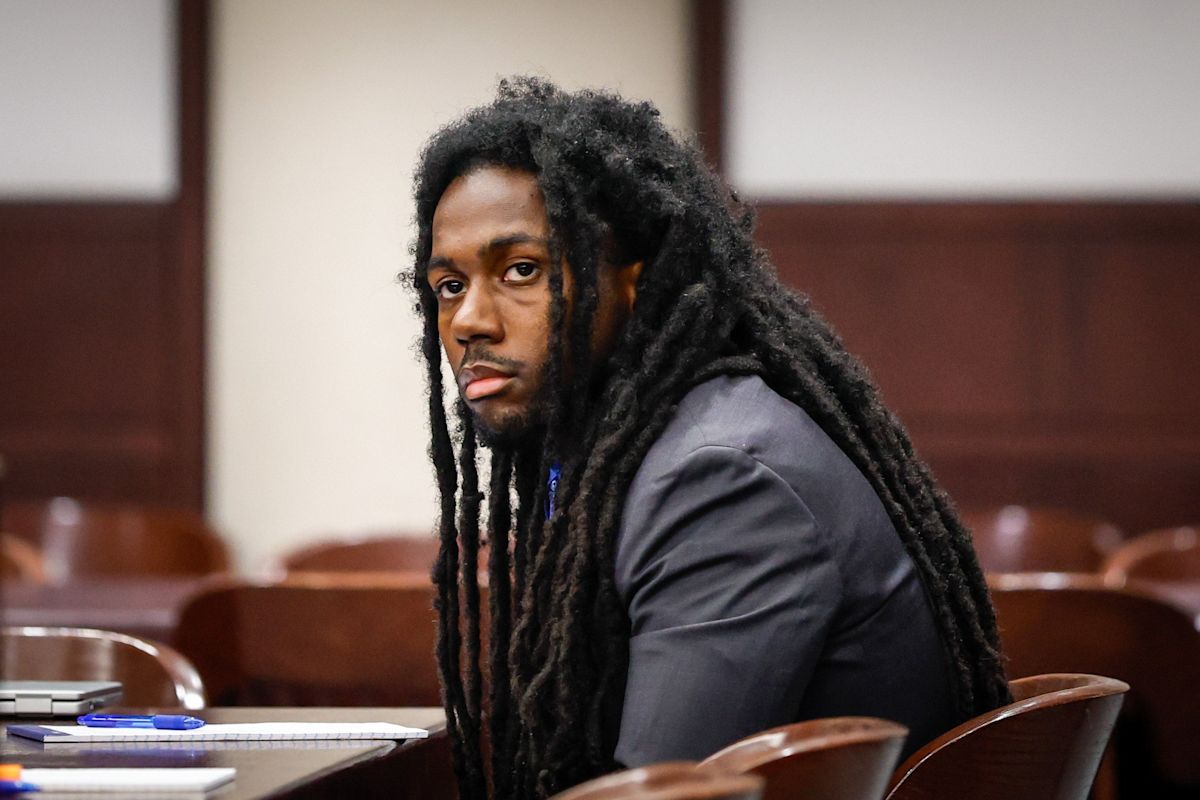
Found not guilty in a double murder case three years ago, Billy Adams III walked out of Tampa’s courthouse with a judge’s admonishment to stay out of trouble.
Three days later, he became a suspect in the killing of a young pregnant mother.
On Wednesday, once again, Adams appeared in Tampa’s courthouse. With a hand resting against his chin, he listened impassively as a prosecutor, for the second time in his life, told a jury that he is a killer.

He is accused in the Jan. 30, 2023, shooting of Alana Sims. The 22-year-old was found late that night lying on pavement in a remote New Tampa subdivision, bleeding from a bullet wound to the back of her head. She was about five months pregnant.
Adams, 28, a hip-hop artist who performs under the moniker Ace NH, faces a possible death sentence if he is found guilty.
Assistant State Attorney Lindsey Hodges told the jury Wednesday that Sims’ slaying grew out of Adams’ desire to end a relationship he’d had with her, and their shared, but mistaken, belief that he was the father of her unborn child.

Assistant State Attorney Lindsey Hodges speaks with other attorneys before the start of jury selection last week in the trial of Billy Adams III in Tampa.
In a half-hour opening statement, the prosecutor told a tangled tale of a love triangle that spurred bloodshed, lies and a painstaking effort by Adams to cover for himself.
Assistant Public Defender Dalton McKeever, in a brief response, did not address much of the state’s theory of the case. But he emphasized that Adams is presumed innocent and asked them to scrutinize the state’s evidence.
Adams had considered Sims his “side piece,” Hodges told the jury. His main girlfriend was a woman named Lakenya Brantley.
Brantley, the prosecutor said, became upset when she learned that Sims was pregnant. She began to text Adams about it. The jury read portions of their conversation on an overhead TV screen.
“I’m just so sad because I thought we was gonna have a real relationship at this point,” Brantley wrote a day before the killing. “And now she’s pregnant and still here.”
Adams responded with the word “no.”
“You not talkin me out of it,” he wrote. “Tomorrow dis s— done.”
Later, he wrote: “We finna have OUR life … And it dont include ha ass. … I want da life I’m pose to have mane.”
“This ain’t the way, baby,” Brantley replied.
The next day, Adams texted Sims through the encrypted messaging platform known as Telegram.
“He tells five-month-pregnant Alana Sims exactly what she wanted to hear,” Hodges said. “He tells her what she wants to hear to lure her to the remote location where he’s going to carry out the plan he’s already put in place.”

Billy Adams III, center, waits with Assistant Public Defenders Jamie Kane, left, and Dalton McKeever before the start of jury selection in his trial last week in Tampa.
The prosecutor pointed to messages in which Adams said he wanted to see Sims. He told her he loved her and said he’d been looking for an apartment where they could live together. None of it, Hodges said, was true.
Sims was skeptical when Adams said he missed her. “You haven’t told me that in a while,” she wrote. She remained skeptical when he told her to meet him at the edge of an unfinished road off Pictorial Park Drive in the Easton Park subdivision.
But she trusted him, Hodges said.
Police would later pull surveillance video and cellphone records showing a Chevrolet Malibu registered to Adams’ parents leaving their neighborhood and driving to the Easton Park subdivision shortly after 7 p.m.
Records showed Sims driving there, too, in a Ford EcoSport SUV. Her 18-month-old child sat in a car seat in the back seat.
At 7:50 p.m., she wrote him again: “I’m gonna go home if you don’t give me directions.”
It was the last message she would ever send.
“By 7:50, Miss Sims is standing next to the man who told her just hours earlier that he loved her,” Hodges said. “She’s standing next to the man that in the next 25 minutes will end her life and that of her unborn child with a single gunshot.”
A neighbor noticed Sims hours later lying dead in the roadside. Her unborn child died with her.
Her 18-month-old was found in the SUV, unharmed.
Tampa police detectives quickly learned Adams knew Sims. When they first questioned him a day after the killing, he said he hadn’t seen Sims since before the prior Thanksgiving, according to the prosecutor. He said he hadn’t left home the previous night.
They went back to him after they pulled records showing his car tag in the Easton Park area at the time of the slaying. His story then changed.
He said he’d been with friends that night and showed the cops a cellphone video of the gathering. It bore a time stamp of 8 p.m. Jan. 30.
When the investigators later pulled his cellphone records, they found the video had been altered. Metadata indicated it was recorded two days before the killing.
They also found that Adams deleted the Telegram app shortly after the killing. They also learned he’d been using a second cellphone the night of the crime, leaving his regular phone at home.
He’d also messaged a third woman not long after the killing, Hodges said. She was an old girlfriend who hadn’t spoken to Adams in some time. He asked if she would give him an alibi, Hodges said.
“If anyone asks, tell them I was with Shay and Tex,” he wrote.
His story changed again in yet another interview with detectives at Tampa’s downtown police headquarters. Confronted with texts and records they’d uncovered, Adams admitted he’d shot Sims, Hodges said. But he claimed it was self-defense.
Twice, he reenacted how he said he disarmed her of a gun, then shot her. The reenactments were not the same, Hodges said. But in both scenarios, he said he and Sims were face-to-face and that he was an arm’s length away when he shot her.
Detectives did not tell him she was shot in the back of her head, Hodges said.

Billy Adams III is escorted by a Hillsborough County sheriff’s deputy before the start of jury selection in his trial last week in Tampa.
Police have previously said Sims planned to attend a party the night she died. The festivities were alleged to be a celebration of Adams’ acquittal in the prior murder case.
In 2020, he was accused of shooting to death Trevon Albury and Daniel Thompson inside a small Lutz recording studio. He testified in his own defense in that case, claiming the shooting was self-defense.
It happened during a late-night recording session in which Adams said he overheard the pair talking about robbing the studio’s owner. He said he saw Albury pull a gun and point it at the studio’s owner, who he said was unaware of the danger.
On the witness stand, he said he feared being shot, so he pulled his own gun and shot Albury in the back of his head. He said Thompson then tried to grab his gun, so he shot him twice in his face. A jury deliberated two hours before finding Adams not guilty.
The jury in the Sims case won’t hear anything about that.
But it’s expected that they will hear from a man who met Adams well after Sims was killed.
Bryan Boggs, a man the prosecutor acknowledged has an extensive criminal history, became a jailhouse formant against Adams. He contacted detectives and said Adams had sought his advice about how to beat his case.
Boggs later provided detectives with five letters penned by Adams. He instructed Boggs to mail them under his own name to several witnesses in his case, including Brantley, the prosecutor said. They were, Hodges said, another effort to craft an alibi.
The trial is set to last through the end of next week.