
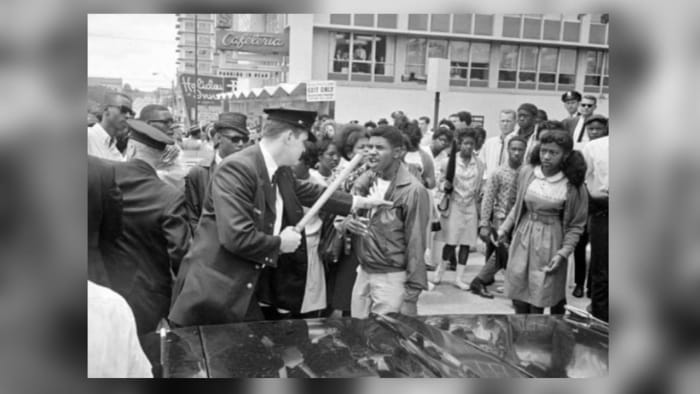
JACKSONVILLE, Fla. – Exactly 66 years after a mob of white men attacked Black teenagers for attempting to integrate lunch counters in downtown Jacksonville, a Civil Rights Trail marker was unveiled, commemorating the bravery and sacrifice of the survivors of Ax Handle Saturday.
RELATED | Newly unearthed footage offers glimpse into Ax Handle Saturday
On Aug. 27, 1960, a mob of white men with axes and baseball bats attacked Black people after a peaceful sit-in at a segregated lunch counter in downtown Jacksonville.
The men had gathered at what was then known as Hemming Park, now known as James Weldon Johnson Park, and the violence first aimed at the demonstrators quickly spilled over to include any Black person in sight of the mob.
Sights and sounds of Ax Handle Saturday etched in witness’s mind
According to the Florida Historical Society, police at first stood by before they joined in with their nightsticks when a Black self-defense group tried to intervene and protect the trapped protesters.
Rodney Hurst, who was among the teens participating in the sit-ins that day, will be at Thursday’s unveiling of a Civil Rights Trail marker at James Weldon Johnson Park, where he and other members of the NAACP Youth Council were attacked more than six decades ago.
“There’s not a day that goes by that I don’t remember those days, 65 years ago,” Hurst told News4JAX last year.
Hurst, now 83 years old, said his memory of the civil rights movement remains because he lived it. Everything was segregated, from public bathrooms and water fountains to beaches and movie theaters.
“We were intent on being a part of the solution and fighting the insidiousness and the insults of a store inviting you in to spend your money, but only where they wanted you to spend your money,” said Hurst.
Rodney Hurst was 16 years old when he and others were attacked on Ax Handle Saturday in Hemming Place in 1960 during a sit in he took part in. His picture is attached while he was being interviewed by reporters after the incident. (Florida Historical Society)
He wrote about it in this book, “It Was Never About a Hotdog and a Coke.”
“When you understand a story that’s a part of you, not instead of something but in addition to, and no matter how hateful that history is, it is history, nonetheless,” said Hurst.
At the time of the attacks, the mainstream media blacked out coverage of the attacks, and as time moved on, the story became unfamiliar.
But Hurst has worked to remind people of a time when humanity was cruel solely because of race. And five years ago, 61 years after the attack, newly surfaced footage offered a rare glimpse at the violent attack.
The video was released by the Jacksonville Historical Society. While there is no audio, the graphic violence shown in the 44-second clip speaks volumes about what took place that day in Jacksonville.
“It’s a footnote in history. It’s something that happened. It’s like other civil rights events,” Hurst said. “You internalize, you read about it, you study about it, you know about it, so it does not happen again.”
The marker in downtown Jacksonville that was unveiled on Thursday is part of an expansion of the U.S. Civil Rights Trail, which also creates educational programming and storytelling that highlight streets, neighborhoods and institutions where civil rights organizing took root.
The Jacksonville Civil Rights Trail will include 40 markers, and the first was unveiled in February in front of Mt. Ararat Baptist Church.
Ax Handle Saturday commemorative Civil Rights Trail marker (Ashley French/News4JAX reporter)
On March 19, 1961, Dr. Martin Luther King gave his “This is a Great Time to Be Alive,” sermon at the church. The speech was centered on nonviolent resistance at a time when African-Americans in Jacksonville stood up to segregationists.
The trail honors landmark events and everyday leaders who worked across neighborhoods and generations to sustain the movement, the city said.
Launched in 2018, the U.S. Civil Rights Trail is a collection of more than 130 churches, courthouses, schools, museums and other landmarks, primarily in Southern states, where activists challenged segregation in the 1950s and 1960s. For more information, visit CivilRightsTrail.com.
Copyright 2026 by WJXT News4JAX – All rights reserved.