
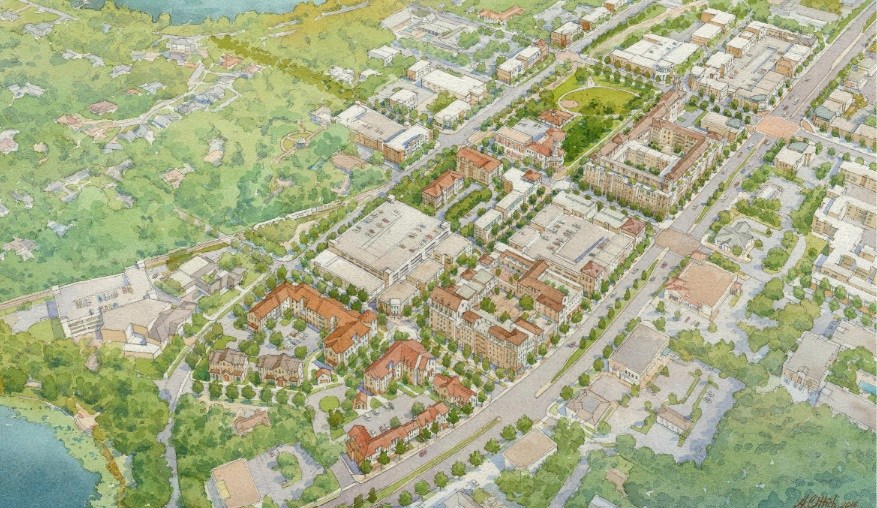
Maitland is moving to make dozens of its smallest downtown parcels easier to redevelop. A proposed code change would allow triplexes, fourplexes and multifamily buildings without ground-floor storefronts on sites city planners say are too constrained for the current mixed-use requirement.
The Maitland City Council voted 5-0 on Monday, August 24 to approve Ordinance 1461 on first reading. Community Development Director Michael Daniels said the city-initiated amendment could affect up to 67 parcels. He noted many of the parcels are in the southern portion around Circle Drive and in the Ridgewood Avenue area.
“Our larger lots are disappearing, and we’ve got these smaller postage stamp lots, and we’re not getting cooperation between property owners to assemble lots to make bigger lots,” Councilmember Bill Randolph said. “So this is a mechanism to solve that problem.”
“Not to say we have a bunch of people standing in line waiting for it to happen, but it gives more opportunity for them to redevelop their lots,” he said.
Maitland currently requires downtown multifamily buildings to place commercial rather than residential uses on the ground floor. Nonresidential uses other than parking also must occupy at least 60% of the ground-floor frontage along a public right of way.
City staff said that model can become economically impractical on small parcels once a developer accounts for parking, drainage, landscaping and other site requirements. A small commercial space built only to satisfy the code also could remain vacant because it would accommodate a limited range of businesses.
Ordinance 1461 would exempt qualifying small parcels from the commercial requirement. It also would make triplexes and fourplexes permitted uses in the Downtown Maitland zoning district and allow multifamily buildings with five or more units to be entirely residential.
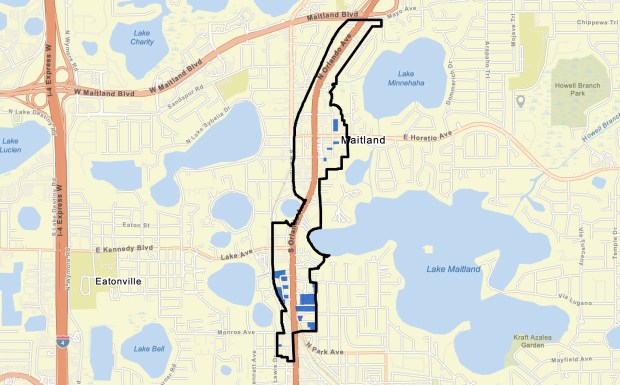 Some downtown Maitland parcels have been difficult to redevelop due to requirements that city coucil is moving to eliminate. City planners identified the parcels for a Aug. 24 meeting. (City of Maitland)
The amendment would not increase the district’s numerical density limits. Qualifying projects still would require development approval and would have to meet the other downtown standards.
The ordinance is scheduled to return to the council Sept. 14 for a second reading and final vote. If adopted, it would take effect immediately.
Where the change would apply
To qualify, a parcel or group of parcels must measure less than 20,000 square feet and face one of Maitland’s smaller downtown streets.
Those include streets designed to carry traffic to destinations within downtown and support urban development, along with narrower streets that have constrained rights of way or connect directly to residential neighborhoods.
The exemption would not apply along downtown Maitland’s two primary commercial streets, Orlando Avenue, or U.S. 17-92, and Horatio Avenue east of Orlando Avenue. Independence Lane also would remain subject to the ground-floor commercial requirement.
The city’s broader downtown redevelopment effort dates to the Downtown Maitland Master Plan adopted in 1997 and the creation of its Community Redevelopment Agency in 2003. The CRA later acquired right of way for an Independence Lane extension.
Maitland rebuilt Independence Lane between Horatio and Packwood avenues in 2018 with brick pavers, wider walkways, trees, lighting, benches and bicycle racks. The city rebuilt the nearly 2-acre Independence Square in 2020 and began work this year on a $3.5 million northern extension of Independence Lane between Horatio and George avenues. The extension received $500,000 in federal funding.
Daniels said the city wants to preserve commercial space along Independence Lane because of its investment in establishing the street as a mixed-use corridor.
Parking requirements remain
The proposed commercial exemption would not waive parking requirements. Multifamily projects still would have to comply with the parking, drainage, landscaping, streetscape and building-design standards that apply downtown.
The current code requires one off-street parking space per multifamily dwelling unit in the Downtown Maitland district and generally caps residential parking at 1.2 times the minimum.
Maitland’s code allows an approved alternative parking plan to reduce the number of spaces provided onsite by up to 25% if the remaining spaces are available in an off-site facility within an 800-foot walking distance of the residential project.
Existing homes could expand or be rebuilt
The ordinance also would change the rules for single-family homes and duplexes that existed in the downtown district before June 22, 2020.
Those properties may currently be repaired or remodeled but cannot be enlarged. The amendment would allow owners to expand or redevelop them if the projects meet the city’s Residential Single-Family and Duplex district standards, along with downtown build-to and public-frontage requirements.
Daniels said the existing restriction can prevent modest improvements to older homes.
“It’s very arbitrary to say … if somebody has an 800-square-foot house, somebody else has a 900-square-foot house. Well, the 800-square-foot house can’t enlarge because of our code,” he said.
New single-family homes and duplexes would remain prohibited in the downtown district.
Daniels acknowledged that allowing more small multifamily buildings could gradually change the predominantly residential character of the southern portion of the district. He noted, however, that townhomes are already permitted on the same properties.
“I don’t think it was a major factor that would really have a major character change, but certainly if we needed to revisit it and add additional requirements, that’s something we could look at,” Daniels said.
Have a tip about Central Florida development? Contact me at SKinbar@GrowthSpotter.com or (407) 420-5246. Follow GrowthSpotter on Facebook and LinkedIn.