

“Fishing on the Pier,” 1940 by George Snow Hill. The mural is located in the stairwell of St. Petersburg’s City Hall.
Pinellas County’s coastline once offered a string of places where someone with a fishing rod and no boat could walk out over the water and cast a line.
Some of those places are gone. Now, one member of the county’s tourism council wants to start a conversation about bringing that kind of access back.
Capt. Dylan Hubbard raised the idea during the Aug. 19 Tourist Development Council meeting, suggesting the county explore rebuilding fishing piers and other shore-based access points that have disappeared over the years. He also floated tourist development taxes as one possible way to pay for them.
For now, that is as far as the idea has gone. The TDC took no vote, no locations have been selected and there is no funding request headed to the Board of County Commissioners. Visit St. Pete-Clearwater staff said in a follow-up conversation that Hubbard’s comments were speculative rather than an official proposal. Hubbard told the Catalyst he wants to start the conversation and see whether a feasibility study makes sense.
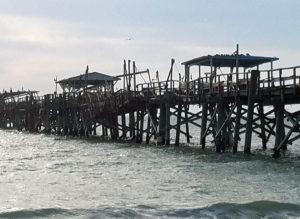
The Redington Long Pier, photographed Dec. 27, 2019. It was demolished in 2020. Photo by Bill DeYoung.
Hubbard has watched that access disappear over his lifetime. At the meeting, he pointed to the Redington Long Pier, the former Indian Rocks Beach fishing pier, fishing structures in Pass-a-Grille and catwalks alongside bridges as examples.
Some of the losses go back decades. The Big Indian Rocks fishing pier opened in 1959 and was destroyed by Hurricane Elena in 1985, according to the State Archives of Florida. The Redington Long Pier, built in 1962, survived until damage and deterioration forced its closure. The state demolished it in 2020, after years of deterioration and storm damage.
Safety Harbor has taken a different path with a pier damaged more recently. The city reopened its marina pier Thursday after hurricanes nearly destroyed it two seasons ago. Mayor Joe Ayoub told the Catalyst the roughly $4 million rebuilding project used insurance proceeds, FEMA assistance and city money.
Finding the money took time. Ayoub said the city had already decided what it wanted to do.
“There was never a question of whether we would rebuild it,” Ayoub said. “It was just, how fast can we get it rebuilt?”
The pier extends into Tampa Bay from Safety Harbor’s downtown waterfront. Ayoub said mornings there drew dog walkers, people exercising and a group of about a half-dozen photographers who regularly gathered to photograph the sunrise. He often saw the same faces when he visited.
“Those people were kind of like a community within a community,” Ayoub said. “I would go out there in the mornings and I’d see the same group of people all the time and we’d have a little chat.”
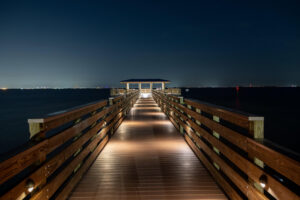
The rebuilt Safety Harbor Marina Pier stretches into Tampa Bay after re-opening this week following extensive hurricane damage. City officials said restoring the pier was a priority because of its importance as a gathering place, fishing spot and waterfront landmark. Photo by Reynaldo Brigantty Martinez.
Hubbard mentioned Safety Harbor’s rebuilding effort during the TDC meeting before turning to the places Pinellas has lost. His concern is partly about what happens when someone can no longer get to the water without owning a boat.
He pointed to the recent death of Capt. Dave Mistretta, whom he described as a legendary local charter captain who got his start fishing from piers. Hubbard said that route into fishing was once common. A kid could ride a bicycle to a pier, learn to fish and eventually move into a kayak or boat, work on a party boat or become a charter captain.
“So many local legendary charter captains started on the piers, bridge catwalks and jetties around the area,” Hubbard wrote in an email.
Anglers were never the only people using those places. Hubbard recalled walking the former John’s Pass jetty and seeing far more people sightseeing or spending time near the water than fishing.
“Nine out of 10 people on that jetty weren’t fishing,” Hubbard said during the meeting. “It’s just people walking.”
Clearwater Mayor Bruce Rector, who serves on the TDC, pointed to two surviving piers that have become landmarks in their own right.
“The two major piers we have in the county, St. Pete Pier and Pier 60, are two of the most iconic photographed places in the entire county,” Rector said.
The subject came up on the same morning Visit St. Pete-Clearwater presented a tourism initiative focused on experiences tied to local culture, history and the environment. The official agenda identifies Vice President of Community Engagement Kylie Diaz as the presenter.
Diaz described the agency’s growing focus on “meaningful travel.” About 20 local experiences have been added to an international meaningful-travel map, including Tampa Bay Watch, kayaking, Hubbard’s Marina and Heritage Village.
Diaz said research presented to the council found 56.1% of travelers consider immersive experiences connecting them with a destination’s culture, history or environment appealing or very appealing. Visit St. Pete-Clearwater has not connected that effort to rebuilding fishing piers, and Hubbard’s suggestion remains separate from the initiative.
Paying for new piers would be another matter.
Hubbard suggested tourist development tax revenue as one possibility. Pinellas’ tourism plan allows some of those dollars to fund qualifying publicly owned tourism-related facilities. County commissioners expanded the plan in January to include publicly owned and operated beach park facilities directly associated with or demonstrated to be tourist attractions. Whether a particular fishing pier would qualify has not been determined.
Hubbard said other arrangements could be considered. A pier could potentially involve a private operator, with anglers paying to fish from a licensed portion of the structure. He pointed to Pier 60 and the Skyway fishing piers as examples of places where fishing access can generate revenue.
Safety Harbor’s project gives some indication of the expense involved. Ayoub put the price at roughly $4 million, with insurance and federal disaster assistance covering part of the cost and the city contributing its own money.
The TDC discussion also comes as Pinellas officials are watching for possible changes to how tourist development taxes can be spent. During the same meeting, Commissioner Chris Latvala raised the possibility that state lawmakers could give counties more flexibility if voters approve Amendment 3, a proposed property-tax overhaul that could reduce local government revenue.
“If Amendment 3 does pass, I think that I would not be surprised if the Legislature allows counties to use TDC funding in a much more flexible manner than currently is allowed,” Latvala said.
Tourism tax collections, meanwhile, are running ahead of recent years. Official county tax records show collections through June running above the same point in the previous fiscal year.
There is no county fishing pier project awaiting approval, and no tourism dollars have been committed to Hubbard’s idea. He is asking officials to first look at what has disappeared and whether restoring some of that access is worth studying.
Safety Harbor has already made that decision for itself. Its pier is open again, returning a place where Ayoub said people fished, exercised, watched the sunrise and came to recognize one another.
Asked what communities lose when places like that disappear, Ayoub came back to the people he used to see there each morning.
“There’s a sense of community around the pier that would have been lost,” Ayoub said.