
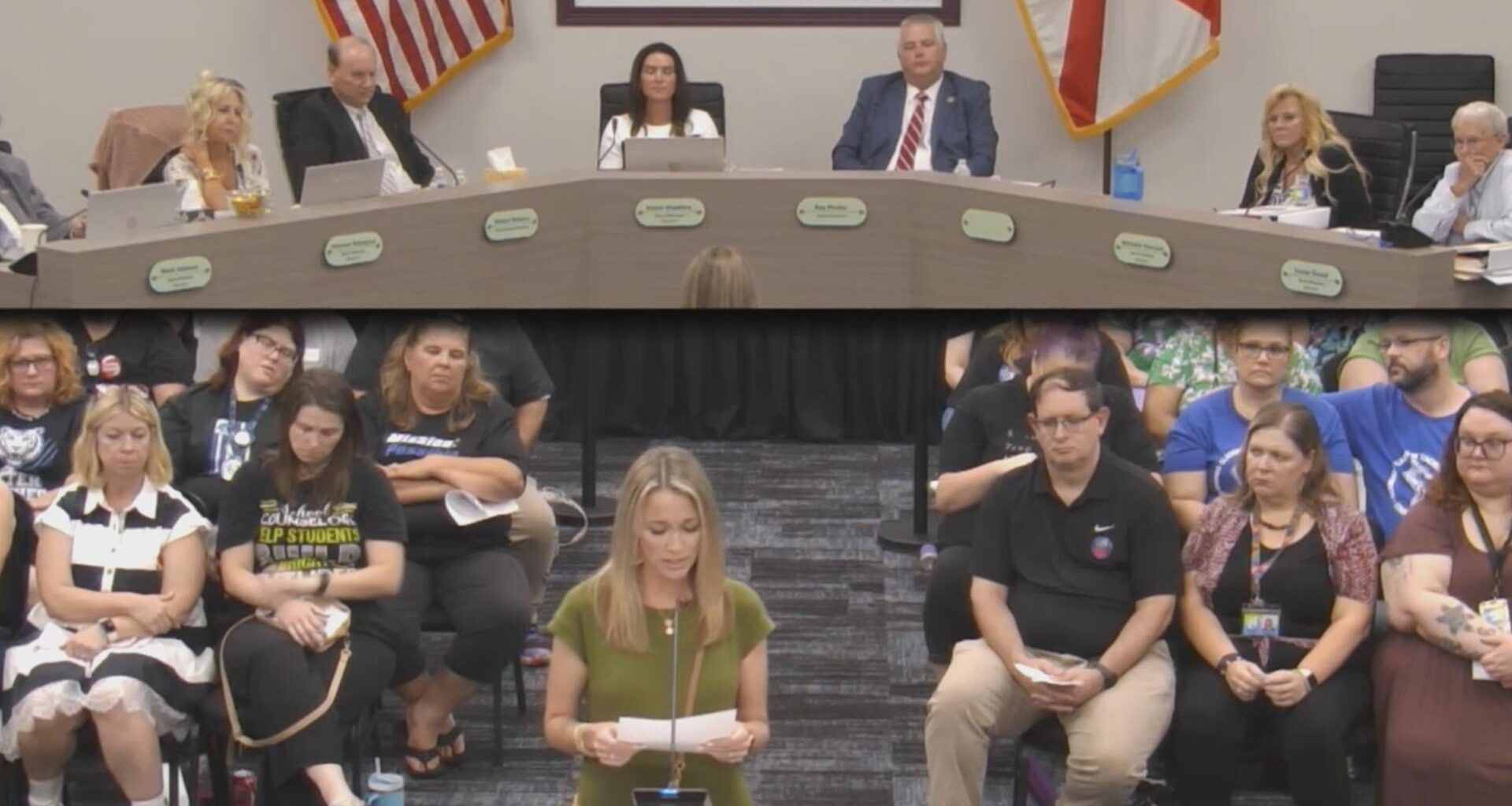
Some teachers said rising premiums are putting a strain on their budget.
TAMPA, Fla. — For teachers across Tampa Bay, healthcare is taking a bigger bite out of their paychecks as school districts deal with the rising cost of providing insurance.
Teachers said every dollar in their paycheck matters, but right now rising premiums are putting a strain on their budget.
“Insurance costs have doubled, while our salaries have barely moved. Meanwhile the cost of living continues to rise, everything costs exponentially more but our paychecks aren’t keeping up,” Carly Nichols, a Hernando County middle school teacher, said.

This story continues below.
The Hernando County School District said in a statement:
“Florida Blue presented a 23.5% increase on a fully insured plan during a July 9, 2026 insurance committee meeting. Their reasoning for the high increase was a medical loss ratio of 107 %. This means the group is creating more claims that our premiums are paying for.
We set another meeting on August 5th to see if Florida Blue would improve their offer however they did not. We also explored a funding recommendation from Alliant as part of an option to go self-funded using the FLEHT model. Alliant recommended funding at a higher rate with a focus on the least risk. The insurance committee decided to recommend the self-insured model using the funding suggested by the renewal due to the safety net of the district assigned health funds. The 23% increase means there will be a $84 -$128 dollar increase per pay period for an individual employee.
The district is investigating other options within Florida Blue and the self-insured model to reduce this increase that would look at plan changes if they can have a significant impact on the increase and any other options to decrease this increase.
Currently the Board contribution to each employee on a health insurance plan is $843.66 a month or $10,123,92 annually which is comparatively higher than most other districts.
This contribution has risen from $275 to $421.83 per pay period over the last four years to support employees not paying increases. Employee only costs have not gone up over the last five years.
The medical loss ratio for this renewal is unprecedented. Previously we have avoided double digit increase years. Only in 2022 was there a renewal rate of 17% which the district reduced to 12% by engaging in a contingency rate plan agreement.
The next insurance committee meeting is scheduled for September 2nd.”
Nichols said the increase for her will be much higher.
“I already pay just under a thousand dollars a month for myself and my two daughters. It’s going to go up to a little over $1,400 dollars a month, so that’s pretty drastic,” Nichols said.
The district calls the increase unprecedented. It said its insurer pointed to a medical loss ratio of 107 percent.
Rick Smith, an associate professor at USF’s St. Pete’s campus, said the insurer is saying for every dollar it collects in premiums, it’s actually paying a $1.07 in medical expenses. Smith said it’s not just limited to one provider, he said insurers are raising rates across the board.
“So, the providers in recent years have been dealing with the higher health care costs but stuck in contracts that they signed several years ago. So, in recent negotiations, the insurers probably had to pay more to stay in business with these providers, and now the insurers are probably passing that additional costs to customers,” Smith said.
But, this isn’t just happening in Hernando County. Teachers in Pinellas County are seeing increases too.
“The problem that teachers and support staff and anyone who works in Pinellas County Schools has is the cost of actually using the plan, especially if you are support staff. But teachers too you are actually functually uninsured. You can pay for your premiums, but then you can’t afford to go to the doctor when something really happens,” Tracey McConnell, Pinellas Classroom and Teachers Association president, said.
The Hillsborough County School District said it’s absorbing the increase for 2027, and employees will see lower copays and no increases in premiums.